In the case of lots of firms, the question of whether the RFID (Radio Frequency Identification) should be implemented remains, by asking a single question: How much is it going to cost?
An RFID system is an ecosystem, unlike purchasing a barcode scanner, where it is advertised with the price stamped on the label. The ultimate price will be based on a complicated combination of hardware, software, environment, and scale. A small boutique may pay out $5 000, and a large distribution center may pay out $250,000+.
This guide is a segmentation of the prices of an RFID implementation and will enable you to budget effectively and prevent some surprises.
What Are The Primary Cost Components Of An Rfid System?
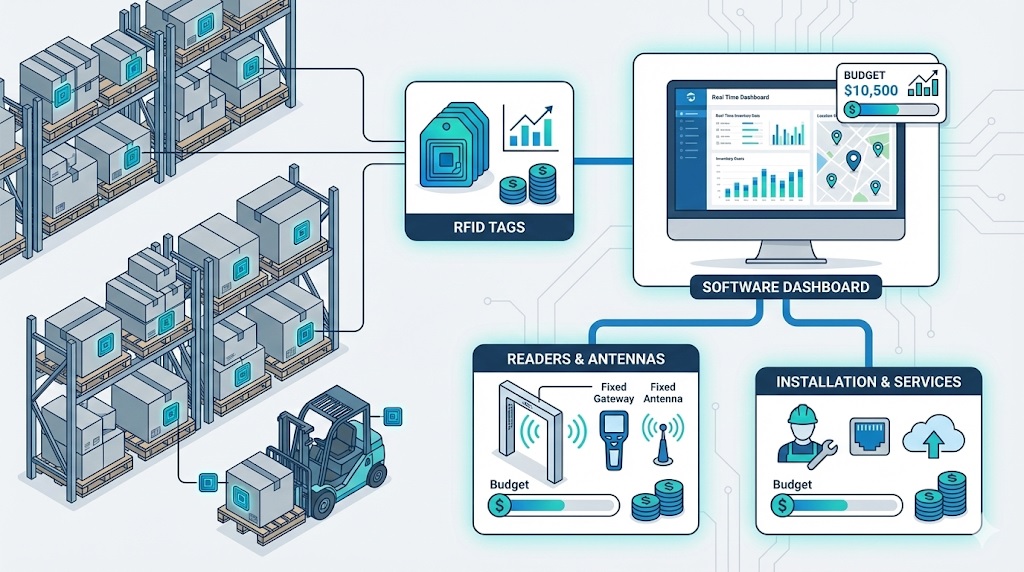
RFID system is not a marketable product but rather a solution that consists of four cost groups. In order to make an effective budget, you will need to spend on each:
Hardware:
The physical equipment (Readers, Antennas, Printers). A UHF RFID reader costs around $1000-$1,500.
Consumables:
Monthly price of RFID Tags/Labels.
Software:
The brain that interprets the data and the one that interconnects it with your own systems.
Professional Services:
Tuning, site surveys, and installation.
The most widespread cause of budget overruns is failure to consider each of these categories.
How Much Do RFID Tags Actually Cost? (The Consumables)
This expenditure is recurring, and as a result, it is the cost that gets looked into. The prices of tags are astronomical, depending on the volume and life.
Standard Passive UHF Labels (Paper/Plastic):
The most commonly used tags are the ones used in retail and logistics.
- Low Volume (1k-10k tags): $0.12 – $0.20 per tag.
- High Volume (100k+ tags): $0.05 – $0.08 per tag.
Specialized On-Metal or Hard Tags:
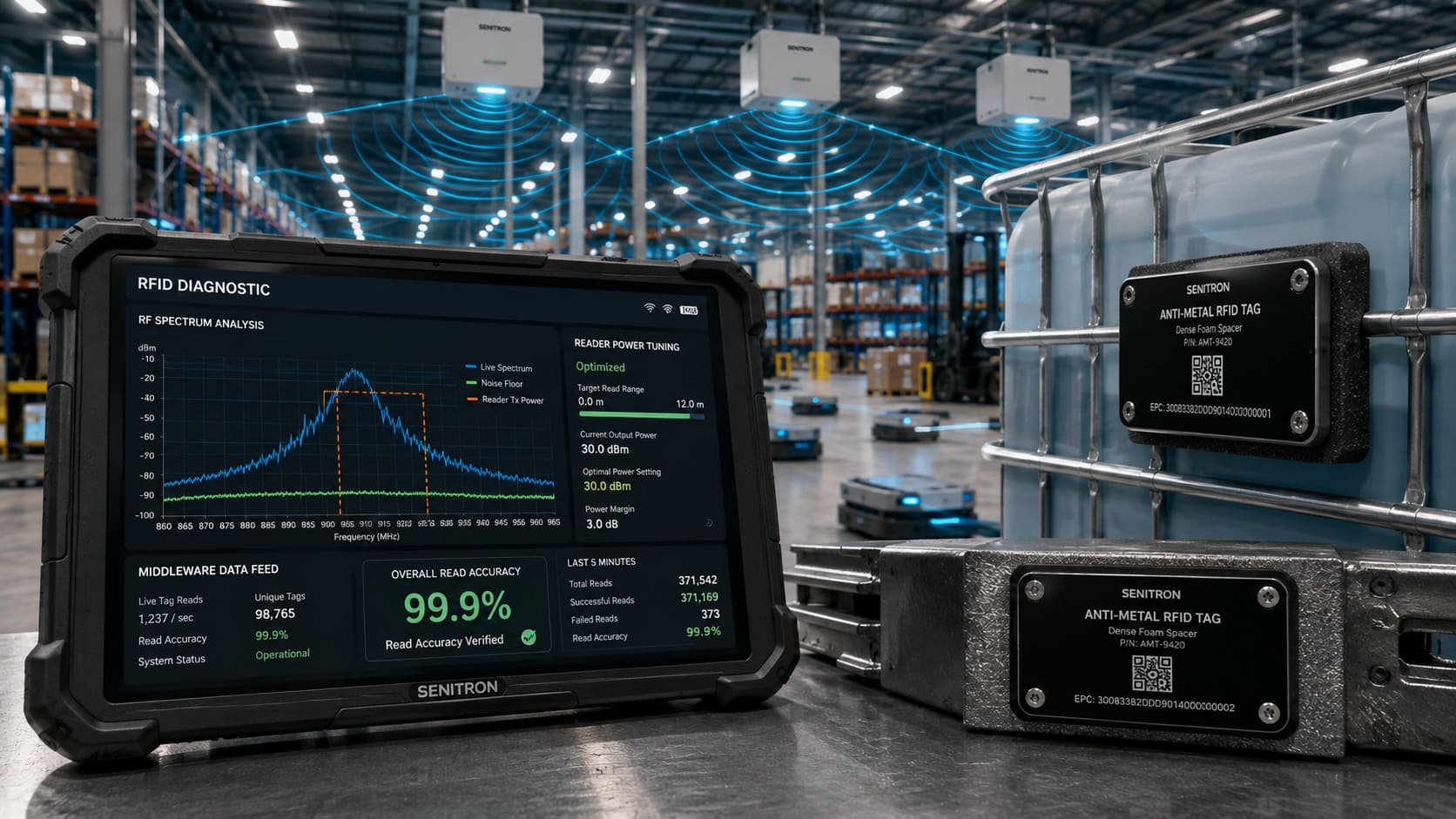
Otherwise, a normal tag is incapable of being read when placed on a metal or liquid container. You require heavier, special tags.
- Price: $0.80 – $5.00+ per tag in relation to ruggedness and distance.
Active Tags: These contain batteries and are sent over long distances (hundreds of feet).
- Cost: $15.00 – $50.00+ per tag. They are used on high-value assets such as vehicles or heavy machinery and not on simple inventory.
Important Consideration:
With the majority of inventory systems, you are reading about a Passive UHF technology. When you have 10,000 items, then your initial tag cost can be approximately 1,000-1,500 dollars.
What Is The Price Range For RFID Readers And Hardware?
Depending on the extent of automation desired, the hardware price will vary.
Handheld Readers:
This is in the form of a mobile computer with a grip like a trigger. They are also adaptable and work well in counting cycles.
- Price: 1,500 -3,500 per unit (e.g., Zebra MC3300 series).
Fixed Readers (Portals):
These are positioned at dock doors or conveyor belts in order to follow objects as they are moved.
- Price: $1,000 – $2,500 per reader.
- Antennas & Cables: Fixed readers require external antennas (that is, 2-4 antennas per reader). Also, add the cost of $150 to $300 per antenna and cabling.
Strategic Tip:
The Start Small strategy frequently includes Handheld Readers early to ensure only the Hardware costs are kept low, and Fixed Readers are added as the ROI occurs.
Why Does RFID Software’s Cost Vary So Much?
The pricing model has changed the most in recent years in software. To you, there are ordinarily two alternatives:
Perpetual License (One-time):
You purchase the software in full. This is costly in the short-term (5,000-20,000 or so) and even involves having to maintain your own server.
SaaS (Subscription):
You pay monthly or annually on a per-user basis or per-equipment.
Cost:
Benefit:
Updates, support, and cloud computing. This reduces entry barriers greatly.
Middleware Rates:
In the event that you are required to have the RFID system communicate with a multifaceted ERP (such as SAP or Oracle), you may be required to hire someone to program some custom middleware, which can exceed the project budget by $5,000 -15,000.
What are the “hidden” costs of installation and tuning?
Hardware does not work by default. Radio waves are reflected off metal and are absorbed because of water. The RFID system has to be tuned to your environment.
Site Survey:
This is an engineer who has come to your facility to test radio interference. (Cost: $1,500 – $3,000 per day).
Installation:
Ethernet cables (PoE) to ceiling-mounted readers. (Cost: Dependent upon facility contractor).
Tagging Labor:
Who is going to slap the first 10,000 tags on your inventory? You need to plan the internal person-hours that would be needed to take this initial setup.
Conclusion
An RFID system is not a mere expense that can be readily defined as the cost of an RFID system. Although installation expenses on hardware and professional tuning may be substantial, the passive tags’ price has fallen to pennies, and this has made the technology affordable even to mid-sized businesses.
Frequently Asked Questions (FAQs)
Is RFID worth it for low-cost items?
Generally, no. When selling products at a value of $1.00, an increment of a tag of 0.10 kills one out of ten dollars. RFID is generally suggested in things whose worth is at the very least 10.00 dollars or important assets whose misplacement is very expensive (such as tools or medical equipment).
Can I use my existing barcode printers for RFID?
Maybe. Certain industrial barcode printers become core RFID or upgradeable. Nonetheless, the conventional desktop barcode printers do not typically contain the internal encoder to write the data to the RFID chip. Probably, you will have to buy specific RFID printers ($1,500 -4,000).
Does the cost of tags go down over time?
Yes, but marginally. Silicon and antenna aluminum, the cost of raw materials, have made things even. Volume commitments are the largest discounts. That will be a much better price to negotiate in negotiating a blanket order of 1 million tags a year than to negotiate 5,000 at a time.
What is the typical ROI timeline for an RFID system?
In the case of inventory management, ROI is normally realized within 9 to 14 months. One of the areas through which the savings will be made is the saving of labor that will be saved by 90 percent, the savings in lost sales that are out-of-stock, and the savings in shrinkage of inventory (theft/loss).