

In the current competitive environment, information is the new currency. However, a lot of businesses get left with pockets of information, a bit here, a bit there, which they can not figure out how to make come up with a coherent narrative. Although RFID has long been an asset identification and tracking powerhouse, the actual potential of RFID is realized when it forms the bedrock of a larger Internet of Things (IoT) ecosystem.
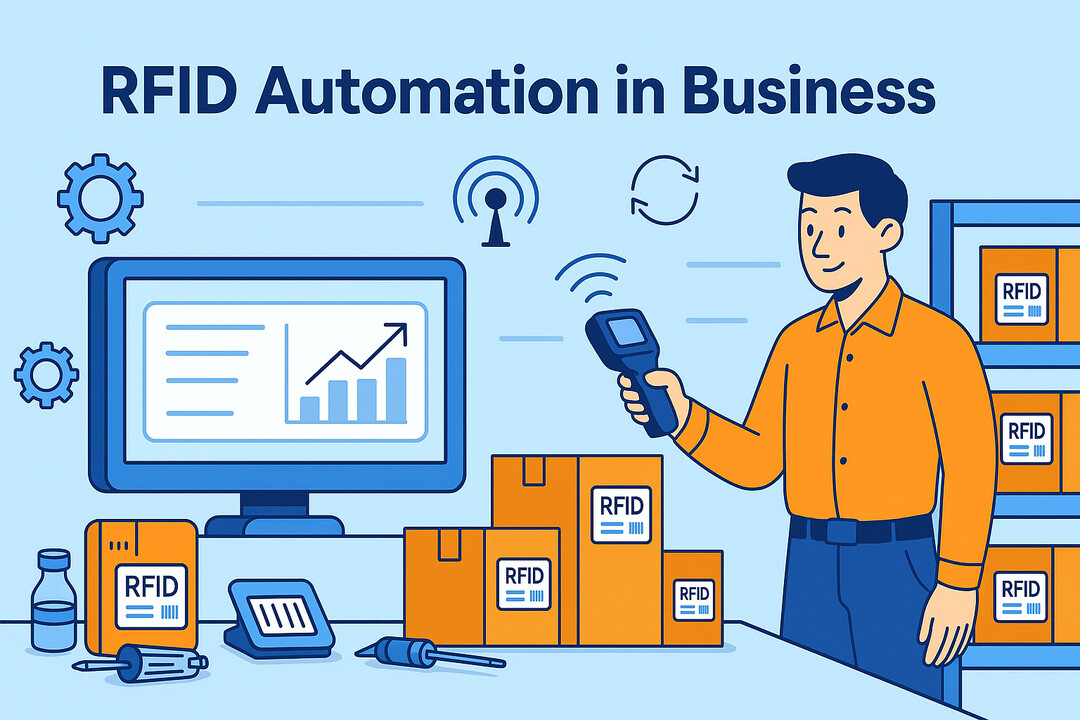
Enterprises taking RFID (and combining it with other sensor technologies) will be able to transition to having an understanding of what and where an asset is, rather than merely knowing that.
What are the Limitations of Siloed Systems?
Old-fashioned asset management is based on single systems.
- The items may be tracked across a dock door via an RFID system, the temperature observed with a separate environmental monitoring system, and a third security system may control accessibility.
- This forms data silos in which the whole picture is not clear. You may have received information that a pallet went into cold storage, but you have no idea whether the temperature went and spiked overnight.
- You are aware that there is a valuable tool in the building, but not sure whether it is being used or not. This is where the interrelated ecosystem comes in.
RFID Being the Core of The Digital Identity of IoT
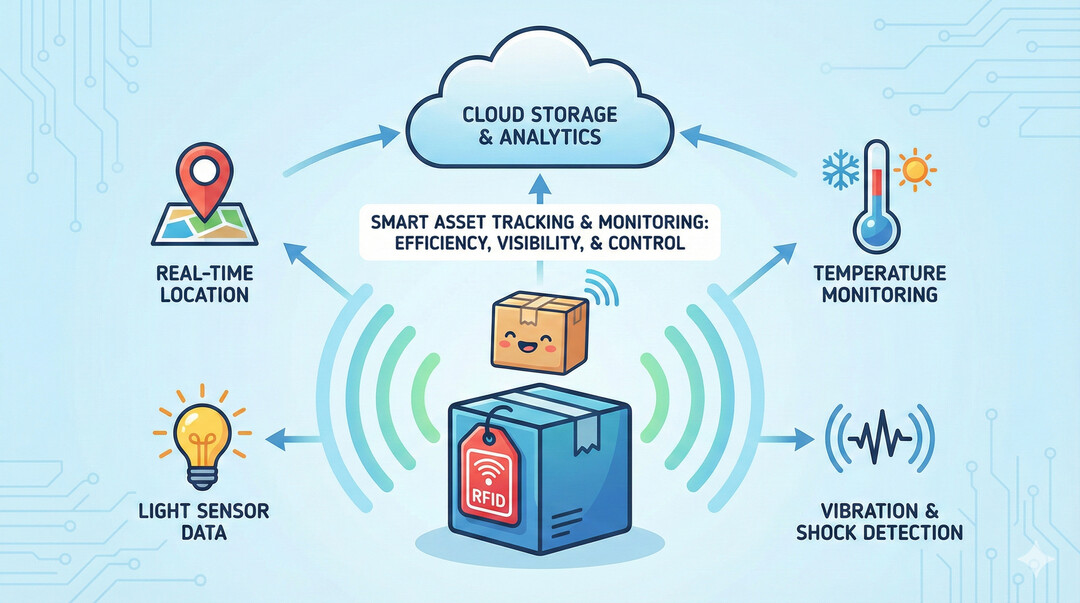
Consider a passive or Active RFID tag as a digital license plate of an asset. It offers an exceptional, permanent identity that can be scanned automatically. It is a very important initial step. However, an IoT world is capable of doing a lot more. Sensing tags come with capabilities to be active and therefore serve as more than beacons; they are smart points of data collection.
These durable tags may be fitted with sensors to be used to track a myriad of conditions, including:
Temperature, Humidity
Important to pharmaceuticals, food, and some electronics.
Shock and Tilt
This type of device is needed to check the processing of delicate goods or to prevent illegal transport of equipment.
Exposure to Light
This is critical for delicate materials such as artwork or some chemicals.
This makes a basic tracking tag more of a proactive sentinel, that is, not only reporting its position, but its condition as well.
How Can We Build the Complete System?
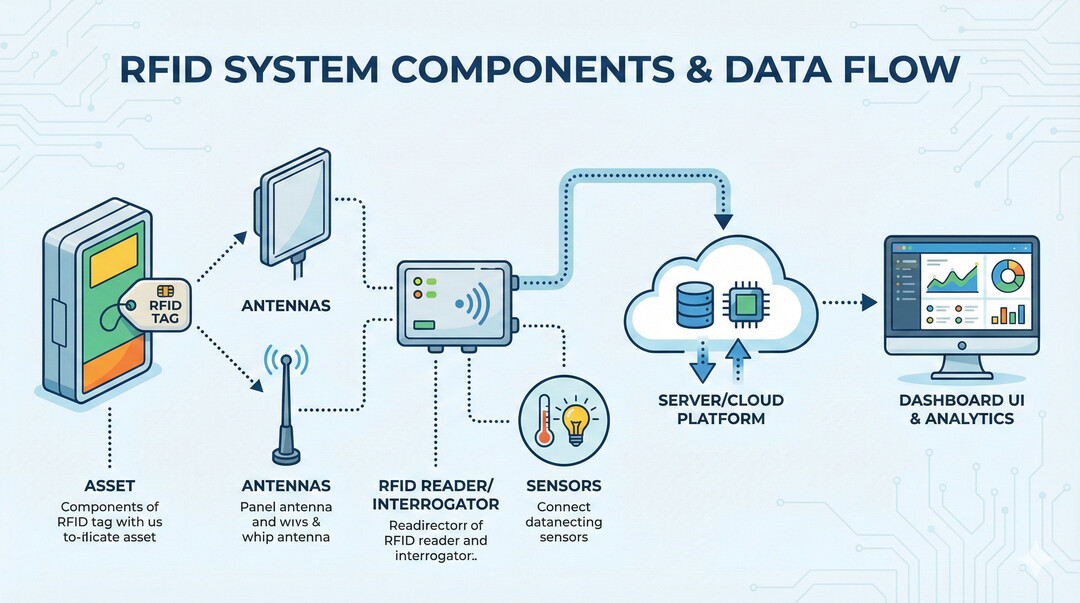
The magic is actually achieved when RFID information is combined with information from other IoT systems. It is not merely a matter of utilizing a variety of technologies in parallel; it is a matter of integrating them into one intelligent outfit with the help of professional System Integration Services.
Check the Details of-
Smart Cold Chain Management
RFID: Monitors a pallet of vaccines loaded in a truck and moving into a warehouse.
BLE Temperature Sensors: Sensors in the pallet are used to provide granular temperature data continuously.
The Ecosystem: The system does not merely record the temperature, but it also correlates it with the position of the pallet. Provided that there is a temperature excursion, it is capable of instantly identifying which pallet is involved and its position, producing an immediate alert that can then help the staff to intervene. This is much stronger than a freezer that has too too-warm alarm that is generic.
High-Value Asset Security
Active RFID with Tamper Detection: This is connected to a server rack or a mobile medical device.
GPS/GNSS Module: It supplies location after going out of a facility.
The Ecosystem: The RFID system offers location on a room level in a building. In case the asset is transferred without permission (activation of the tamper sensor), the system notifies security. In case the asset is moved off-site, the GPS will automatically come into play and give real-time positioning on a map. This makes the line of custody continuous.
Enhanced Operational Intelligence
Passive RFID: Monitors work-in-process in an assembly line.
IoT Vibration Sensors: This will monitor the health of the machinery at the given stations.
The Ecosystem: With the combination of these data streams, the system is able to predict maintenance requirements. It is also able to discover that the same machine exhibiting uncharacteristic vibrations is similarly slowing down the RFID-monitored working process to give a root-cause analysis of a bottleneck.
Tips that Will Help in Building a Connected Ecosystem
An integrated ecosystem needs a strategic approach to be built. Hurrying to do things without planning may cause complexity and investment wastage.
Focus on the Business
Do not ask the question: What can IoT do? Rather, the question: What do I have to solve? Start with a simple use case, e.g., spoilage reduction, theft prevention, predictive maintenance.
Importance of a Unified Platform
The objective is the dismantling of silos. Invest in the platform or use System Integration Services to make sure that data sent by your RFID readers, active sensor tags, BLE beacons, and GPS modules are all sent into a single, centralized dashboard (5). An integrable view is a usable view.
Planning a Network Infrastructure
IoT devices, particularly active sensors, need a strong communication network, i.e., Wi-Fi or Low-Power Wide-Area Networks (LPWAN). Make sure that your IT infrastructure is able to support the increased data traffic.
Evaluate the Total Cost
Active tags have sensor capability, which are more expensive than passive tags, but the loss prevention, quality assurance, and automation of monitoring of the item can provide a quick ROI. Add the cost savings of the prevented incidents.
A company that is driven by a linked RFID and IoT ecosystem is stronger, effective, and smarter. It is a system that not only reports what has already happened, but it also foresees what may happen in the future, and then allows making decisions, which are really proactive.
It is not enough to monitor your assets; know them. Browse our System Integration Services and find our assortment of Active Tags with sensor capability to establish the base to make your enterprise smarter.
FAQ
What are the differences between an RFID and an IoT system?
RFID is an object identification technology. IoT is a wider approach whereby physical entities such as RFID systems can be linked to the internet and exchange information to give insight and automation.
Is it possible to add sensors to existing RFID tags?
This depends on the tag. Simple passive tags cannot be upgraded. Nevertheless, you can combine your existing system with new active sensor tags and other IoT devices with our System Integration Services.
What can we collect using an active sensor tag?
Our sensor-based active tags are capable of tracking different environmental variables such as temperature, humidity, shock/tilt, and light exposure. This gives a full picture of the condition of a given asset, but not its location only.
Is the process of integrating RFID with IoT complex?
It may be, and a strategic approach simplifies it. Our System Integration Services help you to integrate your RFID data with other IoT systems into an integrated platform to have one source of truth.
What is the right time to use active sensor tags over passive ones?
Active tags with sensor ability should be used where you need to check the state of an asset (such as temperature or shock) or need to track the location of the asset in real-time (over a wide area). Passive tags should be used when identifying with large volumes over short ranges.


