In the event management industry, which is highly competitive, VIP experience is your best product. Premium guests will demand premium treatment: they need to enter without problems, they need to have exclusive access, and they need to experience an atmosphere of luxury without any effort. There is nothing more likely to kill this atmosphere than a long queue, a piece of paper, or a security guard who can hardly locate a name on a printed list.
Security, however, cannot be violated. What you must do is to make sure that only the people who should go backstage, artist lounges, and platinum suites. How do you rate between a Fortress-level of security and a frictionless visitor experience?
This guide responds to the critical questions regarding the way that RFID (Radio Frequency Identification) technology addresses this paradox and optimizes access control as a bottleneck rather than a feature.
Q1. Why do traditional access control methods fail at high-profile events?
The standard practices, such as the use of paper tickets, non-technological wristbands, and manual guest lists, are based on manual verification. These result in three failure points of criticality:
The Bottleneck Effect: Security staff must monitor a credential visually, read a hologram, or look up a name on a list, which will require some time. The slightest delay to any individual of 10 seconds generates huge queues when there are hundreds of VIPs at the same time.
High-end Printers Counterfeit Vulnerability: Visual credentials are easily copied using high-end printers. Normal laminate passes are astonishingly easy to counterfeit, and one may access the restricted areas without getting caught.
The Pass-Backfold: An authorized user exits the restricted property and recredentials to a friend, handing them the pass, so they gain entry to the area. This type of fraud is usually impossible to prevent, and at the same time, the manual security staff have no way of knowing who is in or out at a particular time.
Q2. How does RFID create an “Invisible Bouncer” for restricted zones?
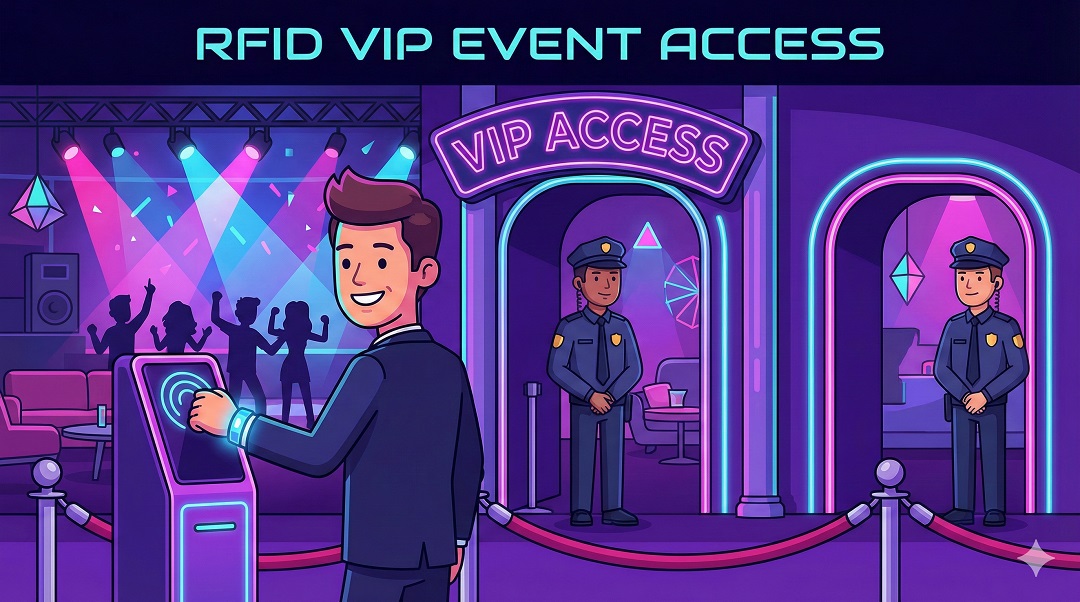
The RFID substitutes the visual verification with a digital shaking hand. The guests are given an RFID-powered bracelet or badge with a chip of encrypted unique chip.
The following is the change in the workflow:
The Tap: To get inspected, the guest does not have to pause: he just taps a wristband with their reader (or passes across a portal).
Instant Verification: The reader sends a message to the chip in less than a millisecond. Go means Green light, stop means Red light.
Granular Permissions: Granular permissions do not work by giving a yes or no. It verifies special rights of access. Does this wristband give access to the Main Stage VIP deck? Yes. Is it accessible to the Artist Dressing Rooms? No.
This is done immediately, enabling the continuous movement on foot. It takes the zone without getting the party slowed down, thus preserving the high-energy environment vital to an effective event.
Q3. Can RFID really stop ticket fraud and unauthorized access better than a human?
Yes, and significantly so. People become fatigued, distracted, or threatened by hostile visitors. RFID systems do not.
Anti-Cloning Encryption: The modern RFID chips are encrypted locally, thus making it extremely hard to duplicate an anti-cloning barcode to a new dishonest party, as it can be easily photocopied.
Electronic Deactivation: In case a VIP claims to have lost or stolen their wristband, one can simply take out the chip ID of that particular VIP and deactivate it instantly. In case an individual attempts to access a stolen band a few moments later, a reader will not permit it.
Anti-Passback Procedures: This is the final security feature. One can set the system to scan an exit on the system before a scan on entry can be resumed. In case a guest gives her wristband to a friend outside, the friend will not be able to get to the zone, as the system will understand that the ID is within the zone.
Q4. Beyond security, what business value does RFID data offer event organizers?
Although the major operation is security, the RFID-generated data is a gold mine in terms of future event enhancement as well as profit maximization.
Live Capacity: This gives you the count of people who are currently within the VIP tent. When it is not over capacity, then you can put up more upgrades for immediate sale. In case it is about to become congested, making the entry a stop prevents problematic overcrowding and risky safety.
Attendee Behavior Mapping: RFID information will show you the heat map of your event. What were the most popular zones? Were VIPs present till the headliner, or did they go early?
Sponsorship Value: You will be able to demonstrate to the sponsors precisely how many high-value guests attended their branded lounge. You can not only speculate on the number of people walking about, but also give specific data that can be verified, and hence it becomes easier to sell sponsorships next time.
Everything in the event industry has to do with the guest experience. Each minute a VIP is waiting in line is actually a minute that the customer is not enjoying the experience that they had paid to enjoy. The RFID technology provides a unique technology that meets the two requirements of high security and hassle-free hospitality.
FAQ
What is the difference between RFID and Barcodes for events?
Bar codes are optical; that is, to be read, the scanner needs to view the black and white lines. This would involve proper lighting and accuracy, which are time-consuming. RFID involves the use of radio waves; all the scanner requires is to bring the scanner close to the chip.
Can RFID wristbands be reused for future events?
It would depend on the kind of system. Most events come in single-use wristbands that have security features allowing transfer. In the case of recurring events or members-only clubs, however, durable silicone wristbands or hard-plastic cards can be issued so that they can be reprogrammed and reused on other occasions, like an employee badge.
Does RFID allow for cashless payments?
Yes. The access control chip can be connected with the credit card of a user or with the prepaid balance. This enables the visitors to purchase beverages or merchandise with the tap of a wristband.