In 2026, sustainability will cease to be a marketing buzzword that is nice-to-have; it will be a financial and legal requirement. Stakeholders are not becoming prey to slick brochures with the full adoption of the CSRD (Corporate Sustainability Reporting Directive) and more rigorous SEC disclosures of climate. They desire pure, verifiable information.
The problem? The majority of sustainability reports are estimated using the back-of-the-envelope and spreadsheet. And the fact that your own metrics regarding being green are not supported by real-time information means that you are not simply putting yourself at risk of having a PR crisis–you are putting yourself at risk of not doing it at all. The RFID technology is being made the Truth Engine of the modern circular economy herein.
Why are manual sustainability reports often considered “Greenwashing” today?
Manual reporting is based on the past averages and not on the events. To illustrate, a business may calculate its carbon footprint on the basis of the quantity of trucks it employs, and not the practicality of the trucks’ conveyances.
This creates “Data Drift.” Spurious distribution of lost assets, spoiled goods, or ineffectiveness in transport corridors causes exaggerated sustainability statements. Digital Audit Trail is a record of the movement of each item, which can be verified without human bias, unlike human judgment. Regulatory bodies and auditors now require it.
How does RFID provide the “Audit-Ready” data that regulators demand?
RFID (Radio Frequency Identification) is an equivalent of a digital witness. With tagging of assets, products, or reusable packing, a business is able to obtain information at the point of action. The Global Reporting Initiative tracks the ESG metrics of organizations and helps regulators to make the transition towards a green planet.
Immutable Records: A pallet that is reusable goes through an RFID portal and automatically creates a timestamp. This confirms the pallet was used again, which directly benefits your measures of “Waste Reduction:
Scope 3 Visibility: RFID enables you to be able to keep track of what raw materials were (provenance). This is necessary to satisfy ethical sourcing criteria, which include making sure that your timber or minerals did not come from limited areas.
Carbon Logic in the present time: RFID data will indicate the actual number of miles traveled by a particular asset, rather than just estimating the amount of fuel it is consuming. This turns the estimated emissions into verified carbon footprints.
Can RFID actually help reduce waste, or does it just track it?
It does both. RFID gives the visibility one requires to perform preventive measures before wastage can happen.
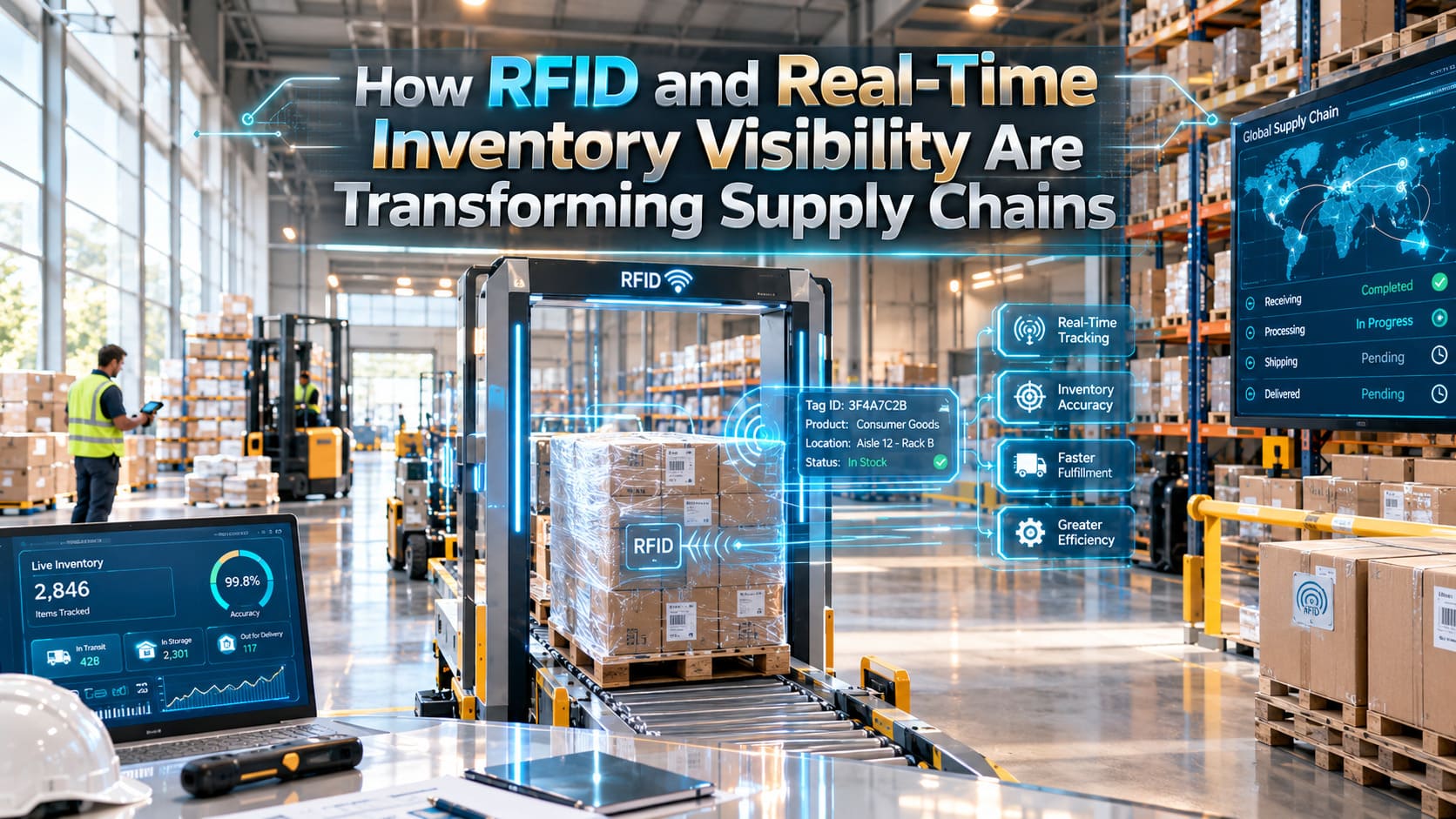
Breaking the Panic Order Retailers tend to overstock due to the fact that most of them do not trust inventory levels. This excessive production is a colossal emission of carbon. RFID offers inventory accuracy at 99% accuracy, and this is where lean-type operations can be performed without having to produce inventory at a rate of more than what is necessary.
Perishable Management (FEFO): RFID sensors are used to monitor expiration in the food and pharma industries. The system is able to automatically notify staff to push back to the front items that are scheduled to expire soon, and hence cut spoilage rates by as much as 40 percent.
Close the Loop: It is a loop economy whereby items are returned to undergo recycling or refurbishing. RFID follows the “Return” component of the route, and that is, the reusable containers indeed get reused, rather than going to a waste dump.
What is the “Digital Product Passport” (DPP), and how does Senitron help?
EU and other markets across the world are shifting towards the Digital Product Passport. This involves labeling all products with a digital identity that contains the material composition and recycling information.
This passport has the best carrier with RFID. A QR code will require a consumer to scan a given QR code, whereas an RFID tag enables a recycling plant to scan one or two thousand devices and then automatically sort materials.
Senitron will incorporate all of this data directly into your ESG dashboards, allowing your company to have accurate sustainability metrics in the same way you have accurate financial ones.
Conclusion
Sustainability 2026 is a data science challenge. Unless you are in a position to measure it in real-time, you cannot manage it effectively. With the implementation of RFID in your work, you will make the jump from guesses to demonstrations and safeguard your brand in the face of greenwashing, and ensure that your business is prepared to enter the world of the circular economy.
FAQs
Is an RFID tag itself environmentally friendly?
This is a common concern. Nevertheless, by 2026, Green RFID will be the direction of the industry. Senitron has tags printed on FSC-certified paper substrates, without inlays made of PET, which can be 100 percent recycled. More so, the carbon emission spared through efficient optimization of a supply chain by RFID greatly outweighs the small footprint of the tag itself.
How does RFID data integrate with our existing ESG software?
Current RFID applications have APIs that integrate information into platforms such as EcoVadis, Persefoni, or SAP Sustainability Control Tower. This substitutes the manual data entry with a live and automated feed of Truth Data.
Does RFID help with Scope 3 emissions reporting?
Yes. The scope 3 (indirect in the value chain) is infamously difficult to follow. With RFID, you are able to track the flow of goods by the partner logistics and supplier-facilities to report accurately on these external impacts.
Can we use RFID to track energy usage in the warehouse?
Although RFID mainly handles the assets, it can also be combined with IoT sensors. RFID could, as an example, monitor the period that a refrigerator door stays open, or the amount of high-energy machinery that is used, and give you a birds-eye view of the energy footprint of your facility.