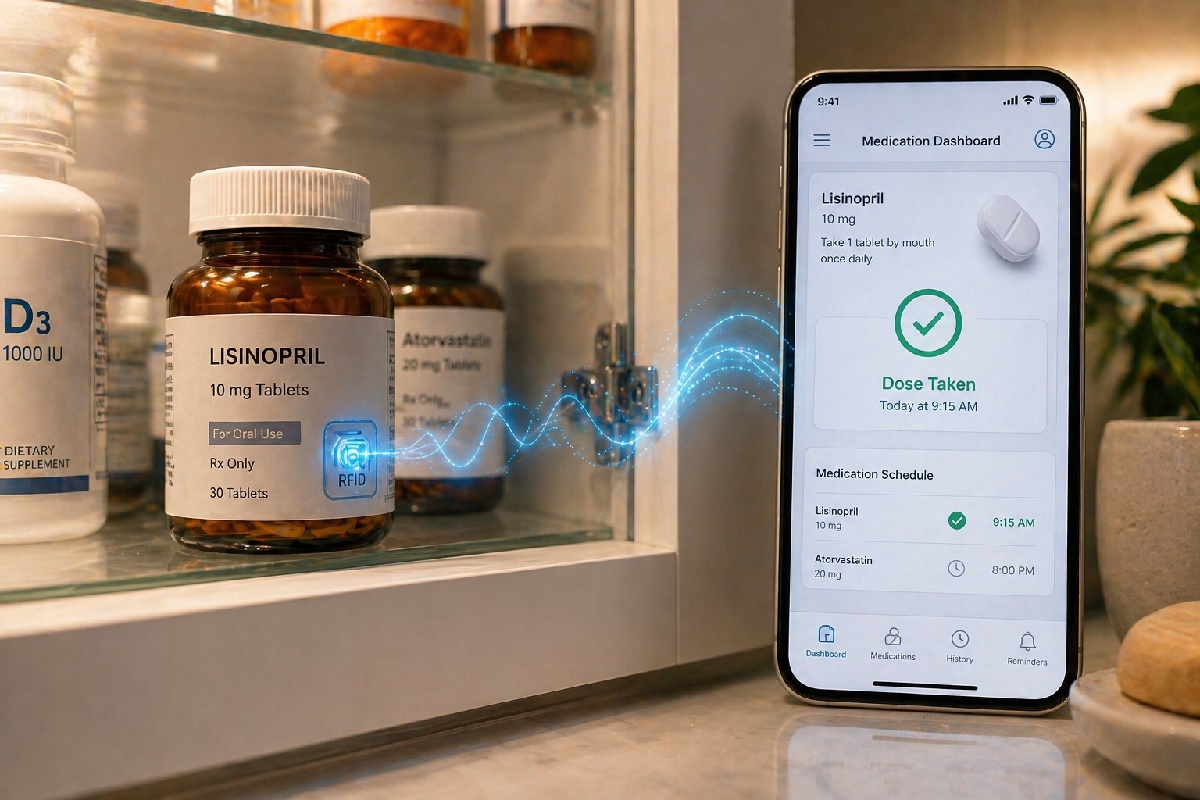
Do you remember when a smart medicine cabinet referred to remembering to purchase more Band-Aids? Those are the days that are passing by. With the advent of healthcare coming out of sterile hospital wards and into the comfort of our living rooms, a low-profile, yet mighty technology is becoming the center of attention: RFID (Radio-Frequency Identification). It likely has been used to tap a credit card or open an office door, but its most significant application is perhaps in the pill bottle you take.
As the U.S. population ages at an alarming rate (more than 10,000 people are turning 65 years old on a daily basis), the idea of smart aging is no longer a luxury but rather a necessity. Parents would like to live longer as a family, but not at the expense of their safety. This is the place where smart packaging that is RFID-enabled makes a common medicine cabinet the silent, watchful caregiver.
What RFID Really Does in Your Meds, Beyond the Barcode?
RFID is a technology that uses radio waves to transmit data between a small tag (stuck to a pill bottle or a blister pack) and a reader (usually your smartphone or a hub in your home), unlike a barcode, which requires direct line of sight. This implies that the cabinet can view your medication without you having to pull it out, scan it, or even contemplate it.
That can make it possible in a home health environment:
- Automatic Opening Detection: The bottle tells when the cap is turned. It does not merely make guesses.
- Temperature Memory: The tag will remember whether your insulin or thyroid drug was stored in a hot delivery truck, or not, for three hours.
- Expiration Notices: Your cabinet keeps you updated on the fact that you have to clear the old antibiotics from last year before you run out of time and take them.
The Game-Changer: Smart Pill Bottle
The smart pill bottle is the most viable one in the present day. Consider the following scenario: You wake up, take your blood pressure medication, and proceed with your day. Your telephone is quiet. But on Tuesday, you get a work call and forget. In 30 minutes, the RFID reader on your phone notifies you that you missed a dose of Lisinopril: “RFID Reader: Missed dose: Lisinopril. Take now?”
Assuming that you still fail to reply, the system goes a notch higher. It is able to send a text message to your grown-up child or a professional monitoring service. This is not science fiction; it is the logical next step of cold-chain monitoring (tracking temperature-sensitive drugs on the pharmacy truck to your fridge), taking the next step to compliance monitoring (tracking whether the medicine actually gets into your body).
Why is This Fresh?
The majority of the health tech is centered around glittering devices, such as smartwatches that monitor the number of steps or sleep. The biggest issue of chronic disease management is non-adherence, but those devices are not the solution.
According to the WHO, half of the patients do not take the drugs as prescribed. To an elderly parent alone at home, forgetting a blood thinner or diabetes pill is not a hassle; it is a visit to the emergency room.
RFID can address this without being complex. The patient does not need to record anything, press buttons, or even recall the need to synchronize devices. They just pop the bottle. The technology does not show itself; this is the characteristic of the great design among seniors.
Important Things You Should Be Aware of
- Cold-Chain at Home: RFID tagging refrigerated medications (such as Humira or insulin) can record temperature variations. In case of a blackout when you are on vacation, the bottle reminds you that the medicines are spoilt and you have not injected them yet.
- Expiration Management: Smart cabinets are able to scan all your bottles simultaneously. Enough of playing find the oldest date. Your phone will send you a monthly digest: Three things are out of date next week.
- Refill Automation: Once the bottle has identified 30 refills (30-day supply), the bottle can automatically send a refill order to your pharmacy. You never run out.
- Security & Tamper Evidence: When a person cracks a bottle, he or she is not supposed to (such as a grandchild using opioids), the tag logs the time and provides a notification.
Some Practical Hints on Implementing RFID in Your Home Health Practice
Fancy updating your medicine cabinet? This is how to be smart, not hard.
- Don’t turn your entire cabinet upside down. Select the single pill that your parent is most likely to forget (e.g. Heart medicine or a daily blood thinner).
- Inquire with your pharmacist in the area to see whether they have RFID-enabled packaging. These programs are being tested by major chains (CVS, Walgreens). Otherwise, think about aftermarket products such as PillDrill or Hero (both based on the same technology).
- The RFID signals can be bounced back by metal cabinets or absorbed by liquids. Store your smart bottles on a dry, wooden shelf or on a plastic organizer- not on a metal lockbox.
- Set the escalation chain. Prior to deployment, make decisions: Who gets the first alert (you)? Who receives the second alarm (your spouse)? Who receives the third (monitoring service or doctor)? Specify this within the application.
- When you purchase a cold-chain RFID tag (some are available in the form of stickers to be placed on a vial), test it by leaving the meds on the counter for 30 minutes. Get familiar with what a warning looks like prior to a real emergency.
- The smartphone application may not be used by the senior. That’s fine. It is the adult child or home health aide who should be the recipient of the RFID data and who calls to say, mom, your bottle says you have not opened it today.
Your medicine cabinet is turning into a low-key genius. There is no device that you need to wear, a password that you need to remember, or a new routine that you need to adopt with RFID. It simply listens.
That kind of silent watchfulness is the difference between an overlooked pill and an avoidable trip to the hospital, as to an aging parent living alone. The most intelligent health technology is not the one that you flaunt; it is the one that you never even think about until it comes to your rescue.
Open that cabinet door so open. The future of “smart aging” is already sitting on the shelf, waiting to remind you.
FAQ
Should I replace my old pill bottles at once?
No. Start with one high-risk medication, like a blood thinner or insulin. The majority of systems are compatible with the current bottles and make use of RFID stickers or smart caps, hence you can convert your cabinet on a small scale at a time without spending a lot of money initially.
Does the patient need a smartphone?
Not necessarily. Instead, the RFID bottle will be able to alert a designated caregiver via his/her phone. The senior simply opens the bottle as usual. The technology is invisible in the background, making it a perfect match for the non-technical people.
Can RFID help us track refrigerated medications?
Yes. RFID tags are capable of tracking cold-chain temperatures. In case your refrigerator malfunctions or a package has been sitting in the heat during delivery, the tag logs the trip. It will notify your phone before you take possibly harmful, spoiled medicine.
How will it know if I have actually taken the pill or not?
It does not prove that one had swallowed but simply that the bottle was opened. Although imperfect, the research indicates opening detection is highly correlated with real use. In the majority of medications, any missed opening is a good early indicator of non-adherence.
Will my insurance cover smart bottles?
Coverage varies. A few Medicare Advantage plans and pharmacy benefit managers are beginning to test RFID with high-risk patients. Before paying out of pocket, check with your insurer or ask your local pharmacist about pilot programs.