During an industrial fire, a chemical spill, or a natural disaster, time is the sole tender that will be valued. Although fire suppression systems of a given facility manage to contain the threat, the most exhausting task of the Safety Officer has started: they have to count every single soul on the lot.
A manual headcount in a big plant or a massive warehouse is a race that is already against a clock that is slowly depleting. When it happens to notice it has taken you 20 minutes to realize a person has been missing, you have wasted more than time; you may have missed the opportunity to rescue the person.
It is, therefore, why The 60-Second Roll Call is the new standard in industrial safety. Using RFID (Radio Frequency Identification) and RTLS (Real-Time Location Systems), firms are changing an insane paper chase into a certain, computerized guarantee of security.
Why is the “Clipboard and Pen” Method Considered a Liability Today?
Manual headcounting assumptions of traditional systems are based on three things that fail in case of crisis: stability, visibility, and memory. * The Lag Time: During a manual roll call, a warden will be required to call out names and wait to be answered. Normally, in a work environment requiring 200 or more employees, this can take more than 15-20 minutes.
- The Mismatch: Workers do not always go through the right door. When an employee in Sector A leaves via the door of Sector C, they are “lost” in one place, actually alive in another, leaving rescuers to lose their lives searching for a non-existent ghost.
- Visibility Visitor/ Contractor Gaps: Temporary workers and visitors are the most prone and of the smallest account to muster since they have not been briefed on what to do at roll-call and are the hardest to count by hand.
OSHA standard 1910.38 states that the evacuation should work out a method to enumerate all the employees. Using paper during wind and rain of a real emergency usually does not prove satisfactory to the standard of efficiency required by OSHA.
How does an RFID System Achieve a Roll Call in Under a Minute?
RFID transforms your staff into a smart network. A sensor is used to seek an object instead of a human being seeking a person.
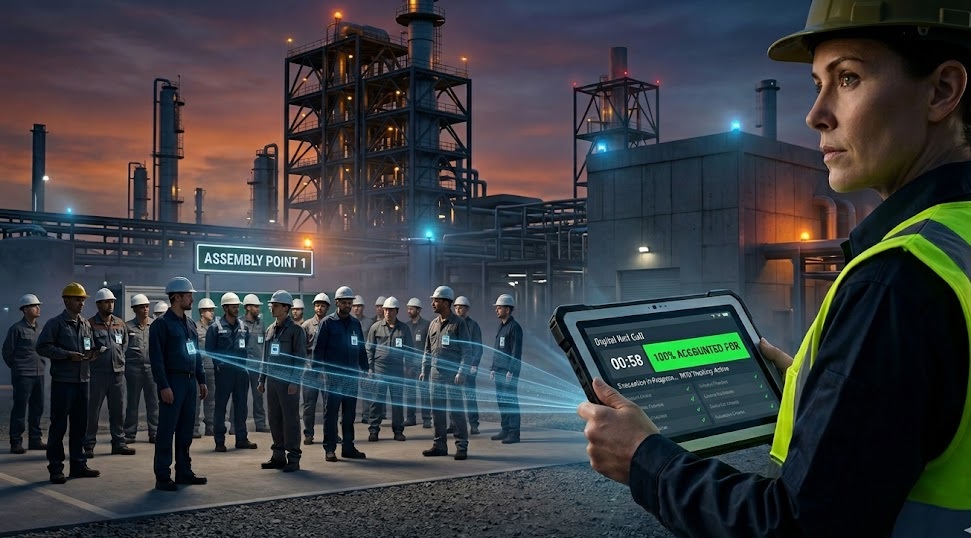
- Passive Mustering: When the employees swipe through Mustering Portals at specific safe areas, the ID badges are immediately recognized by the reader. The employee does not have to badge in or stop; he just has to enter the safe area, and the system records him as being safe.
- Bulk Processing: High-performance RFID readers that are high-performance have the ability to scan at a rate of 200 tags a second. This entails a single movement of the workers through the door of a bay, which can be factored into the time it will be necessary to inhale a breath.
- The Live Missing List: The Safety officer is shown a real-time dashboard on a tablet. They do not see the names of the missing, but those who are safe. This leads directly to the point of those in need of help.
What Happens If the Power Goes Out or the Building’s Wi-Fi Fails?
The safety technology is designed for the worst-case scenario. RFID mustering systems, such as those sold by Senitron, have redundancy infrastructure:
PoE & Battery Backup: It is common in many cases to have fixed readers powered over Ethernet (PoE) with a battery backup, which still provides power to the “gates” even when the main power grid is disconnected.
Mobile Mustering: Kits Security wardens have ruggedized cellular (LTE/5G)-frequency or private radio-frequency hand-held readers. These monitors are not reliant on the Wi-Fi of the building. Chocolate factories are using mobile mustering through the RFID app.
Cloud-Syncing: Cloud-syncing is provided such that when a handheld reader at one of the remote muster points scans a badge, the data is immediately synchronized with the cloud, enabling managers at other muster points to view the global list of people as safe in real time.
How does RFID Help First Responders During a Real Rescue?
Entering a burning building with a search may be among the riskiest activities that firefighters engage in, as they may find someone outside the building already. RFID delivers Actionable Intelligence:
Last Known Location: When an employee has not reached a muster point, this system may display to the fire chief the last reader to read the badge of that employee (e.g., John Doe is the last person to be seen in the Level 2 server room at 10:04 AM).
Poor Protection of the Lives of the First Responders: The RFID is able to eliminate False Alarms because it provides a list of the locations where the people are safe, by 99.9 percent, making it unnecessary to go inside the areas and search through them to find the people that are already safe inside the parking lot.
Conclusion
Information is as essential as air is in the case of a crisis. The 60-Second Roll Call is not just any convenient addition to your Emergency Action Plan, but a life-saving addition to it. RFID technology eliminates the guesswork of the old-fashioned headcount, as well as the time lag involved in counting the heads on paper, so your safety staff is presented with the one thing they need most, and that is the truth in real time.
FAQs
Does every employee need a special badge?
Not necessarily. The vast majority of modern RFID mustering systems are able to piggyback on your existing HID or access control badges. The badge used to unlock the front door can also be used to turn on the safety beacon in case of an evacuation by adding an RFID inlay or a dual-technology card.
Is this technology expensive for a single-site facility?
At the end of the day, however, the cost of a life is the end goal, though, pure operationally speaking, RFID mustering is usually self-limiting, as the time spent in compulsory safety drills is cut down to as little as possible. A 45-minute lost production time can now be done in 10, and this saves thousands of labor costs per annum.
How do we account for visitors who don’t have badges?
Best practices encompass a Visitor Kiosk, with which visitors are supplied with an RFID lanyard on a temporary basis. This associates their name with the tag within the system, so they have to be taken into consideration in the digital roll call alongside full-time employees.
Can the system track employees’ daily movements?
Although the technology is able to mode movement, most of the firms install the system in such a way that only during an emergency event does the system switch to tracking. This not only gives the employee their privacy at the workplace, but it also gives them total visibility when their safety is compromised.