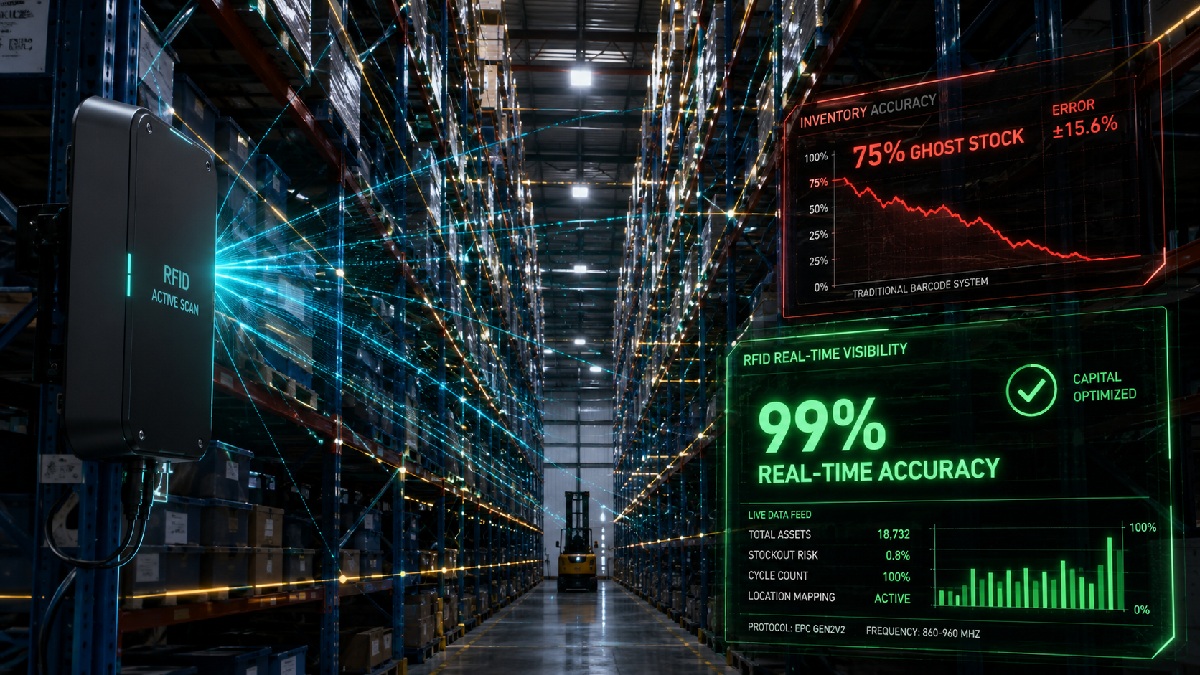
When it comes to high-density warehousing, it’s a costly error to be “close enough. On average, most manual/barcode facilities use accuracy rates of 75% to 80%. Although this could sound practical, a 25% error rate is a “tax” on each consecutive layer within the operation: level of safety stock, order turnaround, etc.
It’s not that the financial impact of such a move to 99% accuracy with RFID is only a matter of technological adjustment—it’s an entire transformation of the whole financial equation of the warehouse. To see the math of why 99% is the only good number for high-density storage, let’s begin with the interrupter sled. Let’s start with the interrupter sled and how it relates to 99%.
Why is 75% accuracy considered a “danger zone” for high-density warehouses?
High-density conditions (e.g., pallets being stacked 4 levels high or bins filled to the maximum depth) have naturally limited visibility. So, at 75% accuracy, one in four is a “ghost.
The loss of math-related issues is:
Managers must inflate safety stock because of the 25% uncertainty, which is considered the Safety Stock Penalty. The odds are that you should be carrying 20%-30% more inventory than is needed to ensure against stockout losses if your accuracy is 75%. This leaves out millions in working capital.
Search labor escalation: If this occurs, and it has a higher-density rack, 25% of misplaced stock must be manually “honeycombed” out by moving 3 pallets to find what is required. This will triple the labor cost per pick.
When the “false out-of-stocks” error occurs, also because it is an item that was not located in the specific bin in the rack, the accuracy rate is 75%, which could represent a loss of total revenue of 3% to 5%.
How does the “99% Accuracy” of RFID transform warehouse mathematics?
With RFID, the “Human Scan Dependency” moves the needle from 75% to 99%, off the radar screen. A record in a barcode system is only updated when a human locates and reads a code. The automatic updation of the record takes place in an RFID system when the infrastructure (portals and overhead readers) is changed.
The mathematical leap is represented as follows:
Industry statistics indicate that with greater accuracy (99%), an 10% to 15% reduction in safety stock levels. That’s $1M to $1.5M in cash that’s now available for a new business or expansion in a warehouse with a $10M inventory.
Cycle Count Compression: Cycle counting is tedious – requiring weeks of manual work when one has a high-density storage system. The capabilities of RFID include “bulk scanning” so that one worker can inventory 10,000 items an hour. In this case, labor hours spent counting are reduced by 80%-90% mathematically.
Because the accuracy level is 99%, you can gain the following 21st Century’s wisdom and safely fill up any space in a high-density rack, as this is “Chaotic Storage.” In the process, this can typically add 15-20% to a space’s effective storage space while adding only one square foot of real estate.
Can RFID effectively “read” through high-density stacks where barcodes fail?
Yes. The main physical benefit of RFID in dense areas. Line of sight (LoS) is required for barcodes and physics-based proximity for RFID.
Through-Material Advantage: A radio wave penetrates cardboard, plastic, and wood. So, the deep-lane-type racking system can enable an RFID reader to capture the identity of a pallet without requiring the operator to move the pallets in front of the reader physically.
The Bulk-Read Velocity: A high-density receiving application can move through a full pallet of 500 distinct items in less than 5 seconds with the use of a portal. It would take a barcode worker 20 to 30 minutes to break open that pallet and read each barcode.
The exact coordinate of any item is always known with 99% accuracy, with the help of the WMS (Warehouse Management System). Mathematically, “search” time quickly lapses to almost nothing.
What is the actual ROI timeline for moving from 75% to 99%?
The “Payback Period” – the period from time spent till cost recovered – is quite short in high-density environments, whereas the up-front cost of RFID tags and readers is greater than that of barcodes.
A return on investment for most medium to large warehouse companies is made within two years or 12-24 months.
The “Hidden” Savings: The reduction in Expedited Shipping Fees due to finding items “lost” late, as well as eliminating Shrinkage (Theft/Loss) at 20%-30% typical reduction from RFID, are also part of the ROI calculation.
By freeing up 80% of the time it used to take to count and search, that time can be utilized on high-value outbound shipping activities, leading to a greater amount of throughput without the addition of more person-hours.
Conclusion
A 75% accurate warehouse is a blindfolded warehouse. It is an incontrovertible fact to be driven home mathematically in the impetus of high-density storage applications. Transitioning to 99% accuracy means it is not just about finding what you are looking for, but it’s about finding the hidden capital, labor, and space that was lost in the “ghost stock” of manual management.
FAQs
Does high-density metal racking interfere with RFID signals?
In contrast to metal, which reflects radio waves, the new radio wave ‘On-Metal’ tags and the highly sophisticated antenna technology (such as that of Senitron) use the radio wave reflections to strengthen the radio wave read field. Metal racks can be transformed into a high-visibility environment with the right mapping.
Can 99% accuracy be achieved in a warehouse with high humidity or cold storage?
Yes. RFID tags are also made to resist the cold up to a maximum temperature of -40°C. The problem of manual scanning is physical, and RFID systems aren’t likely to let the high-density cold store achieve the 99% accuracy needed when the system is automated for high density.
How does RFID integrate with my existing WMS?
RFID acts as the “Data Entry” layer. Instead of a worker typing or scanning, the RFID middleware sends a clean data stream directly to your WMS, ensuring your digital records match physical reality in real-time.
Learn more: RFID warehouse management system