RFID has been a silent factor in the world of logistics for several years. It has enabled companies to keep products in check in many ways – from warehouse automation to retail inventory accuracy – faster and smarter than traditional barcodes ever could. However, in 2026, there has been a movement toward RFID. It’s not just about speed, visibility, and automation. Now it is also a matter of sustainability.
The new generation of innovation is being developed for RFID: chipless, paper-based, biodegradable RFID tags. These solutions offer the industry long-sought-after real-time visibility of the supply chain without adding to the electronic waste problem.
Traditional RFID requires a sustainable upgrade
The conventional RFID tag is composed of silicon chips, metal antennas, adhesive, and plastic substrates. They are very efficient, but when applied on a very large scale, they have a major footprint.
Consider sectors such as retail, pharmaceuticals, food distribution, and logistics. The annual turnover of billions of single-use RFID tags in the world’s supply chains. The majority are thrown out after a single use. This has resulted in an increasing amount of low-value e-waste that can’t be recycled due to the materials being fused together.
In 2026, sustainability reporting has become much more than a branding exercise. Measurable environmental responsibility is becoming more and more the expectation of investors, regulators, and customers. Even the tiniest part of the supply chain, such as labels and tracking tags, is being reconsidered by businesses under that pressure.
What is Chipless RFID?
Chipless RFID doesn’t have the silicon microchip.
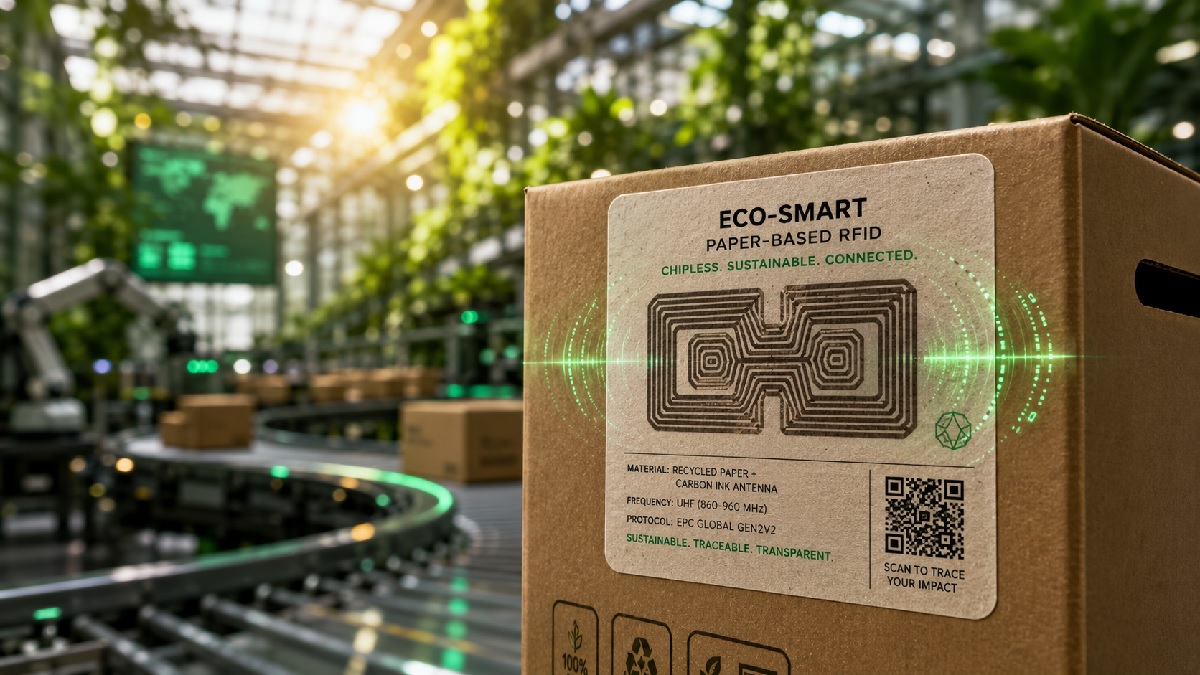
The data stored in a chipless tag is not embedded in a chip, but in specially designed patterns, resonant materials, conductive inks, or printed structures that reflect radio signals in a novel manner. These are reflected and interpreted by a reader to identify the item.
This innovation alters the economics and the environment in some important ways of RFID.
The benefit of chipless RFID is:
- Reduce material consumption due to the lack of silicon chips.
- For high-volume applications, reduced production cost.
- Due to simplified construction, improved recyclability.
- Improved substrate and paper compatibility
- The ability to scale for one-use and/or short life-cycle packaging.
The chipless RFID system is not necessarily a substitute for a high-memory or complex RFID system. It is more and more viable for applications such as product authentication, inventory counting, shipping labels, and retail packaging.
[Image: chipless RFID system]
Paper-based and biodegradable RFID
A major transition in the near future (2026) will be the transition to eco-designed RFID tags based on renewable materials.
Many manufacturers are now trying out:
- There are alternatives to plastic films, such as paper substrates.
- Use of water-based conductive inks instead of heavy-metal-intensive processes
- Cellulose-based antennas
- Compostable adhesives
- Biodegradable laminates
The developments are relevant because sustainability isn’t solely measured by the performance of a technology but by its life cycle
A paper-based RFID tag that can flow through an existing recycling program provides a significant edge to the companies. Simplifies disposal without compromising operations.
What is the reason for the increase in uptake of the 2026 ESG Goals?
ESG targets for 2026 are much more specific than a few years ago. A variety of organizations are judged by the following criteria:
- packaging waste reduction
- recyclable material usage
- Intensity of Carbon per shipped unit
- Initiatives for a circular supply chain
- responsible sourcing commitments
While RFID might seem a small portion of the sustainability solution, scale makes all the difference.
Even minor design modifications can make a real difference in the environment when millions of units are going through the supply chain each month.
Eco-friendly RFID can contribute to ESG initiatives in a number of ways:
- Reduced electronic waste
Silicon chips and the use of fabricated substances reduce waste production directly.
- Better recycling compatibility
Paper-first tag construction helps keep packaging material near mono-material recycling streams.
- Lower material intensity
With less complex tag architecture, there can be less raw material use and lower energy consumption during tag manufacturing.
- Traceability of sustainability reporting improved
Despite the gap, RFID offers the visibility required to track inventory movement, shrinkage, product origins, and logistics efficiency. The latter is essential. Sustainability does not have to compromise visibility. Indeed, the ability to see is increasingly vital to sustainability.
Future Impact on Supply Chain Visibility. Future Impact on Supply Chain Visibility
Ten years ago, sustainability and operational efficiency were frequently seen as conflicting goals for businesses. That’s changing in 2026.
By proving that companies do not need to sacrifice environmental responsibility for supply chain intelligence, Chipless and biodegradable RFID is taking the world by storm.
These are likely to be the areas with the greatest future impact:
- Smart packaging with recyclable intelligent information.
- The right level of stock on hand does not produce unnecessary waste. Optimizing the level of stock for retail without producing unnecessary waste.
- The increasing crossover between traceability and sustainability in food supply chains.
- Where disposable shipping labels are employed in vast numbers, e-commerce logistics is one of the significant applications.
- Cold-chain monitoring for lightweight, sustainable tracking is becoming more desirable
One-step ahead, printing tech pushes eco-conscious RFID toward sleeker designs, lower costs, and shrinking into packaging like it was always part of the fiber. Soon enough, these smart tags will not sit on surfaces – they will blend right in, built during production instead of added after.
One-step isn’t enough when swapping old tags for sustainable RFID. Success hides in how carefully it unfolds.
Here are some practical measures to be taken:
- Begin with high-volume disposable applications
The most efficient sustainability returns typically come from shipping labels/carts and retail packaging.
- Evaluate end-of-life handling
A tag is not truly ‘sustainable’ unless it can be recycled or disposed of in a sustainable fashion.
- Measure real-world reading performance.
Some sustainable materials are different when they come in contact with moisture, metal, and extreme temperatures.
- Collaborate with suppliers for lifecycle transparency
Businesses need to consider material sourcing and manufacturing processes in addition to the finished tag.
- Take measures of ESG and operational KPIs.
Monitor waste reduction, recyclability, returns, and inventory visibility simultaneously.
The technology of the next generation of RFID is not just smarter; it’s cleaner.
The industry is moving away from the barcode and the environmental constraints of traditional tracking tags through the use of chipless, paper-based, and biodegradable RFID technologies.
The future supply chains are realizing that there is a simple truth: visibility and sustainability are no longer competing targets.
The companies that embrace an environmentally conscious RFID now will not only be saving the environment by cutting down on waste, but they will also create more resilient, transparent supply chains, better attuned to the expectations of the current market.
FAQ
What is the definition of chipless RFID?
Every now and then, a different kind of tracker shows up – chipless RFID skips the usual silicon chip entirely. Built into labels through custom-printed shapes or special substances, each one bounces back radio waves in its own distinct rhythm. These signals reveal what item they’re on, making detection smooth during movement or sorting.
Why do we need eco-friendly RFID in 2026?
One year before 2030, firms must answer tougher demands on sustainability and less trash piling up. Instead of tossing more gadgets away, smart tags that care for the planet keep track of goods moving around – these cut down junked electronics, give a hand to reuse targets, and lift green results even in massive setups.
Are biodegradable RFID tags effective as traditional RFID tags?
One reason these tags stand out? They break down naturally after use. For everyday tasks like monitoring shipments or managing stock, that trait matters a lot. Though complex systems still rely on traditional chips, simpler jobs often suit biodegradable versions just fine. Think product wrapping or temporary labeling – places where devices only need to last weeks, not years. Their real strength shows up when volume spikes, but lifespan shrinks.
What are the industries that benefit most from sustainable RFID?
Out in stores, delivery networks, meal supply chains, medicine handling, because they move so much single-use labeling and wrapping – swapping in eco-friendly RFID tags helps track goods better without leaving a heavier footprint on nature.
How can businesses start using eco-friendly RFID?
Start by picking everyday throwaway items – think boxes, mailing tags, or store wraps. When scanning works smoothly, it stays useful. Check how well materials mix with current recycling streams. Working alongside vendors who share full product histories makes outcomes clearer. Success often follows when these pieces line up.