These days, plenty of businesses talk about sustainability like it matters. Across every state, firms face pressure to do more than just advertise green efforts – they have to act, slashing pollution and minimizing trash. Yet proving they follow through? That part trips them up. Reusing things sounds good, but what actually makes sure items get a second life instead of ending up discarded? How to stop great assets from being lost along the way?
The solution lies in the use of RFID technology and the growing implementation of circular economy practices.
The Concept of a Circular Economy
The concept of the circular economy is different from the traditional “take, make, dispose” approach of the linear economy, in which materials and products are used for as long as possible. The aim is to minimize waste and maximize the use of resources, whilst minimizing the impact on the environment.
This concept is frequently related to reusable transportation equipment, including:
- Heavy-duty pallets
- Reusable plastic crates
- Bulk shipping containers
- Returnable packaging systems
- Industrial totes and bins
These assets are intended to be used more than once in a supply chain rather than thrown away after the first use.
Managing Reusable Assets is a challenge
Reusables are a great way to minimize waste, but juggling thousands of moving assets in multiple locations is no simple task.
Businesses often need to deal with challenges like:
- Pallets that are missing or lost. Pallets that are out of place or lost.
- Unreturned shipping containers
- Inefficient asset tracking
- Excessive replacement costs
- The inability to keep track of the use of assets.
In the absence of proper monitoring, companies are prone to buying more containers than they need, leading to higher expenses and environmental footprints.
This is where RFID technology has a big edge.
How is RFID creating “green loops”?
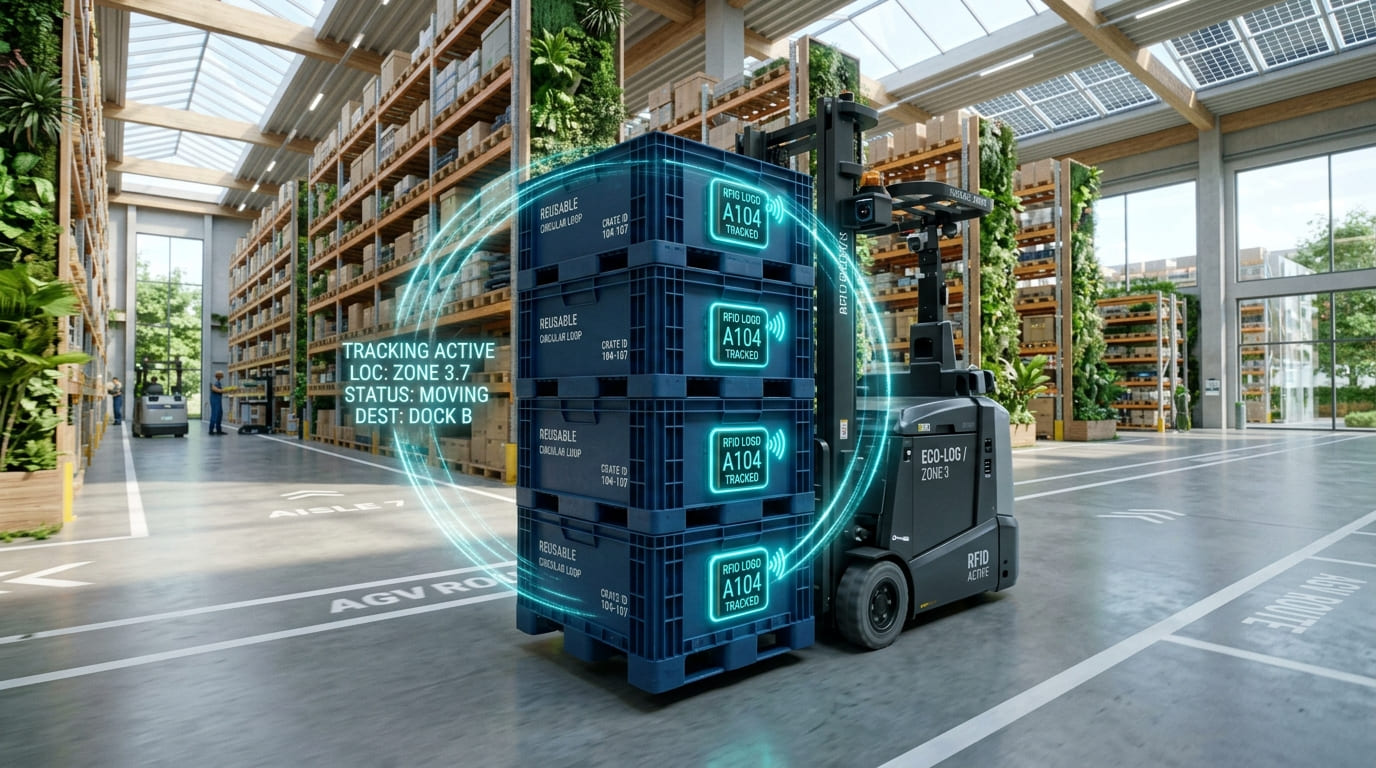
Reusable logistics assets are fitted with RFID (Radio Frequency Identification) tags. These tags carry information that can be read automatically by RFID readers throughout the supply chain, and each one is unique.
Each time a tagged pallet/crate/container passes through a facility, its location and status are automatically captured.
This generates a constant digital trail, which facilitates the tracking of the entire life cycle of each asset.
The typical green loop provided comes with the following:
- Asset is being sent out for distribution.
- It is recorded by RFID readers when you leave.
- The asset is delivered at the destination.
- Automatic tracking of the return process.
- The asset is sent to a sanitation or maintenance facility.
- When readied for reuse, inspection confirms it.
- The Asset is resourced into the supply chain.
Seeing these assets throughout the lifecycle has a significant impact on the ability of the companies to keep them in circulation and not as waste.
The Value of Sustainability Beyond Cost
While RFID cost-cutting is a way to lower operational costs, its effects on the environment could prove even more important.
Reduced Material Waste
Each pallet or container recovered from waste that can be reused takes the place of a new pallet or container to be created. This minimizes the use of raw materials and waste in landfills.
Lower Carbon Footprint
Making new packaging products consumes energy, transportation, and resources. Emissions from manufacturing and distribution are avoided by extending the life of assets.
Improved Resource Efficiency
Organizations get an insight into how the assets are being utilized and can optimize the stock level and prevent overproduction.
Better Sustainability Reporting
A number of businesses today issue environmental, social, and governance (ESG) reports. This data, created by RFID, offers measurable proof of the amount of assets that have been reused and the amount that has been reduced.
RFID and Asset Sanitization Tracking
One of the lesser talked about parts of reusable packaging is sanitation and maintenance.
Reusable containers will frequently need to be cleaned, inspected, and repaired prior to re-use. These processes can be automatically recorded by using an RFID system.
Benefits include:
- Cleaning cycles verified to confirm.
- Maintenance history tracking
- Compliance documentation
- Improved quality assurance
- Reduced contamination risks
Such transparency would be especially beneficial in sectors like the food industry, the pharmaceutical industry, and healthcare logistics.
Industries that are driving the development of the RFID circular economy
Several U.S. industries are adopting RFID-enabled programs of reusable assets.
Retail Distribution
Reusable pallets and containers are utilized by big retailers to shift products from the warehouse to the retail outlet to reduce packaging waste.
Pharmaceutical Logistics
Medical products that are special and need to be tracked, sanitized, and reused can be tracked using RFID.
Tips for Creating a Successful RFID-Based Circular Supply Chain:
To enhance the outcomes of an RFID implementation, there are a number of best practices to consider:
- Select industrial-grade RFID tags that can withstand challenging environments.
- Set return and recovery procedures.
- Implement RFID information with the inventory management systems.
- Keep an eye on the usage of your assets from time to time.
- Record track maintenance and sanitizing activities.
Making some small improvements in processes can yield large asset recovery gains and long equipment life.
Possible Future of Sustainable Logistics
Organizations can avoid making assumptions and monitor each pallet, each crate, and each container at all stages of its life cycle. The end effect is an improved, transparent, and eco-friendly supply chain.
Now the circular economy has become a reality. As tracking via RFID becomes measurable and has become the “green loop”, U.S. supply chains are demonstrating that waste reduction and operational performance improvement can go hand in hand. Companies are making real progress towards sustainability by sending reusable goods back, cleaning them, and getting them back out there.
FAQ
What is a circular economy in supply chain management?
Round and round things go when they stay useful instead of getting tossed aside. Stuff such as shipping pallets, boxes, or bins gets another life because businesses choose to bring them back into play. Waste drops down. So does the drain on raw supplies. One-time use fades out of the picture once reuse takes hold.
How can RFID help support sustainability?
Every time an item moves, RFID shows exactly where it is. Because tracking happens all through its life, companies see what comes back, when upkeep is due, and how often things get reused. When systems watch those details closely, fewer items disappear without a trace. Longer use becomes normal instead of rare. Waste drops off steadily. Goals tied to actual environmental progress start lining up more easily.
What are some common assets you can track with RFID?
Items like plastic crates, bins, and reusable pallets often move through supply chains more than once. From industrial totes to returnable transport packaging, they avoid the trash by design. Reusable shipping containers fall into this group, too. Instead of disposal, these assets get cycled back into service. Their journey continues across operations, again and again.
How can RFID improve compliance and sanitation tracking?
True. Tracking reusable containers through RFID works by logging each clean, check, or repair step. This creates a clear trail, helping firms follow rules and uphold standards – especially vital where safety matters most, like hospitals, drug production, or meal supply chains.
What are some main benefits of asset tracking by RFID?
On top of helping the planet, RFID makes assets easier to track. It cuts down on how often items need replacing because fewer get lost. When things do go missing, they’re found faster. Stock levels stay accurate without constant manual checks. Decisions rely more on real-time numbers than guesses. This means companies operate more smoothly while using less energy and resources.
Learn more: RFID warehouse management system