Today’s globally connected economy constantly poses challenges to supply chains. Natural disasters, geopolitical conflict, skill gaps, lack of transportation infrastructure, and sudden customer orders – the times they are a-changing. Traditional inventory management practices can hinder companies from reacting swiftly to these events.
Now imagine tags that whisper data as goods move. These signals show exactly where things are, every step along the way. Because of this constant flow, delays become rare. Problems get spotted before they grow. The whole system bends instead of breaking when surprises hit. Clarity replaces guesswork, quietly.
How to build a more resilient supply chain?
A resilient supply chain can proactively identify potential risks, respond quickly to variations within the supply chain, and bounce back. Invisible businesses face issues like:
- Inventory shortages
- Overstocking
- Shipping delays
- Production stoppages
- Items that are missing or misplaced.
How is RFID used in the Supply Chain?
There are three main components of RFID systems:
- RFID tags on goods, pallets, or containers
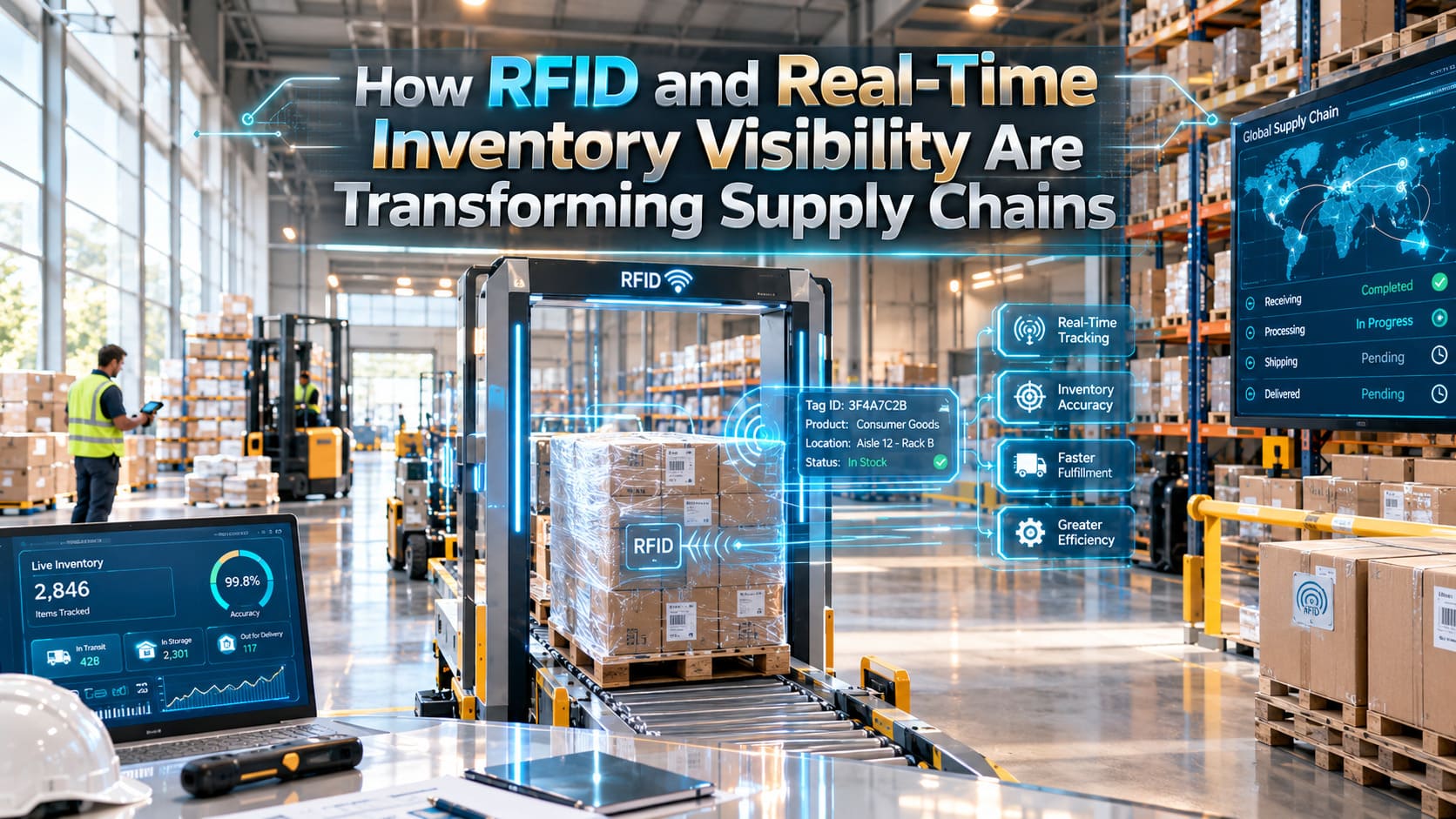
- RFID readers at loading docks, distribution centers, and warehouses
- Software platforms that gather and analyze data on the fly.
One difference between RFID and bar code is that RFID tags do not have to be in line-of-sight to be scanned. Operational efficiency is greatly enhanced by making hundreds of tagged items possible to be identified at once.
Real-Time Visibility in Case of Disruption
One of the best features of RFID is that it can accurately gather information in real-time.
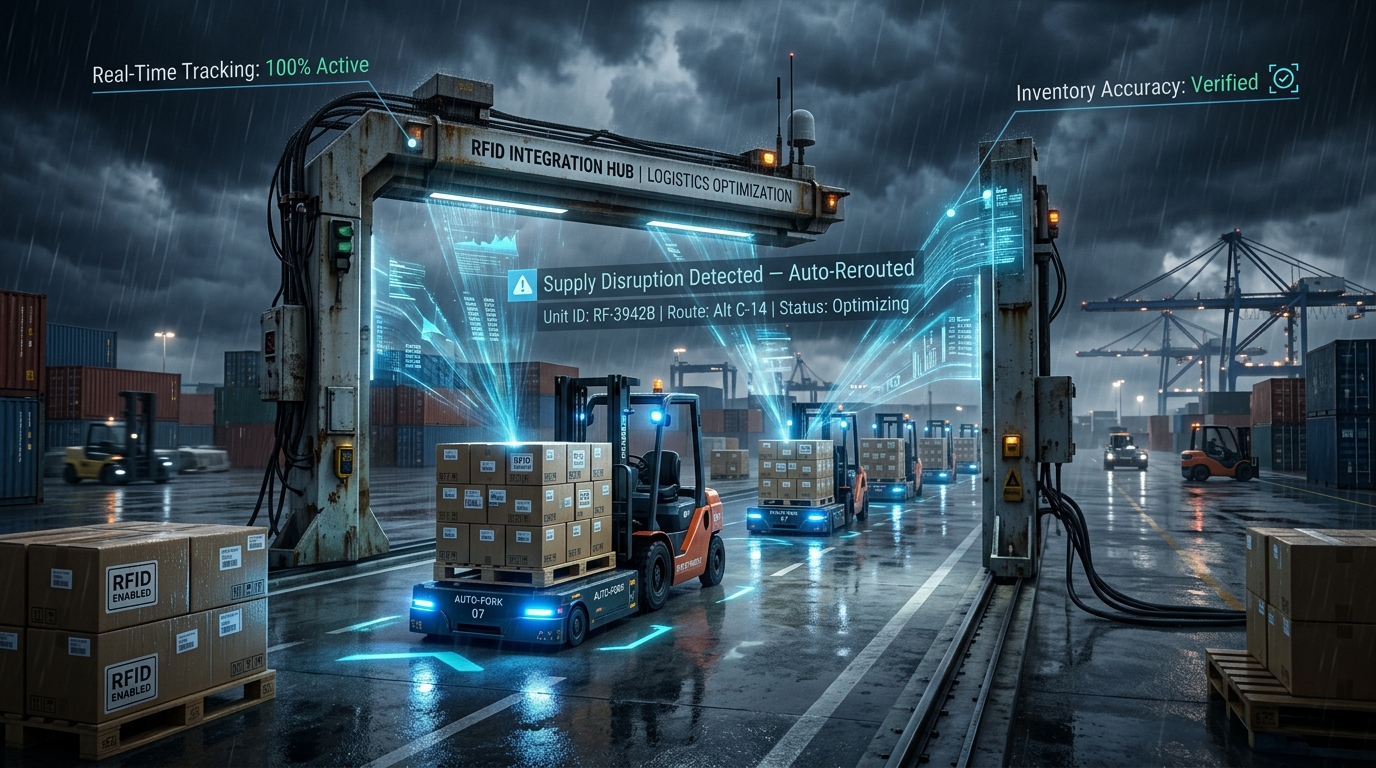
In the event of a disruption, whether it is the port or a transportation strike, or severe weather, businesses can immediately know:
- The exact location of shipments
- What facilities will be impacted
- The amount of product that is available at other locations.
- Expected delivery delays
- The following products may be out of stock:
Example Scenario
Let’s say there is a supplier that has a warehouse and floods there, temporarily stopping the operations. In companies that implement RFID, the following can be instantly determined:
- The number of items in the process of being shipped.
- Products in undamaged facilities.
- Other suppliers that have the products in stock.
- Customers who place orders that need to be fulfilled on a priority basis.
If this information were not available through RFID, it may take hours or even days to collect this information.
Reducing Inventory Uncertainty
Businesses typically end up overcompensating due to disruptions, which entails buying additional inventory, keeping capital tied up, and space in the warehouse.
Companies can benefit from RFID to manage their stock level optimally by benefiting from:
- Accurate stock counts
- Automated replenishment triggers
- Faster cycle counting
- Reduced human error
- Improved demand forecasting information.
This will allow companies to purchase more confidently without causing panic and preserve service levels, knowing that the inventory is more accurate.
Improving Warehouse Agility
One of the most common reasons for downtime in the supply chain is the inability to get materials from the warehouse. The traditional processes can be inundated by the constraints of labor shortage, rapid demand change, and a surge in order volumes.
By using RFID, warehouses can improve their responsiveness by allowing:
- Faster receiving operations
- Automated inventory tracking
- Efficient order picking
- Improved asset utilization
- Faster retrieval of lost items.
Less time on manual tasks and more time on high-priority operational issues.
Strengthening Supplier Collaboration
Resilience in the supply chain goes beyond the company’s facilities. Successful cooperation with suppliers and transportation providers is also essential.
RFID helps with improved communication by allowing access to shipment and inventory information.
Benefits include:
- Improved delivery scheduling
- Improved identification of delays by age 3.
- Better production planning
- Improved visibility between trading partners
- Quick response to unanticipated events.
With this degree of cooperation, there is less of a “shock factor” and a better chance for proactive problem-solving.
Supporting Business Continuity Planning
Radio frequency identification becomes more and more a part of organizations’ risk management approaches.
Data collected with RFID can be used to assist companies with:
- Know the supply chain vulnerabilities.
- Develop contingency plans
- Simulate disruption scenarios
- Prioritize critical inventory
- Monitor incidents and recovery after incident performance
Having reliable operational information helps to enhance business continuity during times of uncertainty.
Some Ideas on How to Make RFID Work
To ensure a successful RFID implementation, there are some best practices that businesses should consider:
- Start with a small-scale test in a critical location.
- Choose the appropriate RFID tags for particular circumstances.
- Enhance the integration of RFID data with ERP and WMS.
- Define performance measures prior to deployment.
- Properly train personnel to ensure optimum system benefits.
Soon won’t bring an end to business disruptions, yet preparation remains within reach. At the core of adaptable, clear, and quick-moving supply networks might sit RFID.
Now, RFID brings live updates, sharpens stock tracking, opens paths for teamwork, while speeding up choices – so companies survive hiccups yet grow stronger. Suddenly adapting, recovering, and moving forward with customers remains possible, even when surprises strike hard.
FAQ
How can RFID improve supply chain resilience?
Out here, RFID keeps track of stock, deliveries, and equipment as things happen. That means companies spot hiccups fast – no waiting. When a snag pops up, items can take different paths on the fly. Stock amounts shift smoothly when needed. Everything keeps moving without long hold-ups.
Can RFID reduce inventory shortages?
Fine details show up clearly when RFID keeps tabs on what’s where. Tracking happens without someone needing to scan each item by hand. Stock levels update themselves as goods move through spaces. This means shelves refill just before they run empty. Too much buildup of unused items stops happening, too.
Is RFID tech better than barcode technology?
Items tagged with RFID respond faster when grouped together – no need to face a scanner one at a time. Instead of requiring clear visual access, signals pass through materials like cardboard or fabric. Information refreshes constantly, moment by moment, without pauses. Each tag holds more detail than flat printed codes ever could.
Which industries are benefitting most from RFID-enabled resilient supply chains?
Because inventory precision matters so much, retail finds gains when shipments arrive on schedule. Manufacturing moves better when operations can shift without delay. Healthcare depends on correct stock levels to keep going. Logistics thrives where timing is predictable yet adaptable. Automotive adjusts smoothly if supply chains bend instead of breaking. Food distribution stays reliable only when systems respond quickly to change.
What is the best way for businesses to start using RFID?
Start small, picking one key spot where testing makes sense. Tie the new tracking tags into what’s already running behind the scenes at work. People doing the jobs need clear guidance before changes roll out fully. Set targets that show real progress, something you can actually check later.
Learn more: RFID warehouse management system