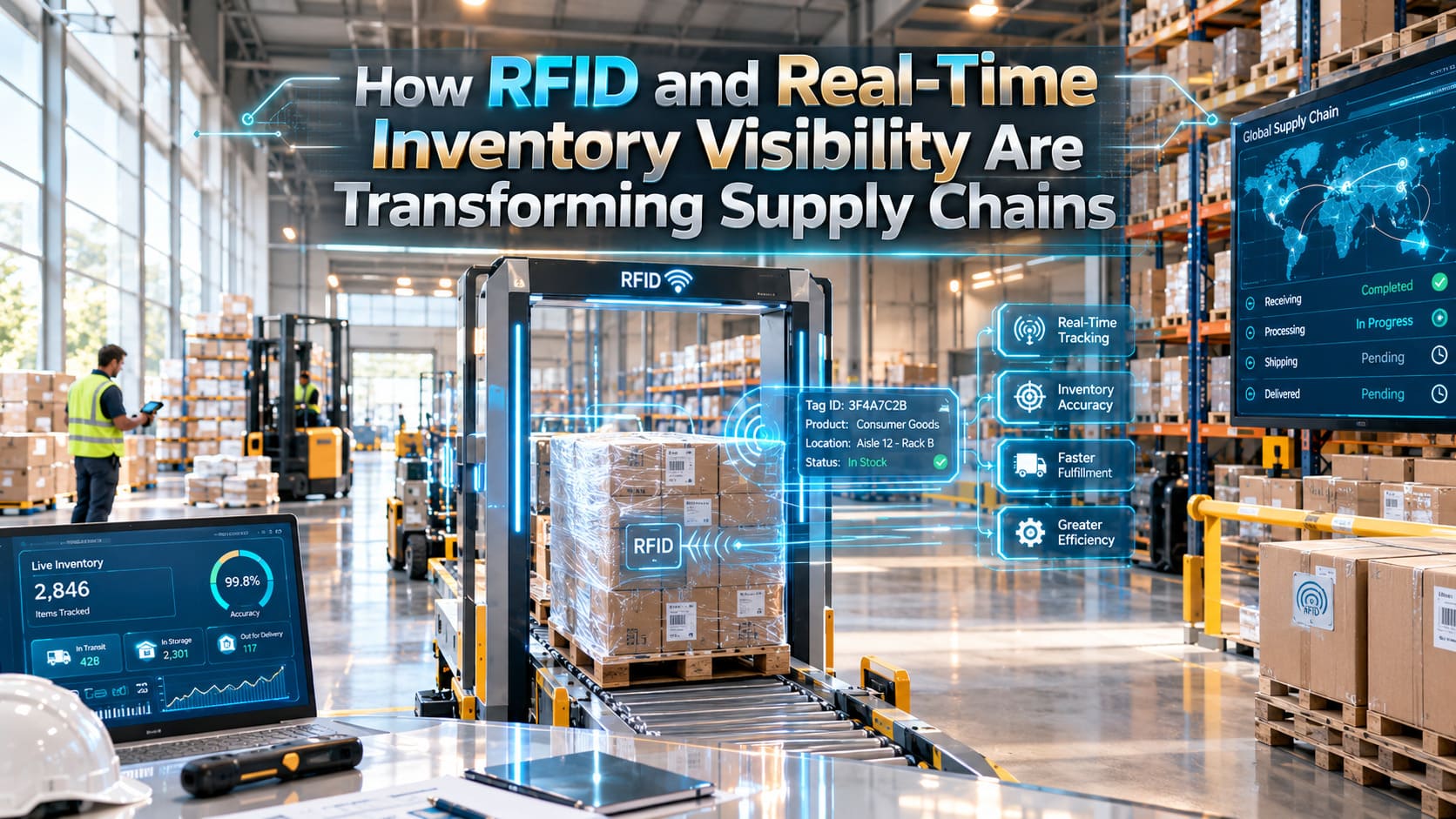
The ability of RFID to revolutionize inventory, asset tracking, retail, healthcare, and supply chains is by no means as easy as purchasing a reader and sticking access tags on products.
The effectiveness of the RFID system relies on the interaction between the various parts of the system in a particular environment, such as the readers, antennas, tags, printer, gateway, and software. What works great in a warehouse might not work so well at a retail store, cold store, or construction site.
Knowing what to expect from the major hardware issues prior to investment can avoid costly replacements and poor read rates.
RFID Hardware Is an Ecosystem
The components of an RFID system are usually several interconnected parts:
- RFID tags: Store identification data and are attached to products, pallets, tools, or assets.
- RFID readers: Radio signals that are sent and received by readers.
- Antennas: Identify how these signals are sent and received.
- RFID printers/encoders: Print labels together with programming RFID tags.
- Gateways and accessories: Integrate the RFID equipment to business systems and automate data collection.
- Software: Processes raw Tag reads to provide useful inventory, location, or asset information.
What is important is that the components are chosen as a system, not separately.
Tag Selection is More Important Than It Seems!
Not all RFID tags are alike. The performance of tags can vary greatly from one material or surface to another on which the tag is adhered.
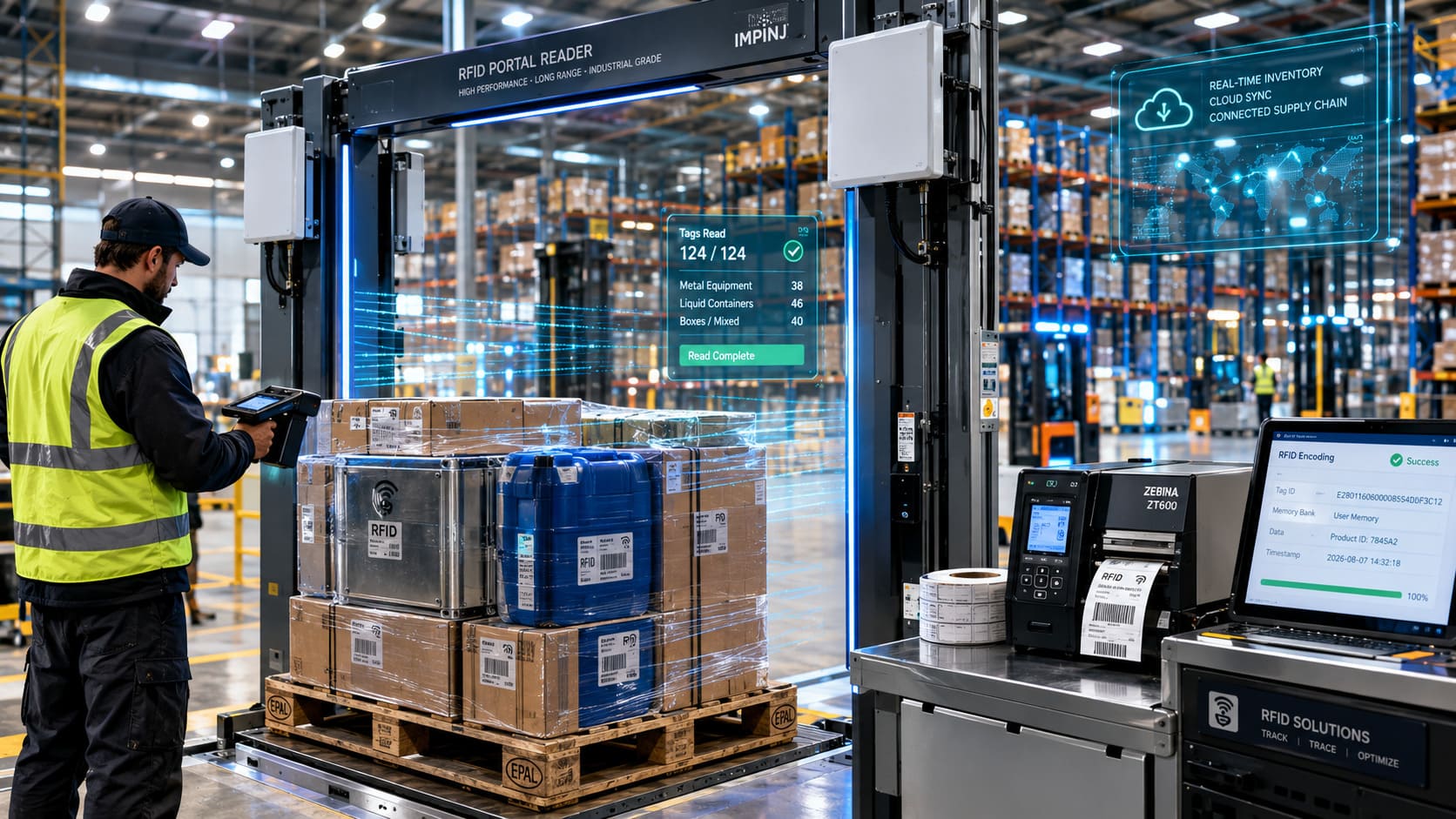
For instance, tags that are attached to cardboard boxes will behave in a different way than tags attached to:
- Metal equipment
- Liquid containers
- Plastic packaging
- Clothing
- Electronics
- Medical equipment
The size, read range, memory, durability, adhesive strength, and compatibility of the tag material should be considered when choosing a tag for a business.
On-metal tags, for example, might be needed for a metal asset, or various designs might work better for liquids or small consumer goods.
The Importance of Reader Power and Reader Performance
The “readers’ specifications” directly impact the system’s coverage and reliability. The maximum advertised read distance doesn’t necessarily mean the same thing in real-world use.
Businesses should consider:
- Required read range
- The number of tags that can be read at the same time
- Reading speed
- Operating environment
- Regional frequency regulations
- Connectivity options
- Power requirements
- Integration capabilities
A high-powered reader is not necessarily the best choice. There is a possibility of unwanted reads from tags outside the covered area due to excessive coverage.
Antenna Configuration Can Make or Break A Deployment
Sometimes the selection of antennas is underestimated.
Either circularly polarized or linearly polarized antennas can be employed in a system depending on the placement of tags and the degree of repeatability of the placement. Read performance can be affected by antenna gain, antenna beam width, antenna mounting height, and placement.
For instance, a doorway-mounted antenna setup to detect tags on items as they pass through the doorway will be different from a workstation where employees scan individual items.
Note: Do not use only lab specs to determine antenna placement.
Environment Changes RFID Performance
RFID signals interact with their surroundings. RF sources, such as metal structures, liquids, machines, shelving, walls, etc., may affect performance.
A store with metal racks in a warehouse is different from a clothing store. Likewise, medical premises might need gear with a particular set of operational and setup specifications.
Ahead of the purchase of hardware, perform an Environmental Assessment to take into account the following:
- What are the tags made of?
- What is the velocity of the tagged objects?
- What is the mounting location for the reader/antenna?
- Is there any possible radio interference source?
- What are the temperatures, moisture, dust, or impact conditions present?
Fixed vs. Handheld Readers
Besides, businesses have to decide if they need fixed, handheld, or hybrid RFID readers.
Fixed readers are suitable for automatic reading at:
- Warehouse doors
- Conveyor systems
- Retail entrances
- Production lines
- Asset checkpoints
Handheld readers are versatile devices that can be used for:
- Cycle counting
- Shelf-level inventory
- Asset searches
- Receiving
- Exception handling
Many successful deployments involve both of these. Fixed readers automatically recognize predictable movements, and handheld devices offer flexibility when an employee is required to locate or verify individual assets.
Don’t Forget RFID Printers
For thousands of labels, the printer becomes critical to the operation.
An RFID printer/encoder should reliably encode the tags along with human-readable information. When considering print speed, tag compatibility, connectivity, encoding accuracy, and maintenance, businesses should evaluate the various options available.
Even if the RFID system is performing well, the printer may become a bottleneck due to problems with the volume of operations.
Integration is a Hardware Decision Too
RFID equipment needs to be integrated with other business systems, including warehouse management systems (WMS), enterprise resource planning (ERP) systems, points of sale (POS), and asset-management software.
When buying hardware, ensure that the hardware can support the following:
- APIs
- Network connectivity
- Communication protocols
- Device-management tools
- Middleware
- Security requirements
The ability to do something technically well is not a great advantage if having to use it in conjunction with one’s workflow demands expensive custom development.
Total Cost Matters More
Not all the cheapest RFID readers are the lowest-cost solution.
To facilitate business decisions, businesses need to measure total cost of ownership, which should encompass:
- Readers and antennas
- Tags and consumables
- RFID printers
- Mounting equipment
- Cabling and networking
- Software and middleware
- Installation
- Maintenance
- Replacement hardware
- Employee training
- Integration costs
An additional cost to purchase a slightly more reliable and manageable device can offer a lot more long-term value.
Tips for Choosing RFID Hardware
Prior to making a major deployment:
- Begin with a pilot: Use actual hardware, products, and workflows.
- Assess read rates – do not assume based on the manufacturers’ specifications.
- Test challenging materials (e.g., metal, liquids, dense packaging, products other than usual).
- Simulate realistic movement: Test tags as employees, forklifts, conveyors, or vehicles are moving as normal.
- Plan for scalability – select hardware that will support future sites and volumes.
- Test interoperability: Don’t develop a closed system that restricts the options for future hardware.
- Assess support: During deployment, good technical support is often crucial.
- Document installation standards: The antenna position and reader configuration are consistent, which facilitates expansion.
Hardware selection for RFID can be tricky because the performance of RF is context-dependent. Proper tags, readers, antennas, printers, networking devices, and software can provide accurate and automatic data collection. The improper mix can lead to misreads, false reads, delays, and unnecessary costs.
Rather than a question about which RFID reader to purchase, a business should be asking, “What hardware ecosystem will reliably solve my specific tracking problem?”
That transition, from buying individual devices to creating an integrated RFID system, is what makes an RFID investment a viable business solution.
FAQ
What are the factors we need to consider while choosing RFID hardware?
Businesses need to consider tag compatibility, reader capabilities, antenna setup, operating environment, read range, connectivity, integration needs, scalability, and overall cost. In addition, it is necessary to test the operation of hardware in actual operating conditions.
Are fixed or handheld RFID readers better?
None of the readers is better in all respects. For the fixed reader, this type of RFID equipment is good for automating such processes as inventory checks at warehouse doors or on conveyors. Handheld readers are more mobile and can be used in inventory counts or for finding and identifying specific items. It is possible to use both readers for different purposes.
Why is antenna selection important for an RFID system?
Such factors as polarization, gain, beam width, location, and tag orientation have a significant impact on the antenna’s performance. Therefore, it is necessary to study the characteristics of different antennas to find out how they affect RFID performance.
Learn more: RFID asset tracking software · retail RFID inventory management