For manufacturing operations to be effective, it is important to know the location of materials, components, and unfinished products at all stages of manufacturing. However, many factories are still using spreadsheets, barcode scanning, manual updates, and verbal communication to manage work-in-progress (WIP). These techniques can lead to blind spots and a lack of confidence in determining what is being created, where, and why it may be delayed.
What is WIP Visibility?
Work-in-progress are products or assemblies that are in the manufacturing process but are not finished. An example is that an item can go through many workstations, inspection points, storage, and assembly processes before it reaches the end of the line to be the finished product.
If manufacturers are unable to track reliably, they may experience the following problems:
- Products that are not finished and are not noticed at the production stages between stages
- Time lost by workers looking for parts.
- Production status information is wrong.
- Loss of time due to missing materials
- Difficulty identifying bottlenecks
- Excessive WIP inventory
- Production plans for outdated information.
This is where RFID can help close the gaps and provide automated movement data.
How RFID Tracks Work-in-Progress?
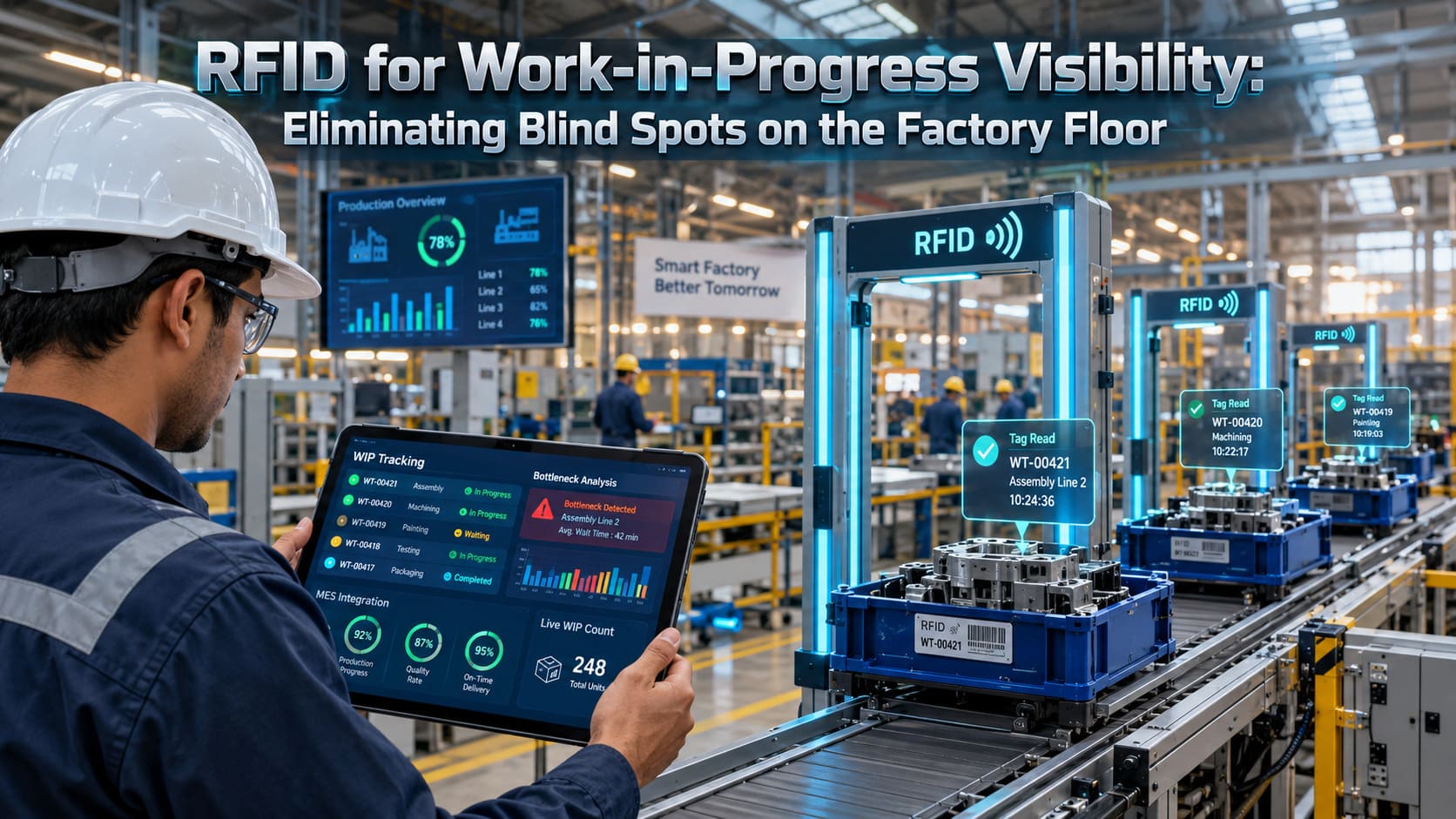
The RFID tag may be mounted on a component, container, pallet, work order, or reusable production carrier. As the item passes through the facility, RFID readers placed at key points are able to detect the unique ID number of the tag.
For instance, an assembly could go from a machining station to a painting station to an inspection station to an assembly station. Every encounter with the reader can generate digital evidence of the movement of the item.
Supervisors may be able to find out through connected software the most recent production location and status of this order, instead of asking “Where is this order?”
This leaves a digital footprint from the manufacturing process.
Identifying Production Bottlenecks
The most obvious benefit of WIP visibility is being able to spot where production is lagging.
Assume that the components are consistently in a specific area for several extra hours than anticipated. This pattern can be detected by RFID data, and it can enable management staff to investigate the issue, such as whether it is a problem of:
- Equipment downtime
- Insufficient staffing
- Quality-control delays
- Material shortages
- Poor workstation balancing
- Scheduling problems
Rather than just relying on employee reports and/or end-of-shift data, manufacturers can use movement data to detect recurring delays.
Improving Production Scheduling
Having accurate WIP information can also help in improved production planning.
Planners can make better decisions on machine capacity, labor allocation, and production priorities when they know which jobs have finished certain processes, and which ones are waiting.
RFID data may be able to provide answers to questions like:
- Which orders are currently being processed?
- What operations are waiting to be performed on which jobs?
- How many days was a product on a workstation?
- Where are there delays in the production process?
- What materials are not yet at the station?
This can lead to more agile production scheduling, which can be better adapted to the actual production situation in the factory.
Integrating RFID with Manufacturing System
The RFID data provides a way to identify and track movement but is more valuable when integrated with current manufacturing software.
RFID events can automatically update operational records by integrating with manufacturing execution systems (MES), enterprise resource planning (ERP) platforms, warehouse management systems, and production databases.
A reader at an assembly station, for instance, might notice a tagged production carrier and then cause a system event to alert others that the job has arrived at the assembly station.
The aim should be to turn raw RFID read data into meaningful manufacturing events, not just raw volumes of tag data.
Helpful tips include:
- Pilot test tags on real materials before they are deployed.
- When metal or difficult surfaces are in the vicinity, use special tags.
- Carefully mark out desired RFID read zones.
- Tune the antenna and power to the reader.
- Avoid collisions between read zones causing unwanted events.
- Run test under normal production conditions.
- Post-test equipment/layout changes for the read performance.
Selecting an appropriate RFID Architecture
There may be different approaches to RFID that are suitable for various WIP applications. Many applications can be identified using passive UHF RFID, while specific tags can be required in high-temperature, chemical, outdoor, or metal-rich environments.
Important considerations for choosing the best architecture are:
- Read distance
- Item size
- Production speed
- Environmental conditions
- Tag durability requirements
- Required data frequency
- Number of items being tracked
A pilot project might enable manufacturers to identify which tag, reader, antenna, middleware, and software are most suitable for their application.
Protecting Data Quality
Building more tracking doesn’t necessarily provide enhanced visibility. Duplicate reads, missed reads, and incorrect associations lead to misleading production information.
Manufacturers need to define rules to filter out RFID events and generate trusted status updates.
Additionally, it is necessary to decide who will be responsible for tag associations, the replacement of lost tags, and exception processing issues.
Some points to consider when implementing WIP RFID:
Manufacturers should take the following steps before implementing RFID throughout a factory:
- Begin with a specific problem: Pick a point of difficulty, a process that has value, or a challenging-to-monitor area of production.
- Trace the process: Know the path that is taken by WIP between stations.
- Test technology in a controlled production area: Pilot first.
- Establish KPIs: Monitor search time, production cycle time, WIP accuracy, throughput, and delays.
- Engage employees: Operators are able to catch practical problems in the workflow early.
- Determine how the RFID data will be integrated into MES, ERP, or other systems.
- Design for flexibility: Be able to add more production lines and tracking points later.
The most significant benefit of using RFID in manufacturing settings is its ability to combine with existing manufacturing processes and business systems. By carefully choosing tags, readers’ locations, data formatting, software systems, and worker training, manufacturers can transform unorganized manufacturing WIP into a stream of real-time actionable data.
For these reasons, WIP-centric RFID technology is a great option for manufacturers who want to get more control over the production process.
FAQ
- How can RFID help improve progress visibility?
RFID automatically identifies and tracks items that are tagged as they move through various stages in the manufacturing process. This offers increased insight into the whereabouts of Work In Process (WIP) and reduces the need for time-consuming manual tracking of WIP, enabling managers to spot delays and bottlenecks in the production process.
- Can RFID identify production bottlenecks?
Yes. Information from RFID tags can provide information on how long WIP items spend at various workstations or areas of production. Such time delays could be an indicator of why production is slowed down, such as machine downtime, labor issues, material shortages, quality control delays, and scheduling problems.
- Can RFID WIP tracking coexist with manufacturing systems?
Yes. RFID information can be supplied directly to manufacturing execution systems, enterprise resource planning, warehouse management systems, or other manufacturing databases. The information can be used to create manufacturing events and be incorporated directly into these systems as needed.