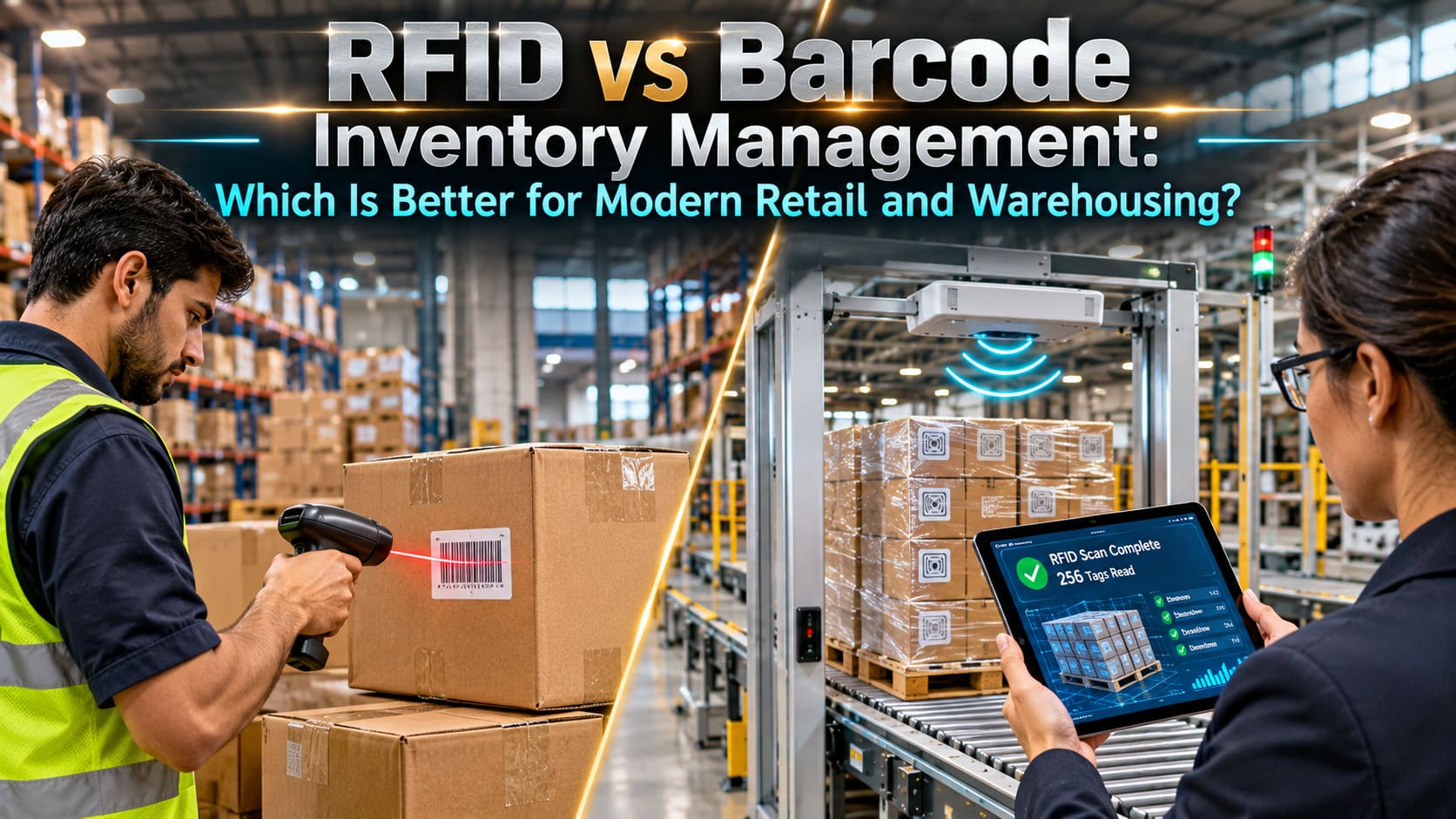
Due to the increasing number of products, higher expectations for customer fulfillment, and more rapid turnaround times, inventory management has grown more complex for retailers and warehouses. To prevent stockouts, lower operations expenses, and enhance the efficiency of the supply chain, businesses require accurate, real-time inventory visibility.
Barcode Inventory Management
A barcode inventory system is a tracking system that utilizes printed labels with machine-readable patterns. These patterns are used to identify product information like a Stock Keeping Unit (SKU), serial number, or product identifier.
The label is scanned by a laser or imaging sensor attached to a barcode scanner. The information is then conveyed to inventory management software and changes stock records.
Barcodes are commonly used in retail checkout counters, warehouses, distribution centers, and manufacturing plants.
Advantages of Barcode Systems
- Easy implementation: There’s no need to purchase expensive software to implement barcodes.
- Easy to adopt: Workers will learn how to use the barcodes without extensive training.
- Reliable identification: Good print quality and maintenance of barcodes ensure reliable product identification.
- Widely compatible: Barcode technology can be used with a variety of current point-of-sale and warehouse management systems.
- Easy maintenance: Companies can swap out any scanner and labels that have broken in a matter of minutes, without requiring the extensive changes to infrastructure.
The problem with Barcode Inventory Management
Barcode systems need to be scanned in direct line of sight. Staff need to ensure the scanner is set up properly and read each label separately.
This poses a number of operational issues:
- Manual scanning can slow inventory counts.
- Damaged, dirty, or obscured labels can be hard to read.
- More labor is required with individual scanning.
- If the scanning action is not performed immediately, the inventory can be delayed.
These restrictions can impact productivity and accuracy of inventory for businesses that process thousands of products daily.
What is RFID Inventory Management?
Radio Frequency Identification – Radio waves are used in the identification and tracking of tagged products.
There are generally three components to an RFID system:
- RFID tags: Electronically store ID data.
- RFID readers: Emit radio signals when they are read.
- Inventory software: Analyzes the data and keeps an up-to-date inventory.
RFID tags generally don’t need to be scanned directly and in line of sight like bar codes do. Depending on the technology, environment, and tag configuration, multiple tags can be read at once.
Passive Ultra-High Frequency (UHF) RFID is a technique used in many modern retail and warehouse applications because of its relatively long read range and its ability to identify many items in a short amount of time.
Advantages of RFID Systems:
- Bookkeeping/inventory can be counted more rapidly, as multiple tagged products can be identified within seconds.
- Less manual work: Staff are not spending time reading each product.
- Better visibility of inventory: Frequently read automations can give better inventory data.
- Less reliance on line of sight: Tags can sometimes be read through packaging or when labels are not on the surface.
In places where inventory levels are high and need to be checked often, RFID can be invaluable.
Limitations of RFID Inventory Management
Implementation of RFID is a process that needs careful consideration.
- RFID tags and readers are typically more expensive than barcode labels and scanners.
- Some RFID signals can be affected by metal surfaces and liquids.
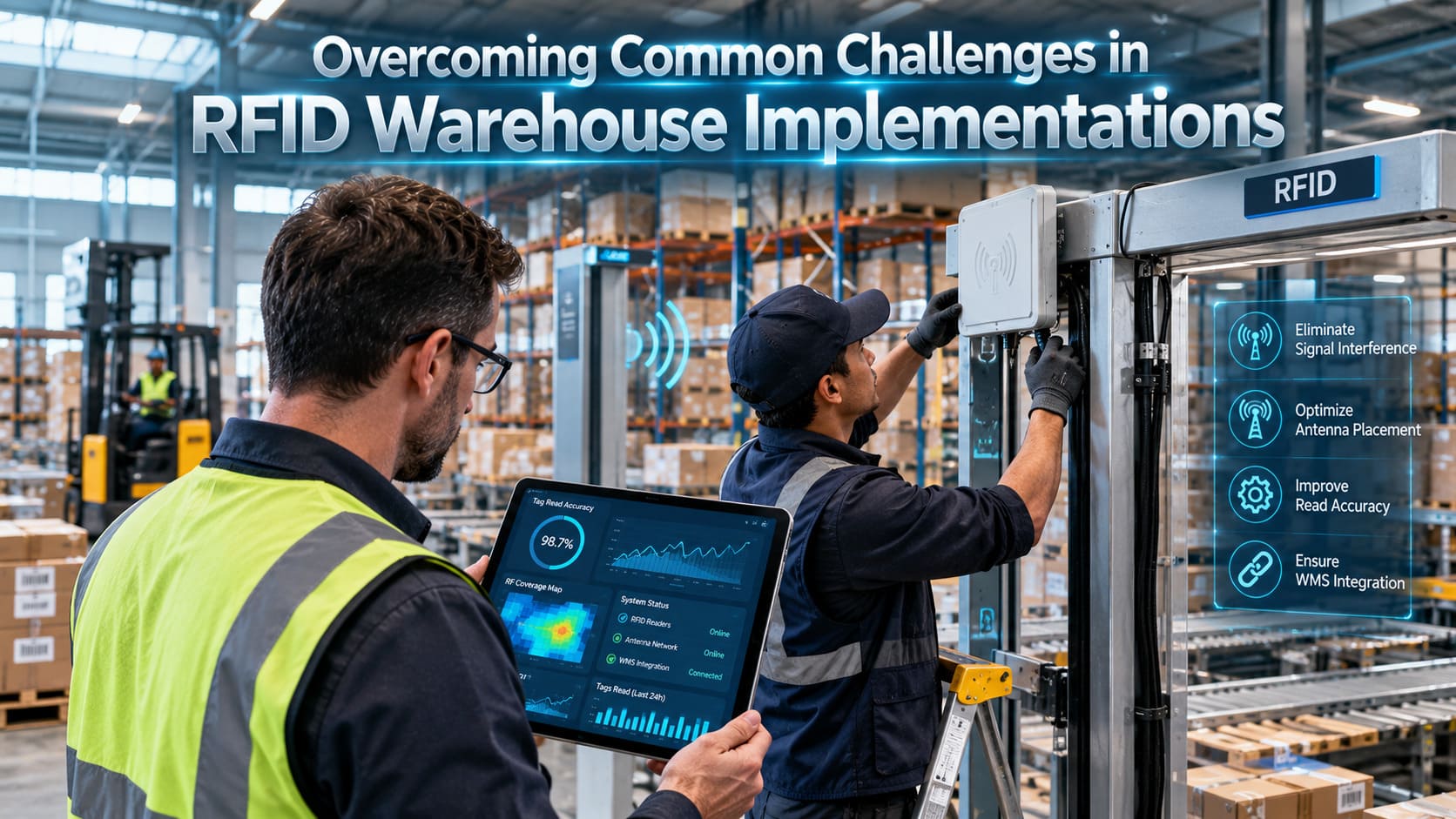
- Testing of reader placement and antenna configuration is needed.
- Incorrectly set-up systems can produce multiple or unwanted reads.
- Employees should be trained on how to operate and deal with exceptions that occur in RFID operations.
While powerful, RFID depends on matching the technology with the business environment to be successful.
Which Technology Would Be Better for Modern Retail?
Retailers require the right stock data throughout the stores, warehouses, and online channels. RFID can provide a dramatic increase in inventory transparency, especially when applied to apparel, footwear, and other items tagged singly. For instance, in merchandise counts, employees are able to move from shelf to stockroom and simply move the handheld reader around to scan the shelves, instead of scanning each item.
This can assist retailers:
- Reduce inventory discrepancies.
- Improve product availability.
- Locate misplaced merchandise.
- Facilitate correct order fulfillment on the web.
- Spend less time cycle counting.
Checking out customers, low-cost product identification, and businesses with relatively simple inventory operations are good uses of barcode systems. A combination of both is possible too. RFID can be used to help with inventory, but barcodes can still be used for checkout and returns, and they are compatible with current systems.
For a warehouse, what are the benefits of each technology?
A warehouse handles receiving, putaway, picking, packing, shipping, and inventory reconciliation.
RFID can help enhance the efficiency of some of these processes.
- Receiving and Shipping
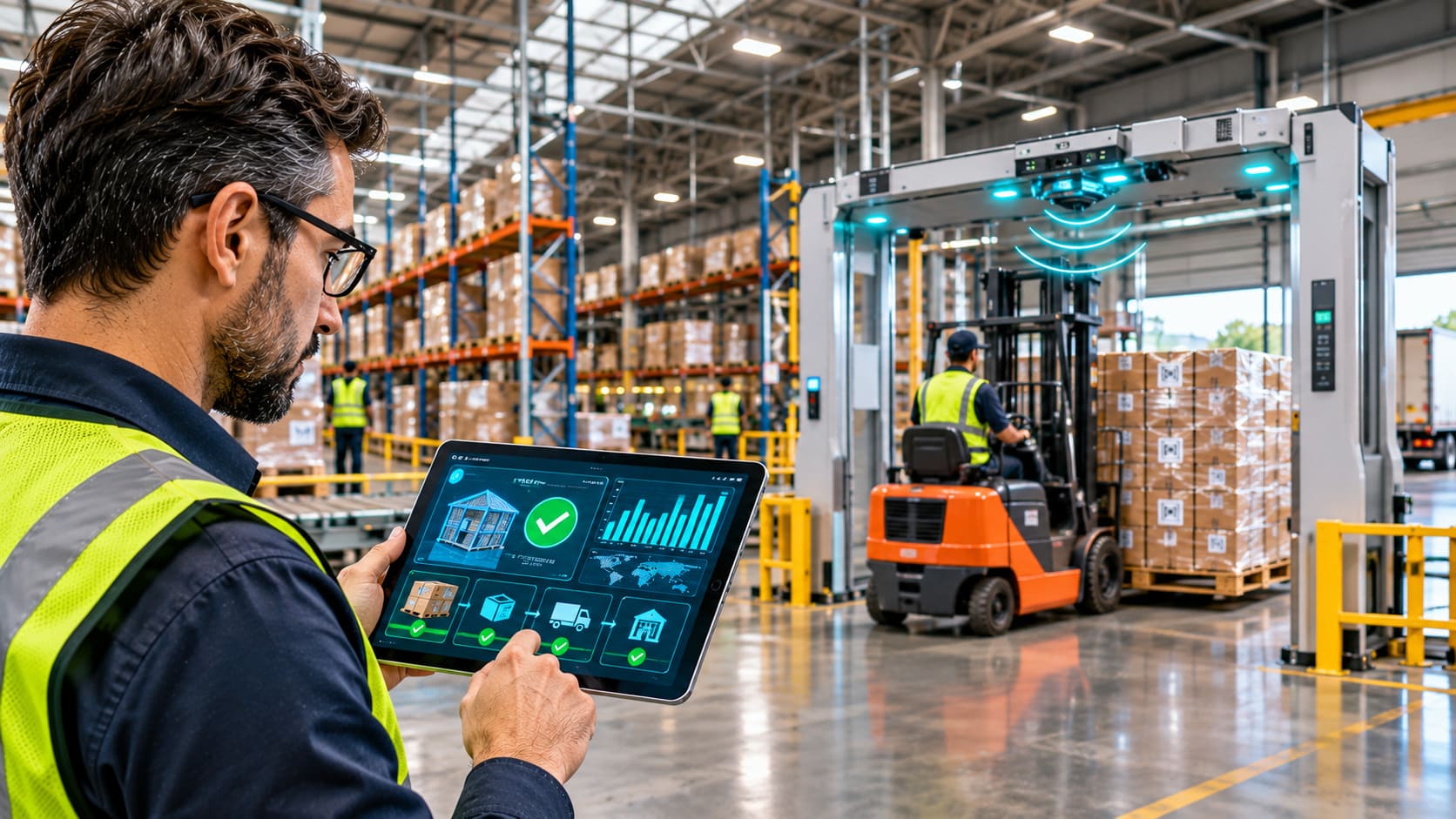
RFID portals can detect the tagged products as they pass through a specific area. This can minimize manual scanning and help to accelerate verification of incoming and outgoing shipments. But when they’re reading RFID tags, they have to be set up correctly to avoid associating products with a shipment that’s not theirs.
- Cycle Counting
Traditional bar code counting requires that staff have to scan each item or location. The ability to identify any individual item by RFID allows for faster bulk identification, thus enabling more regular inventories.
- Gathering and Order Fulfilling
RFID can be used for product identification and location verification. It can be used with warehouse management software to help minimize picking errors. Barcode systems are successful for smaller warehouses, lower volume, and processes that do not require a higher degree of accuracy when each piece is scanned.
Knowing the Total Cost of Ownership
Equipment purchase cost is just a portion of the inventory management cost. Generally, using a barcode system is less expensive and is therefore highly favorable for small businesses.
Additional investment in tags, readers, antennas, software integration, and infrastructure will be needed for RFID. On the other hand, RFID can save labour and lead to better inventory management, which can help to lower operating costs over the long term.
Businesses should evaluate:
- Upfront computer and software expenses.
- Record and categorize expenses.
- Employee training requirements.
- Cost of integration and maintenance.
- Labor savings due to quicker inventory count.
- Minimized inventory discrepancy losses.
- Enhancements to order fulfillment and stock levels.
One effective way to do this is to use the return on investment (ROI) over a number of years instead of just equipment costs.
Tips that will Help You
Here are some recommendations to keep in mind prior to implementing an inventory tracking system:
- Assess the quantity of inventory: If the business has a lot of inventory, RFID automation might be more suitable.
- Pinpoint problems: See if it is a lack of labor, incorrect inventory records, or delayed receiving.
- Test the environment: Performance of RFID may change depending on the environment, such as metal racks, liquids, and dense packing.
- Verify software compatibility: Make sure that the technology is compatible with your ERP, WMS, and POS systems.
RFID and barcode solutions can both provide great benefits:
Barcodes provide you with a low-cost, reliable, and simple solution to managing your stock. RFID can speed up identification, reduce the need for scanning, and provide increased visibility within complex retail/warehouse environments.
Carefully implementing RFID technology, keeping your barcode system up-to-date, or using a mix of both can help improve your stock accuracy, streamline processes, and improve customer experience.