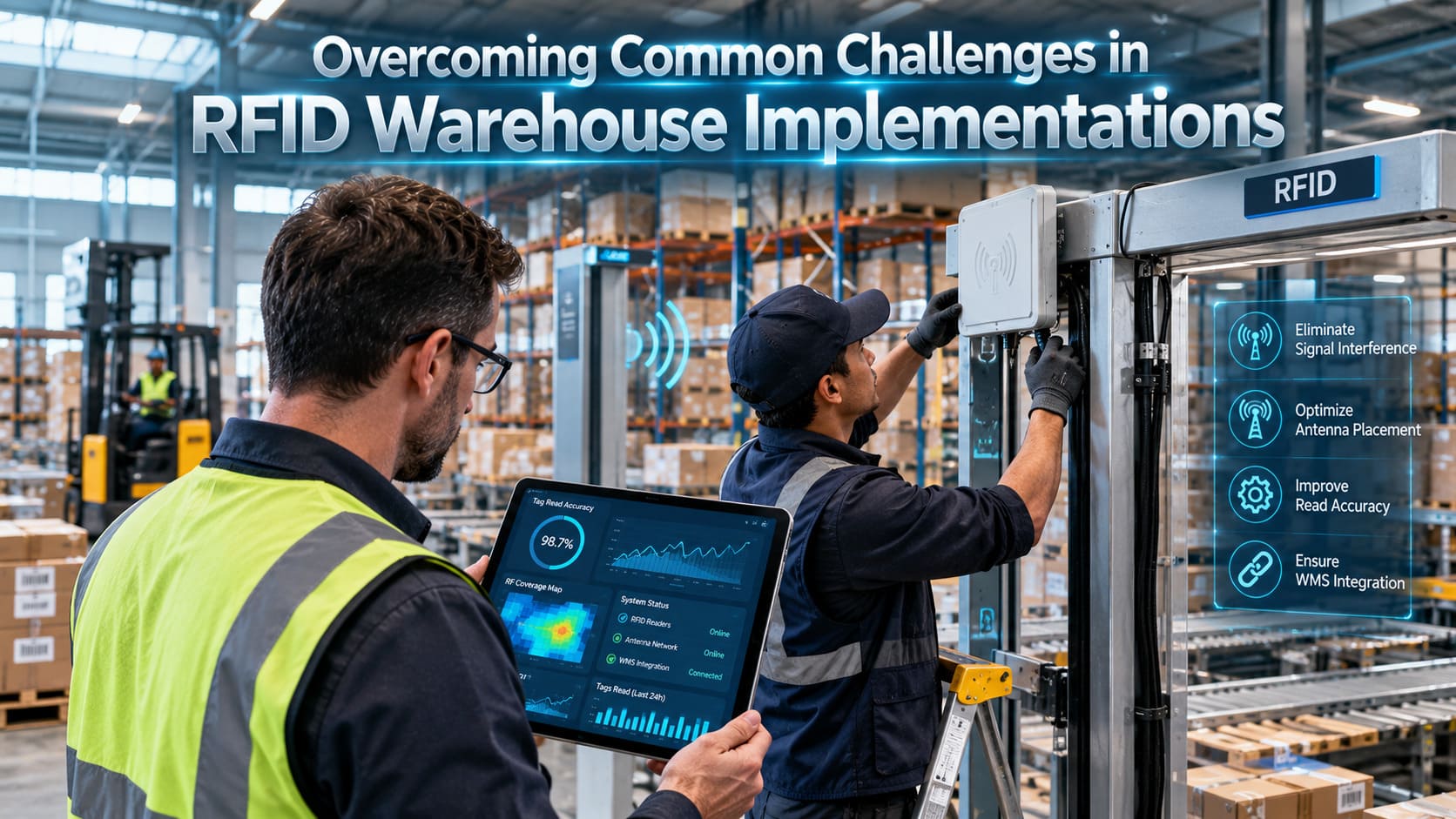
The benefits of Radio Frequency Identification (RFID) technology in warehouses are numerous and can revolutionize their operations by offering improved visibility, automated tracking, and precise item-level information. Implementing RFID is not as simple as just putting the readers in place and putting the tags on.
There are a number of issues with tags that can be encountered in the warehouse, such as tag readability, tag interference, tag integration, adoption and buy-in from employees, cost, and changes in the process.
Businesses can make an RFID system work for them and realize the operational benefits they desire if they know what these challenges are early in the design phase.
Selecting the Right RFID Tags
The first hurdle is to choose the tags that can be used consistently for the products and conditions to be monitored. The performance of RFID may vary with respect to different materials. Radio-frequency signals can be absorbed or reflected by metal surfaces, liquids, dense packaging, and some chemicals.
For instance, a basic passive UHF RFID tag can be effective on cardboard boxes, but is ineffective if directly adhered to the metal parts of a piece of equipment or a liquid-filled container.
Tips:
- Test tags on the product to be deployed.
- Consider using specialized tags—on metal or high-performance—if needed.
- Assess read distance, orientation, durability, and environmental conditions.
- Don’t choose tags on the basis of the unit price.
- Dealing with Accuracy
While 100% read accuracy can be achieved with RFID, it is not guaranteed. Sometimes the reader may read the tag out of the reading zone or fail to read the tag due to orientation, interference, shielding, or tag density.
It’s important to keep in mind that for warehouse doors and conveyor systems, a large number of tagged items might go through a reader at a single time.
Read-zone engineering is required for a reliable implementation. Placement of antennas, power levels, reader configuration, shielding, and/or positioning of tags should be evaluated in actual operating conditions.
Managing RF Interference
There are many possible sources of interference in warehouses, such as machines, wireless devices, metal shelving, electrical infrastructure, and other RFID readers. Also, unpredictable signal patterns can develop from reflections off metal surfaces.
In addition to increasing the power of a reader, enterprises should determine the reason for inconsistent reads.
Helpful Approaches Include:
- Pre-installation mapping of reader coverage.
- Experiment with positions of the antenna.
- Variations in reader power and/or sensitivity.
- Applying shielding as required.
- Changing overlapping read areas.
- Performance monitoring following equipment changes or layout changes.
- Integrating RFID with Existing Systems
Another big challenge is the integration of the RFID data into warehouse management systems (WMS), enterprise resource planning (ERP) systems, inventory systems, and other business applications.
The RFID reader may produce a lot of data, but the raw tag read data is not always valuable. Businesses require software that converts all of those reads into actionable events, like when they’re shipped or moved, or an order is completed.
Integration should thus be designed in the planning of the project and not as an afterthought in terms of technology.
Handling Large Volumes of Data
The amount of information available to a warehouse team can be greatly enhanced by the use of RFID. A potentially new timestamp, location, reader identifier, and tag ID may be generated for every read.
If not filtered and managed properly, organizations can wind up with a lot of unnecessary or duplicate information.
Good RFID architecture should differentiate between “reads” and “business events. The middleware can filter out duplicate reads, identify movement patterns, and pass pertinent data to the WMS or ERP system.
The learning and adoption of the employees
Employees must be taught how and why to use technology in order to solve warehouse problems. Initially, workers might be concerned that the deployment of RFID will add to their workload or add to monitoring.
Training should be oriented towards real-world gains – such as speeding up manual scanning, cutting down on inventory searches, and faster receipt, shipping, and other tasks.
Staff should also be encouraged to report issues in the pilot phase. Operational implications can be discovered during their day-to-day experience, which may not be apparent during technical testing.
Understanding the Value of Your Business
Costs associated with the implementation of RFID may include the cost of tags, readers, antennas, middleware, software integration, installation, maintenance, and employee training.
The error lies in looking at the price of the hardware only when considering the cost of RFID. Rather, companies should add up the potential cost savings from better inventory accuracy, less labor, fewer shipping mistakes, quicker receiving, and lower shrinkage.
Consider a well-defined use case where there is a measurable value for RFID.
Design around warehouse processes
Dedicated to supporting existing workflows, not being added on without taking into account the actual way things are moving through the facility.
Be able to identify key stages of processes such as:
- Receiving
- Put-away
- Picking
- Cycle counting
- Packing
- Shipping
- Returns
Determine and fix points of manual scanning, data entry, and stock delays. These could be the best places to start implementing RFID automation.
Sustaining the Controlled Pilot
When there are no technical and operational issues identified, the full rollout of the warehouse can be potentially dangerous. The pilot process allows tags, readers, software, workflow, and employee procedures to be tested under realistic conditions.
Record performance metrics such as read accuracy, inventory accuracy, processing time, labor needs, and exception rate.
When the system is consistently working, slowly increase the level of exposure.
Here are Some Tips to Make Your RFID Implementation More Successful
These are the best practices to take into account when undertaking an RFID warehouse project:
- Write a business problem statement first. Avoid using RFID just because it can be done.
- Evaluate products in actual use. Laboratory data is not necessarily an accurate representation of the warehouse results.
- Incorporate warehouse personnel in the early stages. Their feedback can be used to enhance the workflow design.
- Integrate with existing systems. Don’t build another siloed data platform!
- Measure results continuously. Have clear KPIs to see if RFID is providing value.
- Plan for scalability. Further product lines, more readers, and greater data volumes should be investigated.
- Think of the process change as RFID. It will not simply be a case of hardware providing the benefits.
The best way to go is to start with an operational problem, experiment with RFID in the real-world warehouse, make adjustments based on a controlled pilot, and then expand only once success has been demonstrated in measurable terms. Combined with technology, processes, people, and software, RFID can be a strong base to create a more efficient connected warehouse.
FAQ
- What are some common challenges when implementing RFID in a warehouse?
Common challenges include RFID tag selection, achieving read accuracy, RF interference, RFID integration with WMS or ERP, huge volumes of data, employee training, and cost.
- How can we improve RFID read accuracy?
Warehouses can maximize read accuracy by conducting tests with RFID tags on the actual products, fine-tuning the antenna placement, reader settings, RF interference, and RFID read zones. It is critical to perform a pilot test before implementing an RFID system in a warehouse. A company should identify business processes that need improvement and set priorities concerning RFID technology.
- How can a business maximize the ROI of an RFID warehouse system?
A business should consider the value of inventory, labor, receiving, order accuracy, and shrinkage. These factors will help a company evaluate whether the RFID system will bring the expected benefits.