For companies that rely on quick and efficient order processing, warehouse accuracy is crucial. A slight difference in inventory can lead to major issues, such as late deliveries, order inaccuracies, stock shortages, wasted manpower, and customer dissatisfaction.
Many traditional warehouse management systems (WMS) use periodic inventory counts and manual data entry or barcodes for scanning products. These methods still work but are not efficient when dealing with high-volume warehouses that receive, store, pick, and ship thousands of items daily.
What is an RFID Warehouse Management System?
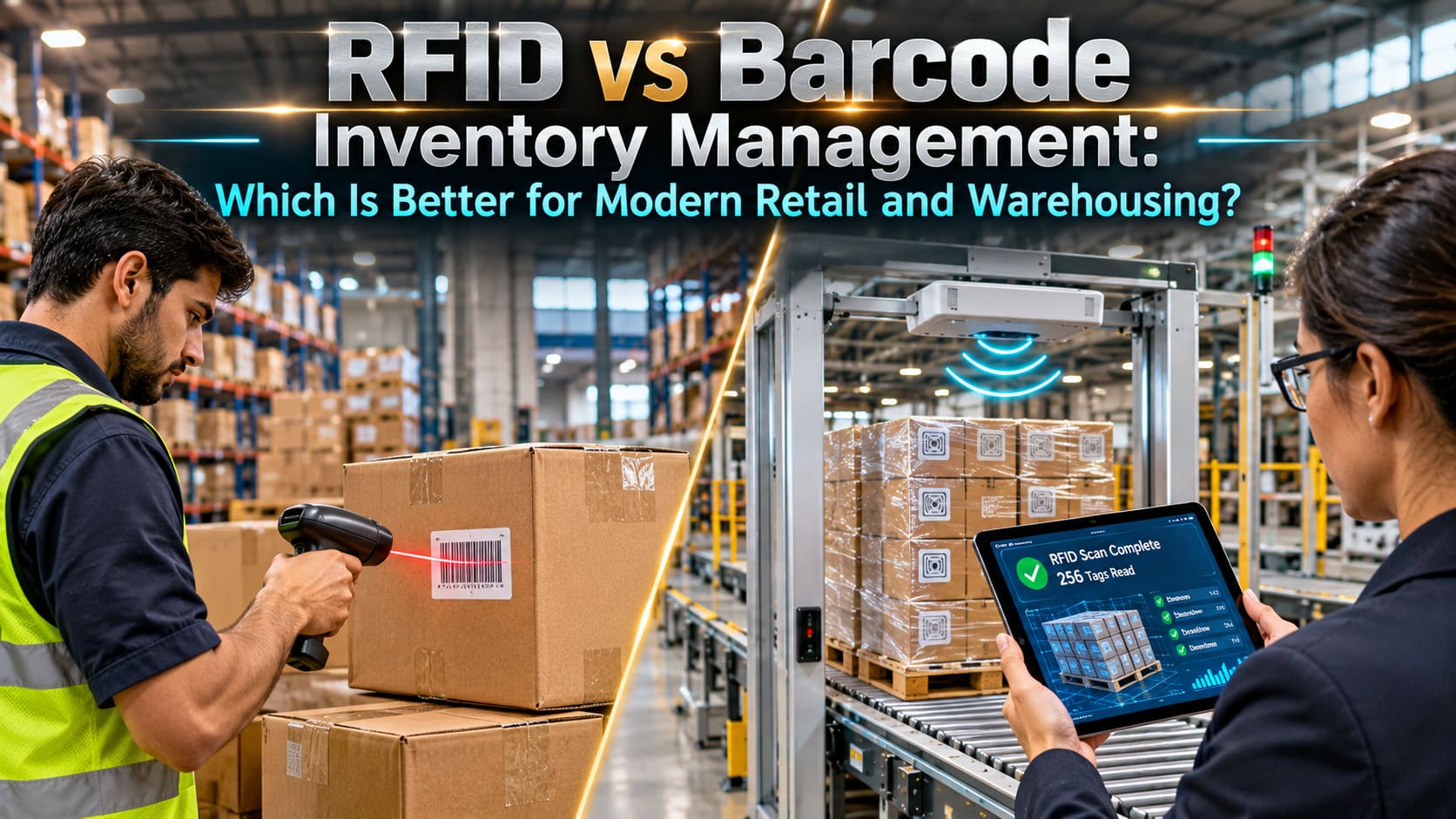
RFID warehouse system is a combination of RFID technology and warehouse software to help identify, track, and manage warehouse inventories.
There are generally the following components in a system:
- RFID tags: Tags that are small electronic devices attached to products, cartons, pallets, or reusable containers.
- RFID readers: Devices that broadcast radio frequencies and can receive information from the tags.
- The reading zones are created with antennas and assist in the collection of tag information.
If a tagged product comes within the reach of the reader, the reader reads the identification information of the tag. This information is then compared to expected inventory information, and the corresponding transaction is updated by the WMS.
Automated Shipment Verification
It can identify:
- Missing cartons.
- Unexpected and duplicate shipments.
- Incorrect product identifiers.
- Quantity discrepancies.
- Products received for the wrong purchase order.
This decreases the need for manual counting and increases awareness for the receiving team to look out for discrepancies before inventory moves to storage.
Improved Handling of Receiving Exceptions
RFID is not a substitute for inspection. It, however, assists warehouse personnel to concentrate on the exceptions.
For instance, if it identifies 96 cartons instead of the 100 expected, the system can mark the shipment for review.
These are the things employees can then look for:
- Cartons that were not unloaded.
- Damaged or unreadable tags.
- Incorrect supplier labeling.
- Products that may need to be manually verified.
A receiving tolerance policy is a practical tip. Establish procedures for discrepancies between the accounts that need to be investigated right away and those that can be addressed with regular reconciliation.
This reduces unnecessary delay in the receiving dock and minor data issues.
RFID is used to enhance picking accuracy
Customer satisfaction, fulfillment costs, and warehouse productivity are all directly impacted by picking accuracy.
A picking error is when an employee chooses the wrong product, quantity, size, color, or inventory location.
Real-Time Inventory Visibility
An RFID-enabled WMS can track the inventory by reading the identification events from the readers.
The system can be updated when inventory is received, moved, picked, or replenished.
This can help the warehouse employee identify the right product and minimize the chance of picking from the wrong location in the warehouse.
For instance, a warehouse employee may be instructed to pick a particular product from bin A-12.
RFID-Based Pick Verification
RFID can also confirm that the appropriate merchandise has been picked for an order.
Suppose that you have an order with 5 different products.
The RFID reader reads the tag IDs as the employee picks up the items. The WMS then checks the captured IDs against the order requirements.
The system can alert the employee if the employee selects the wrong product before the order is dispatched to packing.
This is particularly beneficial for warehouses that store:
- Similar-looking products
- Multiple product sizes and variations
- High-value inventory
- Many lines of order
- Fast-moving e-commerce orders
Minimizing Picking Errors with Automated Validation
RFID verification can be combined with picking carts, handhelds, conveyor systems, or designated reading stations.
Picking carts fitted with RFID tags, for instance, could be in a warehouse with compartments for each individual order.
The system can check whether products placed into each compartment are valid and determine missing or incorrect items, and will alert the user.
This provides an extra check without the need to scan each barcode by the employee.
Supporting Batch and Zone Picking
Advanced picking strategies can also be improved with the use of RFID.
- Batch picking: Staff member picks items for multiple orders at one time. If using RFID, it can be used to confirm the product type for each order.
- Zone picking: Products are collected from specific areas in the warehouse. RFID can aid in inventory visibility and validate transfers of inventory between zones.
- Order picking: Orders are issued in blocks of orders. RFID can be used to match the product picked with the wave requirements prior to packing.
Practical tip: Implement RFID verification at the greatest risk location for picking errors. In the case of high-value goods, this might involve double-checking all picks. If it’s a low-risk product, verification at the picking cart or packing station might be all that’s needed.
Enhancing Shipping Accuracy by RFID
The last chance to catch warehouse mistakes before they get to the customer is shipping.
Inaccurate shipments can result in significant expenses since the company may have to return the item, replace it, refund the customer, or send it back again.
When a shipment is to be made, it can be validated with RFID to ensure that the correct stock-outs are being made, thus increasing the accuracy of the shipment.
Automated Outbound Verification
The RFID readers can collect the tag ID data of tagged pallets or cartons before they are sent out from the warehouse.
The WMS cross-checks the items with the shipment manifest or customer order.
This helps identify:
- Items given to a customer that should have been assigned to another
- Missing cartons
- Extra products
- Incorrect pallet contents
- Shipments placed on an incorrect truck
An example of that is that if you are shipping 50 cartons, but the RFID portal is only seeing 48 of the expected carton IDs, the system can mark the shipment before it goes out the door.
Staff can check out the discrepancy and make the correction to the shipment.
Preventing Wrong-Order Dispatches
In high-traffic distribution centres, several orders can be queued close to various loading docks.
Even if the shipment is packed properly, it is possible to put the wrong shipment in the wrong vehicle if there is no way to verify.
The validation of the relationship between the shipment, loading area, and the designated transportation path can be achieved using RFID.
The WMS can then check the contents of the tagged shipment against the planned shipment information when the shipment passes through the designated reading zone.
The system can raise an alert if the shipment is related to a different route.
Improving Proof of Shipment
The data on an RFID event record can be used to include other data regarding the time the tagged product has moved past a shipping checkpoint.
These records can be used for shipment reconciliation, investigation of operations, and inventory movement audits.
But an RFID read is not conclusive evidence of delivery to the customer. You might need carrier tracking, ePoD, or proof of delivery records for delivery confirmation.
Useful hint: Locate the RFID verification as near as possible to the actual loading point. This decreases the likelihood of a shipment being altered after it’s been verified.
Real-Time Inventory Accuracy is enabled through RFID
Accurate inventory is critical to the receiving, picking, and shipping process.
When 20 units are listed on the WMS system, but only 12 are actually available, employees could waste time looking for the missing inventory and/or place orders that cannot be delivered.
RFID technology contributes to improving inventory accuracy by identifying inventory more frequently and automatically.
Continuous Inventory Reconciliation
Conventional cycle counting involves reading out the inventory in selected locations by employees.
RFID can be used to aid in quicker inventory checks with handheld readers or stationary infrastructure.
In a location, employees can scan several different tagged products without having to scan each individual barcode.
The WMS can compare detected inventory vs. quantity recorded and alert to discrepancies for investigation.
Better Inventory Movement Tracking
This may help to minimize the risk of mistakes associated with:
- Unrecorded putaway activities
- Incorrect replenishment transactions
- Items that are placed in the wrong waste bin
- Any inventory moved inter-zone without updating records
The reading zones and event rules have to be carefully developed to ensure a reliable location-tracking process. RFID readers installed throughout a warehouse do not necessarily provide accurate location data.
How Powered by AI, RFID technology enhances warehouse safety and compliance?
RFID can enhance the accuracy and lessen the effort involved in maintaining accurate inventories.
Less Picking and Shipping Errors
Wrong orders result in additional picking-related expenses.
Additional labor in the warehouse, customer service, replacement products, and return shipping fees may be incurred by the business.
These unnecessary costs can be mitigated thanks to RFID, which can identify the errors earlier.
Reduced Manual Scanning
Multiple tags can be read at once with RFID.
This could save time for employees to scan each barcode during receiving, stocktaking, or shipping goods.
Actual savings will vary based on warehouse design, tag placement, transaction count, and amount of automation.
Better Labor Productivity
If stock information is more accurate, staff don’t need to waste so much time looking for items that are missing or investigating discrepancies that have no explanation.
Warehouse workers can dedicate more of their time to productive activities such as receiving, replenishment, picking, and dispatch.
Reduce Inventory Carrying Costs
Enhanced inventory visibility will enable businesses to make better replenishment decisions.
If records are correct, businesses might not be so inclined to carry excessive safety stocks in anticipation of uncertainty.
While RFID can’t solve the problem with excess inventory, it can give better information for inventory planning.
Best Practices for Implementing an RFID Warehouse Management System
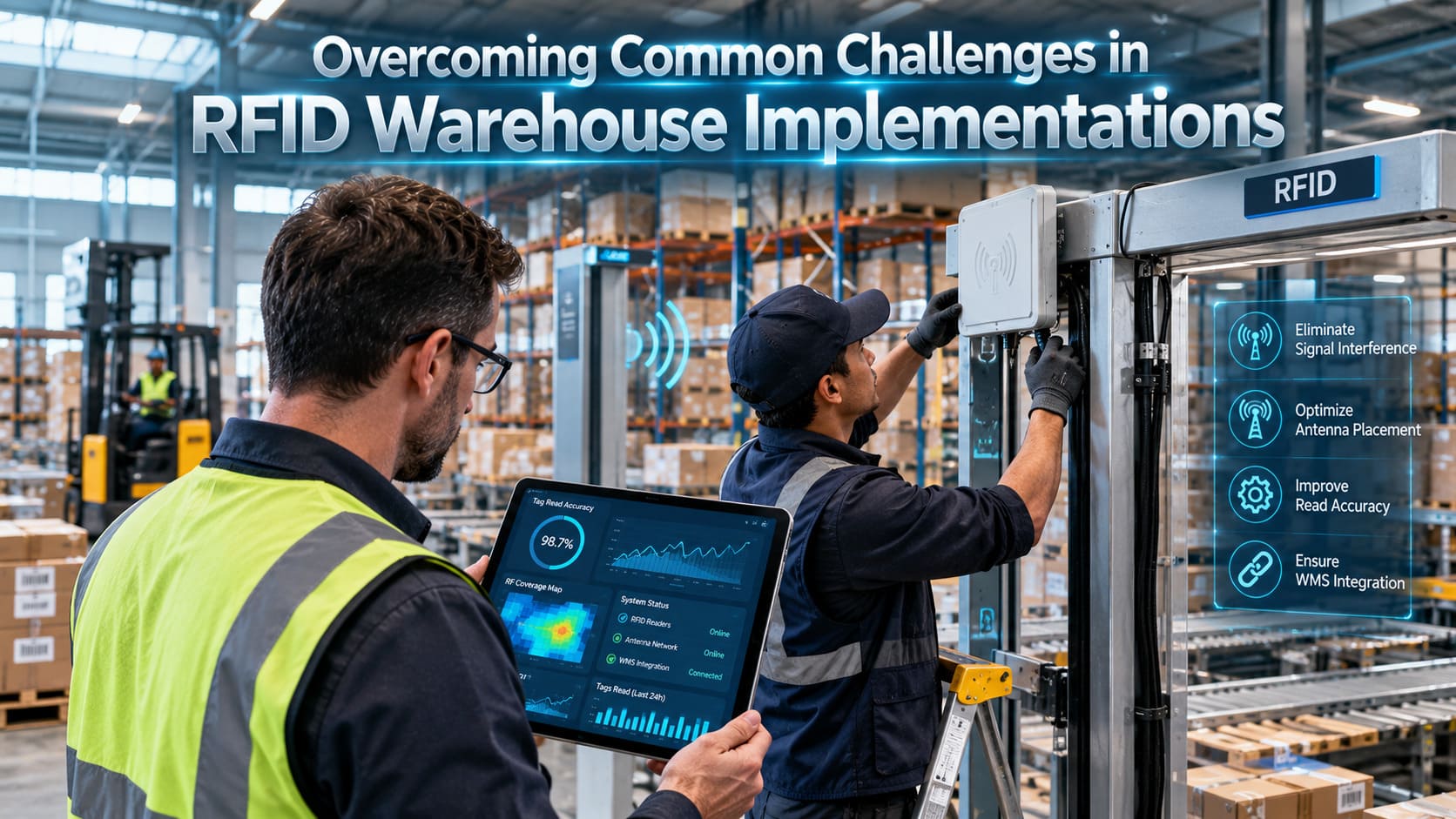
Implementing RFID isn’t as simple as buying tags and readers. To get to significant accuracy improvements, businesses must have a clear deployment strategy.
Start with a Defined Business Objective
Determine the warehouse process that poses the most risk
Examples include:
- Calculating deviations from the other person due to human counting errors by both parties
- Selecting mistakes with similar products
- High-volume shipping centres with incorrect deliveries
- Replenishment inaccuracies in inventory
It is easy to determine the value of RFID if you have a definite goal
Choose the Right RFID Tags
The frequency, read range, durability, and applicability of RFID tags for various products differ.
Passive UHF RFID is widely used in the warehouse and supply chain for identification, as it is able to provide a relatively long-range and bulk identification.
But there are materials like liquids and metal that may impact performance.
Before choosing a tagging standard, businesses should test the tags on real products, packaging, and pallets.
Design RFID Reading Zones Carefully
RFID can assist with verifying receipts, assisting product verification, and increasing accuracy of inventory during the picking process. It can also help verify that the correct items are being allocated to the correct order and transport during shipping.
This can also assist with inventory verification, increasing productivity and improving decision-making.
The best way for a business to improve its warehouse performance is to implement RFID technology in combination with a reliable WMS integration, well-planned reading areas, staff training, and performance targets.
If implemented strategically, RFID can help change a manual verification warehouse into an automated, transparent, and accurate supply chain.
With RFID integrated into your warehouse management software, optimal read areas, and staff training, you can avoid human error, improve efficiency, and create a more efficient, reliable, and accurate supply chain.
FAQ
How to improve RFID warehouse receiving accuracy?
RFID enables automation of identifying incoming stock and matching it to purchase orders or advance shipping notices. It can help identify any missing, incorrect, or unexpected items. This helps to reduce manual data entry errors.
Can RFID improve picking and shipping accuracy?
Yes. RFID helps to ensure that the correct items have been picked by verifying they match a customer’s order. It also helps to ensure the correct items are being shipped out by verifying they match the shipping manifest. This helps to reduce incorrect items, missing boxes, and incorrect orders being dispatched.
What are the benefits of using RFID in warehouse management?
RFID helps improve visibility of stock. It reduces manual scanning within the business and increases receiving and picking speed. This helps reduce errors within the process, improve employee productivity, and reduce costs from incorrect shipments.