RFID could change the way inventory is handled, assets are seen, the supply chain is made more efficient, and how control of operations is exercised. The combination of installing RFID readers and attaching tags is not RFID-ready.
Enterprise-scale RFID is more likely to be successful if technology, processes, people, and data are ready for use, and if leadership is in place. Without this maturity assessment, organizations may experience unreliable reads, disjointed systems, unclear ownership, and underwhelming ROI.
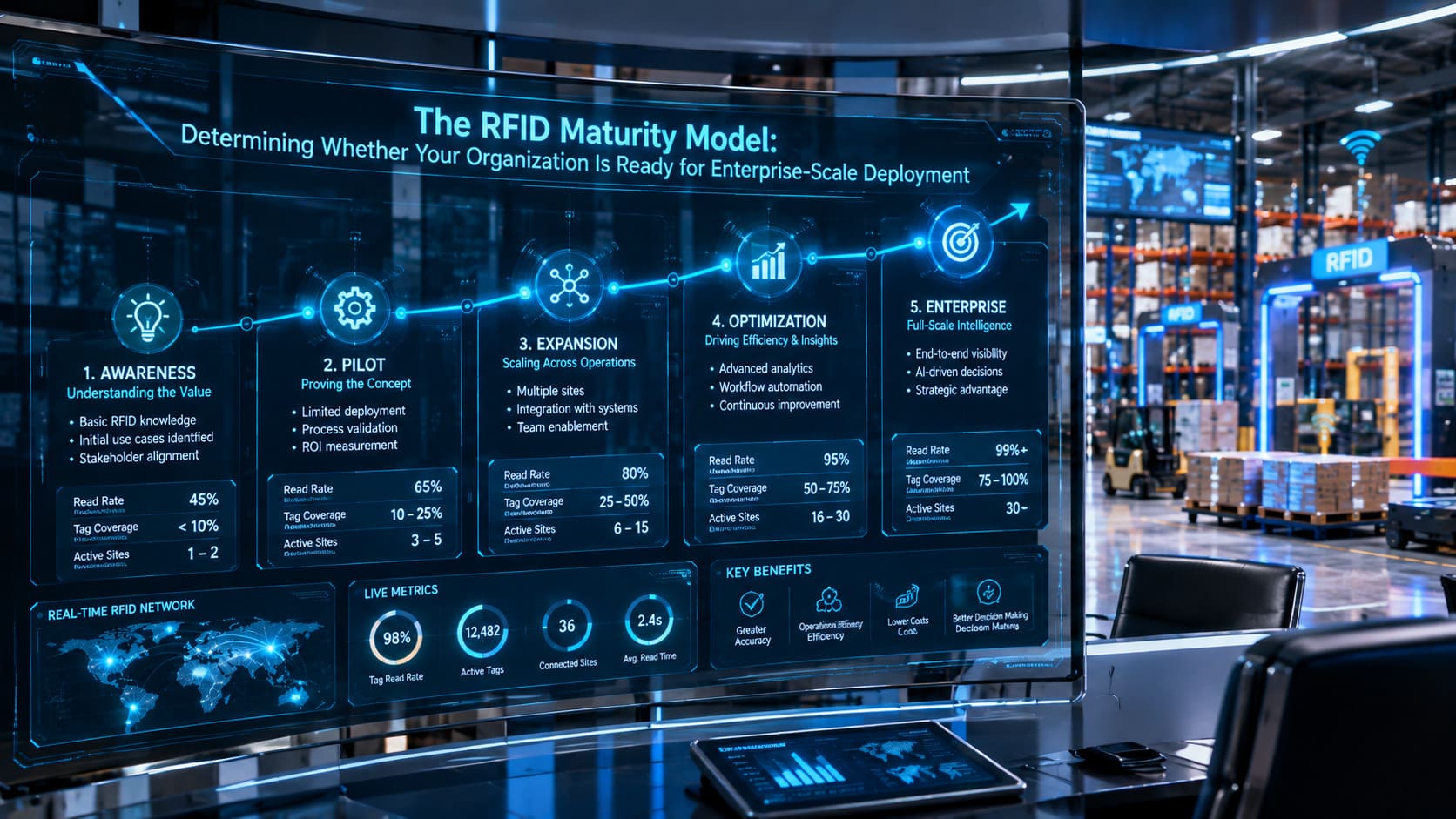
A practical RFID maturity model can assist businesses in assessing their current position and what more needs to be done in order to move to the next stage of the journey.
What is an RFID Maturity Model?
The RFID maturity model is a process that assesses an organization’s RFID readiness and readiness to scale RFID technology.
- Rather than asking “Can we install RFID?”, it’s asking “What is the best way to install RFID?”.
- Do our business processes have a standard?
- Are our data credible?
- Is there an overlap to integrate RFID information into existing systems?
- Do employees have the readiness to adapt to process changes?
- Is it possible to calculate the financial effects of RFID?
- Are leaders dedicated to the expansion of the program?
The answers reveal whether it’s a company conducting experiments with RFID or if it’s actually prepared to deploy it in the enterprise.
Level 1: Manual and Barcode-Dependent
In the initial phase, manual labor and legacy barcode reading are key critical points in operations.
Typical characteristics include:
- Manual inventory counts
- Paper-based workflows
- The use of barcodes in individual touchpoints
- Limited asset visibility
- Inconsistent data collection
- Minimal automation
RFID at this point has a lot of potential but can be too much complexity if implemented across the enterprise now.
Recommendation: First, determine a single problem that has high value, like inventory accuracy, asset loss, or receiving delays.
Level 2: RFID Pilot Stage
The organization starts to test RFID in some controlled environment.
A pilot could be interested in:
- One warehouse
- One retail location
- A particular type of product
- A manufacturing line
- High-value equipment
The goal here is not just to demonstrate the tag-reading capabilities. The organization must first decide if a measurable business process can be enhanced by the use of RFID.
Some key pilot indicators could be:
- Read accuracy
- Inventory accuracy
- Labor hours saved
- Processing time
- Shrinkage reduction
- Asset utilization
- Exception rates
If a pilot is successful, there is evidence to support additional investment.
Level 3: Operational Integration
Now RFID is a regular part of the way things get done, not an experiment in independently running technology.
RFID data is beginning to be fed into systems like:
- Warehouse Management Systems (WMS)
- An Enterprise Resource Planning (ERP) platform
- Inventory management software
- Manufacturing execution systems
- Retail platforms
- Asset management systems
This is a pivotal maturity stage given that there is a significant amount of event data generated as part of RFID. Without this information getting to the systems that the employees use, it will have limited value.
Fundamental need: Set up standard rules for identifying tags, data access, event handling, and exception handling.
Level 4: Multi-Site Deployment
An organization is at this stage when it has proven RFID’s effectiveness and starts to start applying it across a number of facilities or locations.
Scaling, however, is a new challenge.
There may be different locations with:
- Different layouts
- Different workflows
- Different network infrastructure
- Different equipment
- Different employee practices
Standardization becomes essential.
Enterprises should establish enterprise RFID standards on the following aspects:
- Approved tag types
- Reader configurations
- Naming conventions
- Data formats
- Integration requirements
- Installation procedures
- Maintenance responsibilities
- Security policies
If no standards are in place, each new deployment can be considered a custom project, which will drive up costs and decrease consistency.
Level 5: Enterprise-Scale Optimization
The most advanced organizations use RFID as more than just a tracking solution as an operational data platform.
RFID information can be used in higher-level analytics and automation, such as:
- Predictive inventory management
- Automated replenishment
- Asset utilization analysis
- Supply chain optimization
- Process-performance monitoring
- Loss prevention
- Automated alerts
- Digital workflow triggers
At that stage, organizations can integrate other technologies, such as IoT sensors, analytics platforms, artificial intelligence, and real-time location systems with the RFID data.
The objective shifts from “Where is the item?” to “What do we need to do based on what the item is doing.
The Five Readiness Areas are organized under the following headings:
The Five Readiness Areas
Technology Readiness
Determine if your infrastructure can accommodate RFID.
Consider:
- Reader placement
- Antenna configuration
- Network connectivity
- Tag performance
- The use of metal and liquid interference.
- Software integration
- Environmental conditions
The performance of RFID systems can range significantly based on the physical conditions. Lab success does not necessarily equal warehouse or manufacturing success.
Process Readiness
RFID should enhance an existing process; it should not just automate a poorly designed process.
Record existing processes and:
- The place where items are received
- The location of the storage
- Where they move
- Where errors occur
- In areas where employees are counting manually
- Where knowledge goes astray
Next, figure out just where RFID can eliminate unnecessary steps.
Data Readiness
Enterprise RFID requires reliable, accurate data.
Organizations should establish:
- Unique asset identifiers
- Product master data
- Location identifiers
- Event definitions
- Data retention policies
- Data ownership
Master data is a critical capability that can derail an otherwise great RFID implementation.
People Readiness
Staff members must be aware of how the RFID technologies impact their jobs at work.
Provide training covering:
- New workflows
- Exception handling
- Reader operation
- Tag placement
- Troubleshooting
- Data interpretation
State the “business need” for the change. Armed with a clear understanding of how RFID will help them avoid repetitive tasks, employees will be more likely to embrace RFID.
Financial Readiness
Don’t measure RFID success using technology metrics alone.
Construct a full business plan with the following elements:
- Tags
- Readers
- Antennas
- Software
- Integration
- Installation
- Training
- Maintenance
- Infrastructure
- Labor savings
- Inventory improvements
- Loss reduction
Consider ROI over a number of years, not just the hardware cost.
These are Some of The Indicators That You Are Not Ready Yet
If an organization requires extra preparation, it may be because:
- Inventories don’t always match what they show.
- The processes of the business differ from one place to another.
- There is no owner of RFID data.
- It is difficult to integrate RFID events into existing systems.
- There are no measurable criteria for success in the pilot.
- Staff have not been involved in planning.
- Leadership believes that RFID will cure all operational ills.
- There is no apparent financial gain for the business.
These do not justify rejecting RFID. They are indicators of the need for basic work to occur first.
Hints for Moving Up the Maturity Curve
Be small: Pick a process where RFID can make a difference.
Define KPIs: Make sure you have clear metrics for success before buying lots of equipment.
Test the environment: Test tags and readers in an actual environment.
Include staff: Seek input from those who will be using the system.
Plan for integration from the outset: think ERP, WMS, and other systems.
The readiness of an enterprise for RFID technology is not dictated by how much hardware it can afford to purchase. It is defined by whether the business has the processes, infrastructure, data, people, integration capabilities, and financial justification in place to turn RFID signals into useful operational information.
The maturity model offers a concrete roadmap: from manual processes to controlled pilot programs, RFID integration, RFID standardization across multiple sites, and finally to intelligent utilization of RFID data to drive automation and optimization.
The most pragmatic organizations are not rushing to adopt enterprise-level RFID systems. They are building the needed capabilities to make such adoption sustainable and subsequently capitalizing on the opportunities it creates.