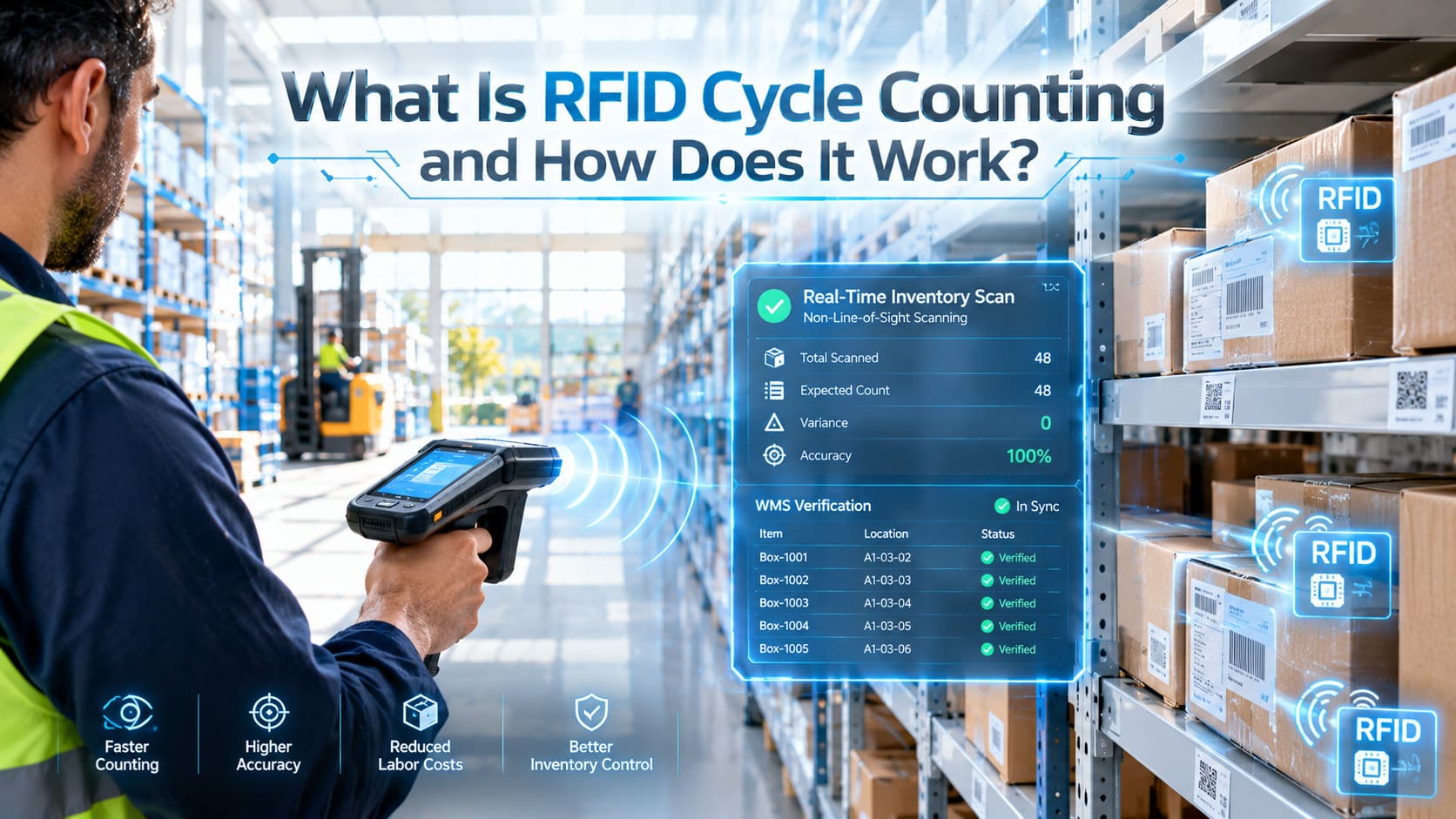
RFID has the potential to revolutionize the way businesses track inventory, assets, products, and operations. However, just putting in RFID readers and tags isn’t necessarily the answer to better efficiency. The most frequent error companies make is employing RFID to resolve the wrong problem, at the wrong priority, and not one that is really a lack of identification and visibility.
When establishing an RFID system, a fundamental question that needs to be asked is: what problem are we trying to solve?
When the answer is not clear, even high-level RFID systems can turn into an expensive technology project with little operational value.
RFID is a Tool, Not the Problem
Radio frequency identification (RFID) technology identifies and tracks objects via software, tags, readers, and antennas, without the need to scan them directly.
This can be used for applications like:
- Inventory counting
- Asset tracking
- Warehouse visibility
- Retail replenishment
- Manufacturing traceability
- Shipment verification
- Cold-chain monitoring
- Loss prevention
But RFID does not magically solve issues of inaccurate processes, inventory policies, inadequate staffing, or disconnected systems.
For instance, if the warehouse is not properly organized, employees spend hours looking for stock; RFID can help to increase visibility, but it will not actually address the issue of inventory storage.
The Wrong-Problem Trap
There are many common RFID pitfalls that businesses can fall into.
The First Step Is to Begin with The Technology
A company may learn about RFID technology and know that within a few minutes, hundreds or thousands of items can be scanned, and decide to implement it.
Starting with an operational problem is better, and then measure it.
Instead of asking:
Where might we use RFID?
Ask:
What am I wasting time, accuracy, money, and visibility on?
This technology should then be tested with that problem.
Attempting to correct bad data through more tracking
The benefit of RFID is that it can efficiently capture information about the identity of items, but if the information to be captured is not accurate, it is useless to the benefit.
SKUs that are wrong, duplicate records, missing locations, or out-of-date databases can destroy the potential benefits of RFID.
Before implementation, review:
- The accuracy of the SKUs and item master.
- Location data
- Product labeling
- Existing barcode information
- Inventory records
- The integration of ERP or WMS.ERP or WMS integration.
Inaccurate data cannot be improved through better identification.
Measure Scans Rather Than Business Outcomes
The success of a project can be judged by the number of RFID tags that can be scanned by the RFID readers in a single hour, which reached thousands in this project.
However, speed of scanning is not the business goal.
The crucial questions are:
- How did inventory accuracy improve?
- Were the labour needs reduced?
- Did stockouts decline?
- Did they become faster when they received it?
- Did it improve the accuracy of the order?
- Was there any growth in asset utilization?
- Were products delivered earlier to the customers?
RFID metrics should be directly linked to operation and financial results.
First, name the Real Pain Point
Map the current workflow prior to choosing RFID equipment.
Record the process from receiving through storing to picking, shipping, and reconciling.
Identify particular bottlenecks, including:
- Manual counting
- Repeated barcode scanning
- Missing inventory
- Slow receiving
- Misplaced assets
- Shipping errors
- Poor inventory visibility
- Frequent cycle-count discrepancies
Next, make an estimate of the costs for each problem.
For instance, if hundreds of employees are counting stock in the warehouse monthly, then it would make sense to implement RFID to automate this task if it involves high volumes of stock.
Choosing the Right RFID Solution
Where businesses need to quickly identify a lot of items multiple times, RFID can be very helpful.
It can be useful if:
- The data points need to be counted in bulk: RFID can read multiple tagged items as opposed to hundreds of barcodes.
- Objects are moving frequently: Companies can establish visibility at receiving docks, production points, storage points, or shipping points.
- Inventory accuracy is important: Frequent and effective counts can help you gain a clearer view of the discrepancies.
- Finding assets is a challenge: With RFID, it’s easy to learn where assets were last seen.
- Manual execution is costly: Automation of repetitive identification processes can save on labor requirements and increase productivity.
When RFID Can’t Solve Your Problem
RFID may not be the appropriate first investment if the real issue involves:
- Poor warehouse layout
- Incorrect inventory policies
- Inadequate employee training
- Weak demand forecasting
- Poor supplier performance
- Inaccurate product data
- The lack of standardization in processes.
- Software limitations that are not related to identification.
In such cases, process improvement can occur either prior to or during the deployment of RFID.
Take a Holistic Approach to the RFID System
RFID is more than just a tag attached to a product.
In a successful deployment, the following elements are in play:
- Tags-Tags are attached to a product, case, pallet, or asset.
- Readers-Capture information from the tag.
- Transmitters-Send signals to antennas. Receivers-Receive signals from antennas.
- Middleware-The processes and filters that are used to capture information.
- Business software Integrates RFID data with ERP, WMS, POS, or other applications.
- Operational processes-Identify how employees use the information.
A weak link in the chain can mean that the system as a whole might not provide the value promised.
Tips for Avoiding an RFID Misstep
If you are thinking about embarking on a significant deployment, take your time to think about these practical tips:
- Identify one particular problem in detail.
- Set up baseline measures prior to implementation.
- Determine the present value of the issue.
- Select KPIs that are related to business outcomes.
- Do a pilot before scaling.
- Apply test tags to real products and materials.
- Assess the performance of reading in the real operating environment.
- Review integration with business systems.
Instruct staff prior to workflow changes.
Analyze the Process Following Implementation
A pilot should try out more than just whether tags can be detected. It should illustrate the changes in the business process that RFID is making.
Proactive Beyond Inventory Counting
While inventory accuracy is one of RFID’s more well-known applications, RFID can offer a company the benefit of knowing where an item is in real time or near-real time.
RFID data may be useful in facilitating:
- Automated replenishment
- Better asset utilization
- Faster receiving
- Improved order fulfillment
- Traceability
- Exception management
- Loss reduction
- More frequent verifications of inventory.
The most useful application might not necessarily be the one producing scans. It could be the one that helps with the business decision.
While there are great operational advantages to be gained from using RFID, it should be a tool for solving a problem rather than a problem in itself.
When a business has a clear pain point, measurable goals, real-world testing of the technology, and the incorporation of RFID data into the business workflow, the investment has a more solid basis.
FAQ
How can a business determine whether RFID is solving the right problem?
Start by defining particular issues that could be solved through the use of inventory control technology, such as inventory inaccuracies, time-consuming inventory counting, misplaced assets, or slow receiving processes. Measure goals and see if RFID technology could resolve or assist in resolving the problems.
Can RFID fix a poor inventory management process?
RFID technology may help in identifying goods, but aside from that, it will be unable to remedy issues such as inadequate warehouse organization, incorrect data, or lacking procedures. The issues should be addressed, and RFID should be implemented to see whether it may help the company.
What should you check before implementing RFID?
It may be vital to measure and track certain performance indicators to spot discrepancies and bring about improvements in the supply chain. Some of the crucial statistics include inventory accuracy, labor time, stockout percentages, speed of inventory receiving, order accuracy, and equipment utilization.