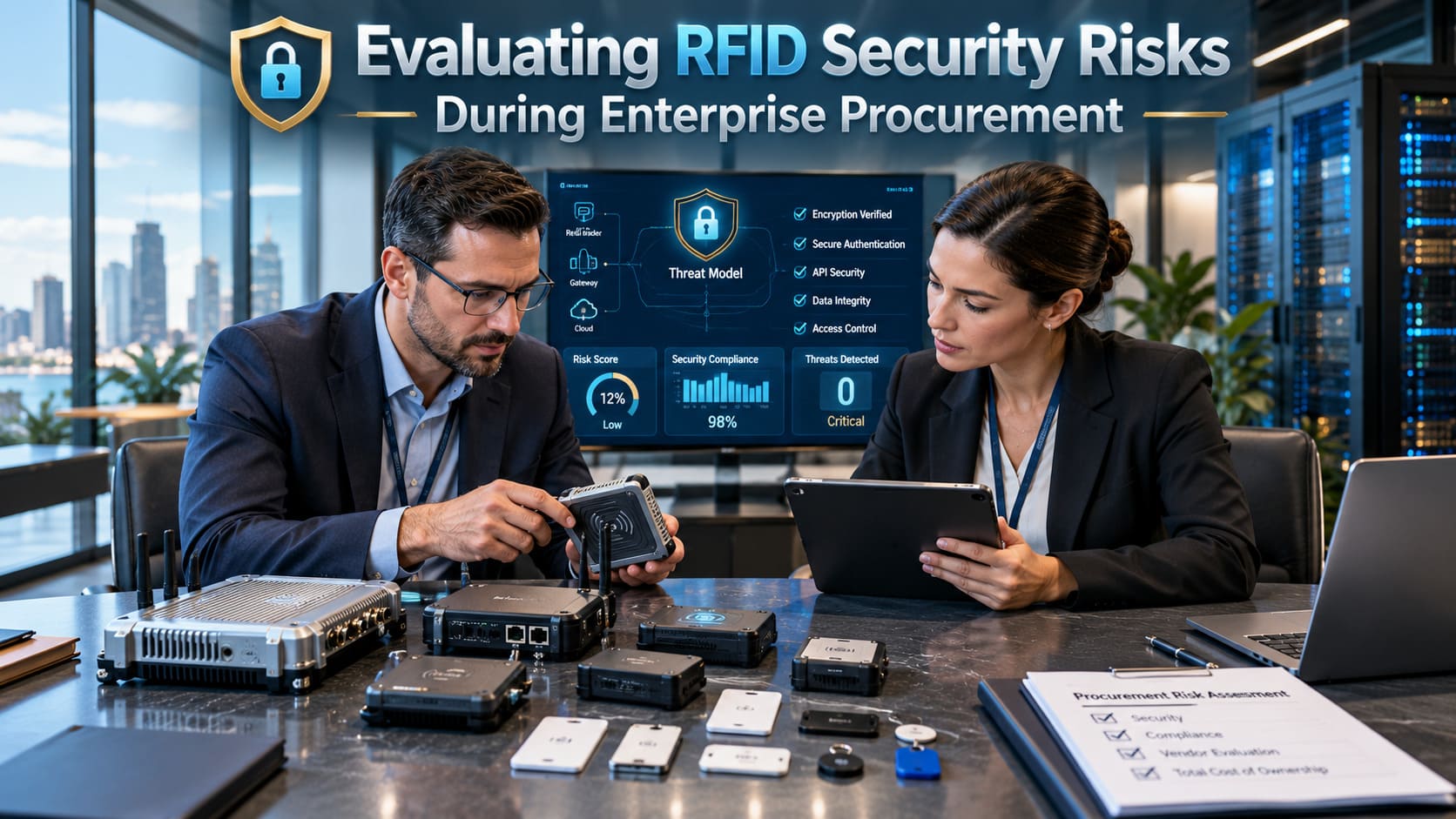
RFID has the potential to revolutionize inventory visibility, asset tracking, access control, and supply chain operations. However, in the world of enterprises, security is a second thought when considering RFID solutions. This can introduce tag data, reader, and system weaknesses, wireless communication weaknesses, and even physical tag weaknesses.
Thus, the procurement process should assess the security of the RFID equipment prior to purchase, rather than trying to make it secure after a large deployment. Awareness of the potential risks enables organizations to choose technology that meets their needs while optimizing functionality, security, scalability, and cost.
Why RFID Security Matters?
RFID systems automatically communicate information among tags, readers, middleware, and enterprise applications. That information can refer to products, assets, employees, locations, or events of operations.
An insecure RFID environment may result in:
- Unauthorized tag reading
- Data interception
- Tag cloning/spoofing
- Unlicensed Tag Information Change
- Tracking of people or assets
- Radio frequency interference (RFI) to the radio frequency identification (RFID) system.
- Bypass of interdependent enterprise systems
A warehouse inventory system’s security needs can vary from what’s required for staff access badges or healthcare items. Procurement teams must, therefore, consider risk based on the data and processes used in each business.
Identify the RFID Attack Surface
Define and understand the flow of information in the total RFID system before comparing vendors.
A common design could be:
The technology involves an RFID tag, an RFID reader, a wireless network, a middleware application, a database, and an enterprise application.
Every layer has its own set of security issues.
For instance, the tag itself can have less security than a reader or cloud platform, and it might not be as capable as a reader. However, if not set up correctly, a network-connected reader could also be a gateway into a larger business network.
Procurement teams should review:
- Secure and tag memory elements
- Reader authentication
- Wireless communication
- Network connections
- Middleware
- APIs
- Cloud infrastructure
- Databases and dashboards
- Administrative interfaces
Here are Some of The Most Common RFID Security Risks to Be Aware Of
Unauthorized Reading
Some RFID tags can be read without touching or apparent user intervention. If the tag stores sensitive information directly, its readers can access it.
If the data is sensitive, inquire with vendors whether their tags have features like authentication, access control, encryption, or secure memory.
Tag Cloning and Spoofing
The attacker can try to generate the identifier of a legitimate tag or tamper with the tag information. If the RFID system is used to decide whether to allow an asset to be accepted, released, or given access to the system, then cloning may be an issue of serious concern.
The system needs to be able to tell the difference between a proper tag and an illegal copy.
Eavesdropping
Depending on the technology and deployment environment, wireless communication between tags and readers can potentially be intercepted.
Security considerations will include whether sensitive information is sent over the air and the security provided for the communication between the reader, middleware, and enterprise systems.
Denial of Service
The operations of RFID can be interfered with by radio interference, manipulation of the reader, network attack, or even intentional obstruction.
If automated RFID identification is critical for a warehouse, it is necessary to have contingency measures when readers are unavailable.
Backend Vulnerabilities
RFID security doesn’t stop at the reader. Eventually, data is delivered to some software platforms and databases, which can include valuable operational information.
When the tags are secure, but the other devices or the cloud are not, RFID information can be compromised. RFID information can be made public even if the tags are secure, if the other devices are not.
Questions to Pose to RFID Vendors:
Security should be a part of the request for proposal process. Do not accept generic responses like “enterprise-grade security” from vendors, but request specific technical responses.
Important questions include:
- Which forms of authentication does it support?
- Are there any possibilities to encrypt or access-control tag data?
- What is a reader’s method of authentication?
- Which is the best method to update and secure firmware?
- Does the platform have role-based access control (RBAC)?
- Do APIs have authentication and security?
- What logging and audit options are there?
- How are bugs in security disclosed and fixed?
- What are the consequences of a device going out of use?
- Is there a central configuration of security settings?
Seek documentation and evidence as much as possible.
Evaluate Privacy Separately
Another area of privacy concern is that individuals or assets may be tagged with an RFID device, which may be used during employee, customer, or visitor identification or used for tracking objects.
Organizations should determine:
- What data can be recorded on tags?
- Who can read it?
- What is the lifetime of RFID data?
- Is it possible to trace people?
- Where is information stored?
- Who can have information on previous locations?
Data minimization may be helpful: only store information that the RFID system requires.
Here are some tips on how to purchase RFID systems safely:
- It is best to begin with the threat model. Describe the consequences of a tag, tag reader, or database being compromised.
- Don’t put unnecessary data on tags. An identifier might be more secure than including confidential business or personal data.
- Segment RFID networks. If possible, isolate RFID infrastructure from critical corporate systems.
- Require strong authentication. No default login credentials or shared administrative accounts should be used.
- Plan for updates. Security issues may arise once installed; therefore, vendors should offer a realistic firmware and software update procedure.
- Test before scaling. Test security and penetration on a safe test ground before rolling out thousands of devices.
- Plan for failure. Set up a protocol for lost tags, compromised readers, suspicious activity, and system outages.
- Security should be a procurement requirement. Make security a requirement in procurement.
While the technology contained in the RFID tags can offer tremendous value in the operation, security relies on more than the technology within the tag. All aspects of the radio communication process, readers, APIs, DBs, cloud, and administrative aspects need to be taken into account.
The best approach to procurement is to consider security in addition to read range, accuracy, scalability, integration, and TCO. Through in-depth questioning, testing of solutions prior to deployment, and planning for the entire technology life cycle, enterprises can mitigate risk while putting together a useful and resilient RFID infrastructure.
FAQ
- What are the main security risks involved in RFID systems?
Common risks include unauthorized tag reading, tag cloning, data interception, reader compromise, denial-of-service attacks, and vulnerabilities in connected databases, APIs, or cloud platforms. The security of the whole RFID ecosystem, not just the tag, must be considered.
- As an enterprise, what should you ask?
Ask about tag authentication, secure memory, reader security, encryption, firmware updates, API protection, role-based access controls, audit logging, vulnerability management, and end-of-life support. Vendors should be able to provide technical documentation on these topics rather than vague statements about RFID security.
- How can companies improve RFID security?
Conduct a threat assessment, limit the amount of sensitive information stored on RFID tags, implement network segmentation, require strong authentication, perform pilot testing before large-scale RFID network deployments, and have processes in place to deal with compromised tags, readers, and software. And build security requirements into vendor selection criteria from the start.