
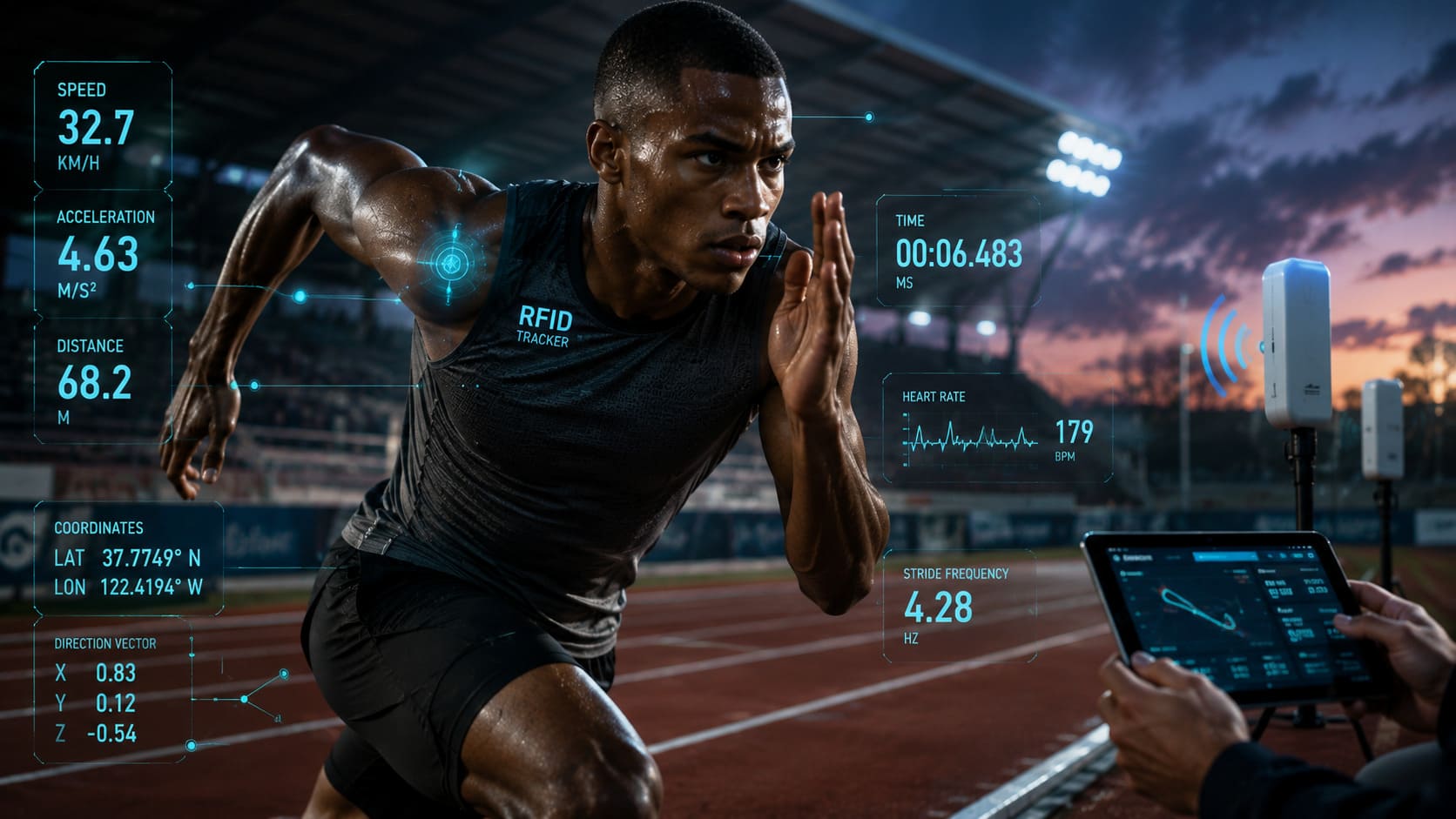
Today, sports have moved into a new era where every sprint, pass, tackle, and crossing to the finish line can be measured with an incredible level of accuracy. Television cameras and video replay are still vital but no longer the sole technologies that are influencing the game.
Today, Radio Frequency Identification (RFID) micro-chips are turning athletes into real-time data sources for coaches, broadcasters, analysts, and fans to discover performance like never before.
Whether you’re in an NFL stadium, a large-scale marathon, or anywhere in between, RFID technology provides accurate, millisecond-by-millisecond insights into the player’s location, enhancing broadcast quality, coaching decisions, and race management.
What is RFID in Sports?
RFID (radio frequency identification) is a wireless technology that identifies and tracks tagged objects. In sports, for example, the tags are inserted into the sports equipment or athletes themselves, and the location and movement of the athletes are tracked continuously by readers set up at suitable locations.
Unlike conventional camera tracking, RFID can supply accurate location data even when players are surrounded by others, or occasionally obstructed from view.
The common uses of RFID include:
- Player tracking
- Ball tracking
- Race timing
- Equipment management
- Athlete performance analysis
NFL Next Gen Stats: Every Movement Matters
The most famous example of the use of RFID in sports is the NFL’s Next Gen Stats platform. The active RFID chips are fitted in the player’s shoulder pads and into the football. Through the eyes of stadium receivers, they receive a wealth of information, and they’re doing it repeatedly every second, so they’re able to get a really detailed view of each and every play.
This technology measures:
- Player speed
- Acceleration and deceleration
- Distance covered
- Route efficiency
- Separation between receivers and defenders
- Time to throw
- Ball velocity
- Exact field position
For instance, analysts can figure out how much space a wide receiver was able to gain before making a catch or how fast a quarterback could get rid of the football when operating under pressure.
Coaches are not just given an indication through visual means, but rather have measurable performance data that can be used to improve game strategies.
What Makes Active RFID Ideal for Professional Sports?
In professional sports, the monitoring of a player’s movements needs to be continuous over a wide area. Active RFID tags have their own power source, which enables them to broadcast signals over greater distances with high fidelity.
Benefits include:
- High-speed real-time tracking
- Accurate location updates
- Low latency
- Stability under crowd pressure.
- Very little contact with players and equipment.
This allows analysts to recreate each play with great fidelity.
Marathon Timing Without Bottlenecks
RFID has revolutionized mass participation races.
Tens of thousands of people run along the Boston Marathon and the New York City Marathon. Manual or camera-only recording of accurate finish times would be almost impractical.
Runners, however, wear a disposable RFID timing tag on their race bibs or shoes.
Timing mats are set up at the following points throughout the course:
- Start lines
- Split checkpoints
- Finish lines
Instantly identifies all the participants as they cross.
The system automatically records:
- Start time
- Intermediate splits
- Finish time
- Pace changes
- Overall ranking
Runners do not see any delays or congestion as they cross timing points since thousands of tags can be read at a time.
Improving Athlete Performance
Coaches and sports scientists can benefit from the vast amounts of data produced by real-time RFID tracking for better training.
Performance metrics include:
- Sprint frequency
- Maximum speed
- Recovery patterns
- Positional efficiency
- Workload distribution
- Fatigue indicators
Instead of the subjective comparison, coaching staff can use objective data generated during practices and competitions to compare athletes.
As time goes on, these insights enable coaches to fine-tune conditioning programs and minimize injury risk by identifying overloading at a point before it becomes an issue.
Smarter Sports Broadcasts
RFID data is used more and more in modern sports broadcasting.
Now fans will be able to view graphics that display:
- The first player to be on the field, or the last player to leave the field.
- Live running speeds
- Receiver separation distances
- Ball travel paths
- Defensive coverage efficiency
- Player heat maps
These visualizations help games to be grasped more easily and provide viewers with more appreciation of athletic performance.
Broadcasters can even show in detail movement overlays that were not possible just ten years ago.
The Rise of Fantasy Sports and Live Betting
Real-time and accurate statistics are integral to fantasy sports and sports betting.
RFID technology can assist in providing real-time information for:
- Live fantasy scoring
- Player prop statistics
- The provision of passing and rushing analytics.
- Distance-based milestones
- Possession tracking
- Predictive win probabilities
The data is automatically collected, and statistics are available almost on-the-fly, which means broadcasters, fantasy sites, and sportsbooks can provide information almost immediately.
The use of RFID in sports goes beyond just football
While a lot of focus is given to football, RFID technology is being used in a variety of sports.
Examples include:
- Emphasize the use of the tracking player to position player base running.
- Monitor Player movement and workload in soccer.
- Basketball: analysing defensive spacing and transition speed.
- Cycling: Taking lap times and rider positions.
- Tracking Golf Equipment for tournaments.
- Swimming: managing athlete identification and race timing.
The adoption of RFID technology continues to expand, especially in the industry and in the field of football games, because of the capability of the technology to be smaller and more precise.
RFID Sports Tracking Challenges
Although there are some benefits to RFID, there is a need to plan for its implementation.
Organizations must consider:
- Infrastructure costs
- Stadium-wide reader installation
- Data storage requirements
- Signal calibration
- Equipment maintenance
- Effective athlete privacy and data governance
Many large sporting bodies integrate RFID with other technologies, such as GPS, ultra-wideband (UWB), computer vision, and AI analytics to provide even more detailed insights into performance.
A Number of Helpful Tips
To reap the most benefit from RFID, teams, race organizers, and sports facilities should follow these best practices:
- Choose the appropriate RFID technology for the sport and venue.
- Have readers set up strategically to cover blind spots.
- Test equipment regularly prior to competitions.
- Connect RFID data to current analytics applications.
- Set clear guidelines for athlete privacy.
- Train staff to be able to interpret performance measures.
Reliable data collection and meaningful performance analysis are dependent upon proper planning.
The Future of Intelligent Sports
RFID has made sports a science of measurable performance, and not just a game of observation. From determining how well an NFL receiver is creating separation to monitoring split times on a marathon runner, to driving interactive television graphics, RFID provides a view that cameras can’t.
With advancements in artificial intelligence, wearable technology and advanced analytics, the role of RFID will only grow in significance for coaching, broadcasting, engaging fans and athlete development. The outcome is a smarter, faster, more connected sports experience that provides a real-time supply of sports-actionable data.
FAQ
How can RFID technology improve sports analytics?
RFID technology reads information on the athletes or the equipment to find their speed and acceleration. This data can then be used to determine the position of the person or the object, and to show it to the audience to see, and for the coaches to see and evaluate the performance of an athlete or object for that game or race.
Why should we use RFID for marathon timing?
RFID technology enables to register precisely the start, split, and finish times of thousands of runners at the same time. The mats, which are placed at certain points, read RFID tags on bibs or shoes, preventing tangles and ensuring precision.
Can we use RFID data for fantasy sports?
Yes. Real-time RFID data can be used to provide position and speed information on players and to provide statistics during the game that broadcasters, fantasy sports sites, and sports books need to give their customers.
Learn more: RFID asset tracking software