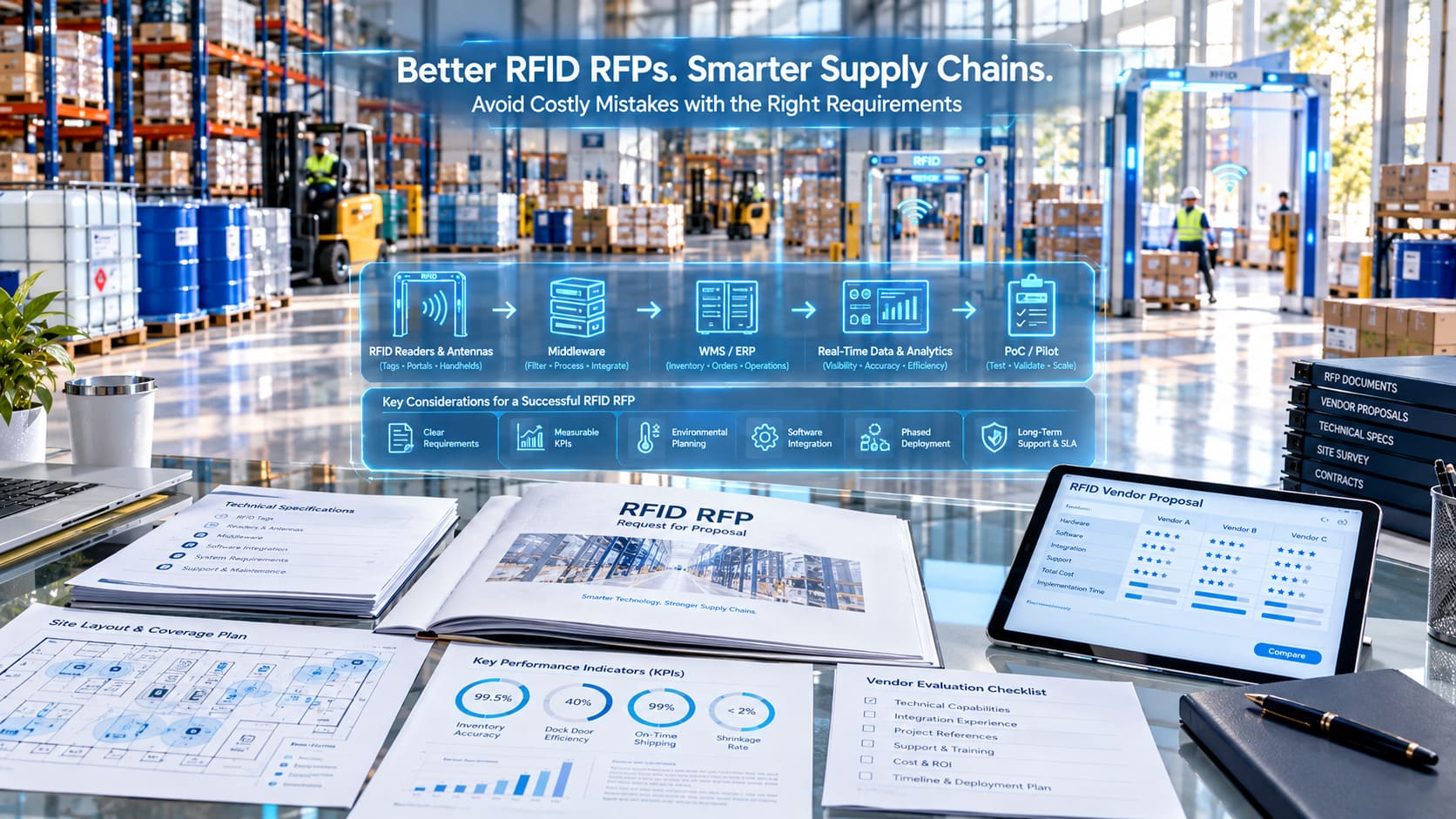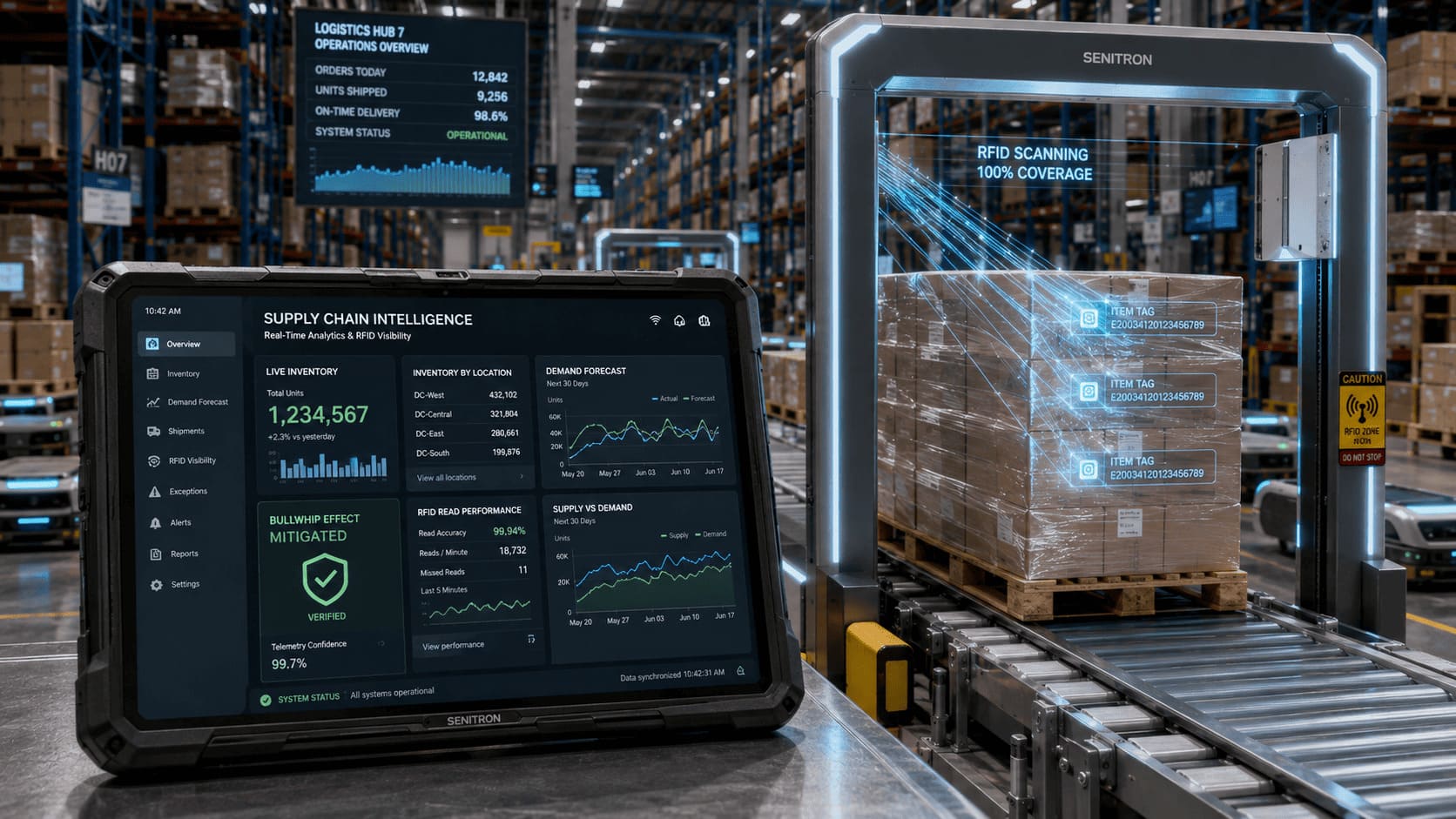
The purpose of supply chains is to ensure that products flow from manufacturers to distributors to retailers to customers with relative ease. However, even the smallest fluctuations in consumer demand can cause very large variations further up the line. This effect, called the bullwhip effect, can result in overstocking, stockouts, production delays, and increasing logistics costs.
Radio Frequency Identification (RFID) is one technology that may be used to solve this. RFID can bring better visibility to the supply chain, with more accurate, timely, and granular information, and help businesses make decisions based on what is really going on, not what they think is going on.
Explain The Bullwhip Effect?
The bullwhip effect is the phenomenon of relatively small changes in customer demand becoming increasingly large as they proceed up through each tier of the supply chain.
For instance, a retailer could see 5% more sales of the product and place a corresponding order with its distributor. The distributor expects that the manufacturer will continue to make the product, so he/she orders more from the manufacturer. The manufacturer may see this as a big rush of orders and ramp up production levels markedly.
If customer demand reverts to normal, the supply chain could be stuck with overstocks.
A number of reasons cause this:
- Inaccurate demand forecasts
- Lacking information or incomplete information.
- Large batch ordering
- Promotional pricing
- Long replenishment cycles
- Safety-stock policies
- Poor communication between supply chain partners is a problem.
- Inventory inaccuracies
This can lead to a situation of overproduction, shortage, emergency shipping, and unnecessary expenses.
Why Data Accuracy Matters?
Information is the key to decisions in the supply chain. In a general retailer, they might have 1000 units in stock, but their inventory records show that they have 1200, so they will be incentivized to replenish when they actually don’t.
Good old barcodes can deliver valuable data and are often used for individual items or cases. RFID can automatically identify and track many items.
An RFID tag holds the unique identification data of an item, and an RFID reader is able to read multiple tagged products without having to be directly located in front of them. This enables faster and more uniform data on inventory and movement to be gathered.
RFID Can Help Minimize the Bullwhip Effect
RFID does not eliminate demand fluctuations, but it can help to lessen the uncertainty that can worsen demand fluctuations.
Real-Time Inventory Visibility
Using RFID, the information on the location and quantity of products can be updated more frequently.
Retailers can get more visibility of:
- Store inventory
- Distribution-center inventory
- Goods in transit
- Receiving activity
- Warehouse movements
- Product availability
With a more accurate inventory, businesses can avoid overordering just because they think they have less inventory on hand than they actually do.
Faster Demand Response
RFID can reduce the time lag between the actual movement of physical products and digital information.
Increased speed of sales, shipments, receiving, and inventory movements allows supply chain managers to react to the reality of the situation rather than just relying on historical estimates.
This can help to facilitate more responsive replenishment and production plans.
Reduce the levels of safety stocks
Some businesses keep safety stocks as they do not know what demand may be, what the length of lead time will be, or how accurate they will be in their stock levels.
Better visibility can help minimize some of that uncertainty. Although RFID is not a stand-alone solution for automatically lowering safety stock, the certainty of being able to experience inventory data enables the organization to determine if they have more safety stock than is needed.
Improved Order Accuracy
If the inventory records are not accurate, then there is a chance of unnecessary replenishment orders. RFID can be used to help with discrepancies in receiving and picking, shipping, and cycle counting.
More accurate records will then be able to help avoid the creation of artificial upstream demand signals.
Improved Cooperation in The Supply Chain
The worse the bullwhip effect, the more supply chain partners are not using the same information.
Data produced by RFID can add to a common understanding of inventory movements. Having more consistent information also allows retailers, distributors, and manufacturers to coordinate replenishment and production better.
It’s Not a Magic Solution, RFID!
The use of RFID does not guarantee a stable supply chain. The technology has to be integrated with the current processes, systems, and decision-making of businesses.
However, data from the tag can be overwhelming if it’s not collected with a clear objective.
Requirements for a successful implementation are:
- Compatible hardware and software for RFID.
- Seamless ERP, WMS, and inventory integration.
- Proper tag placement
- Reliable reader infrastructure
- Employee training
- Data-quality controls
- A straightforward set of metrics that are clearly defined.
It’s also important for companies to differentiate between data collection and actionable intelligence. Information about a pallet location does not always help to explain the change in demand or the production level to be scheduled.
Strategy for Keeping Supply Chains from Becoming Volatile by Using RFID.
To achieve the best outcomes with RFID, take a systematic approach:
- Focus on one use case: Do not try to introduce RFID across the entire supply chain from the outset; start with an accurate use case like warehouse visibility, receiving, or inventory.
- Link RFID to ERP, WMS, inventory, and analytics systems to enable information to drive real business operations.
- Track Inventory accuracy: Take an inventory measurement prior to the implementation, and then track improvement afterward.
- Track exceptions: Identify that certain inventory is missing, misplaced, delayed, or unexpected without the need to check every transaction using RFID data manually.
- Provide relevant and adequate data: If possible, give out relevant data to the supply chain partners at the right time for better coordination.
- Don’t order too much: Improve visibility and order better. The key is organizations must use that data to make disciplined decisions to be most valuable.
- Track ROI: Quantify reduction in stockout, inventory carrying costs, labour efficiency, order accuracy, and fulfilment.
- The Bigger Picture: From visibility to stability
So at the end of the day, it’s about information quality and the bullwhip effect.
When decision makers don’t have access to current or accurate inventory data, they can’t make the most efficient decisions about a supply chain. RFID can generate a more accurate digital photograph of the physical object as they circulate throughout the warehouse, distribution center, retail store, and travels along the transportation network.
But most effective RFID is when it is used as part of a wider supply chain solution. They need to integrate accurate data, the right forecasting models, cooperative planning, rational inventory policies, and communication.
The bullwhip effect is as much an information and coordination problem as it is a demand problem. The uncertainty can be reduced by using RFID, which contributes to the reduction of the relatively small demand changes to increasingly large fluctuations upstream.
FAQ
What is the bullwhip effect related to supply chain operations?
The bullwhip effect refers to the phenomenon where demand oscillations are magnified as one moves from the end-consumer to the suppliers in the distribution chain
How to use RFID in reducing bullwhip effect?
Using RFID will help in improving the situation because of the increased accuracy and visibility of the information. This will result in better replenishment, which in turn will lead to a lessening of the demand fluctuations.
Can RFID eliminate supply chain instability?
No, RFID technology cannot help in reducing demand fluctuations and disruptions in the supply chain. However, it can be combined with other technologies such as ERP, WMS, forecasting, and inventory systems to provide a reliable source of information that can be used to improve the supply chain.
Learn more: RFID warehouse management system