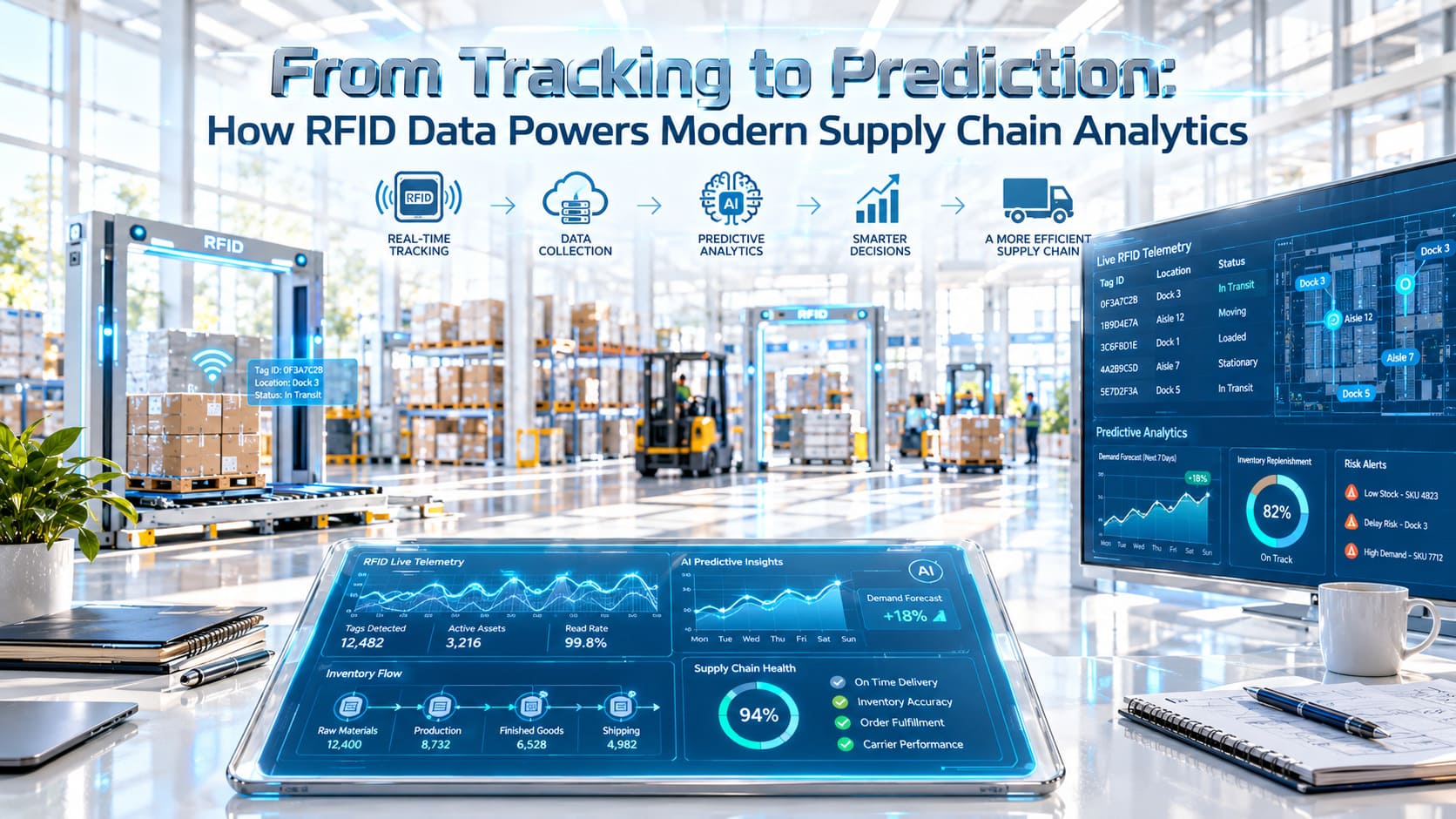
Quick answer: An RFID reader is a device that uses radio waves to read RFID tags without line of sight. It sends energy through an antenna, the tags in range answer with their unique IDs, and the reader passes those IDs to software. A UHF RFID reader can read hundreds of tags per second from many feet away. The main types are handheld readers, fixed readers with mounted antennas, POS and desktop readers, and RFID printers that encode tags.
The reader is the part of an RFID system that does the work. Tags are passive and quiet until a reader wakes them up, and software has nothing to show until a reader reports what it found. Choosing the right reader for each job (counting, receiving, checkout, security) is what makes an RFID project fast and accurate. This guide covers how readers work, the types available and what to look for when you choose one.
How an RFID Reader Works
- The reader transmits. Through its antenna, the reader sends a radio signal. In the US, UHF readers operate from 902 to 928 MHz.
- Tags power up. Each passive tag in range uses that energy to run its chip.
- Tags answer. The tag reflects a modulated signal back (called backscatter) that carries its EPC, the ID linked to the item.
- The reader sorts the answers. Anti-collision rules in the EPC Gen2 standard let it read hundreds of tags per second without mixing them up.
- Software takes over. The reader sends the IDs, with the time, antenna and signal strength, to software that turns them into counts, locations and alerts.
The antenna matters as much as the reader. It shapes where the reader can “see”: a wide beam from a ceiling, a narrow zone at a dock door, or a small field on a checkout counter.
Types of RFID Readers
Handheld RFID Readers
Handhelds are carried through a store, stockroom or warehouse to count, search and receive. Some are sleds that attach to a mobile computer or phone, others have the RFID reader built in. Most also scan barcodes, and many include a locate mode that beeps faster as you get closer to a specific item. They are the starting point for most inventory projects because one device covers a whole site.
Fixed RFID Readers
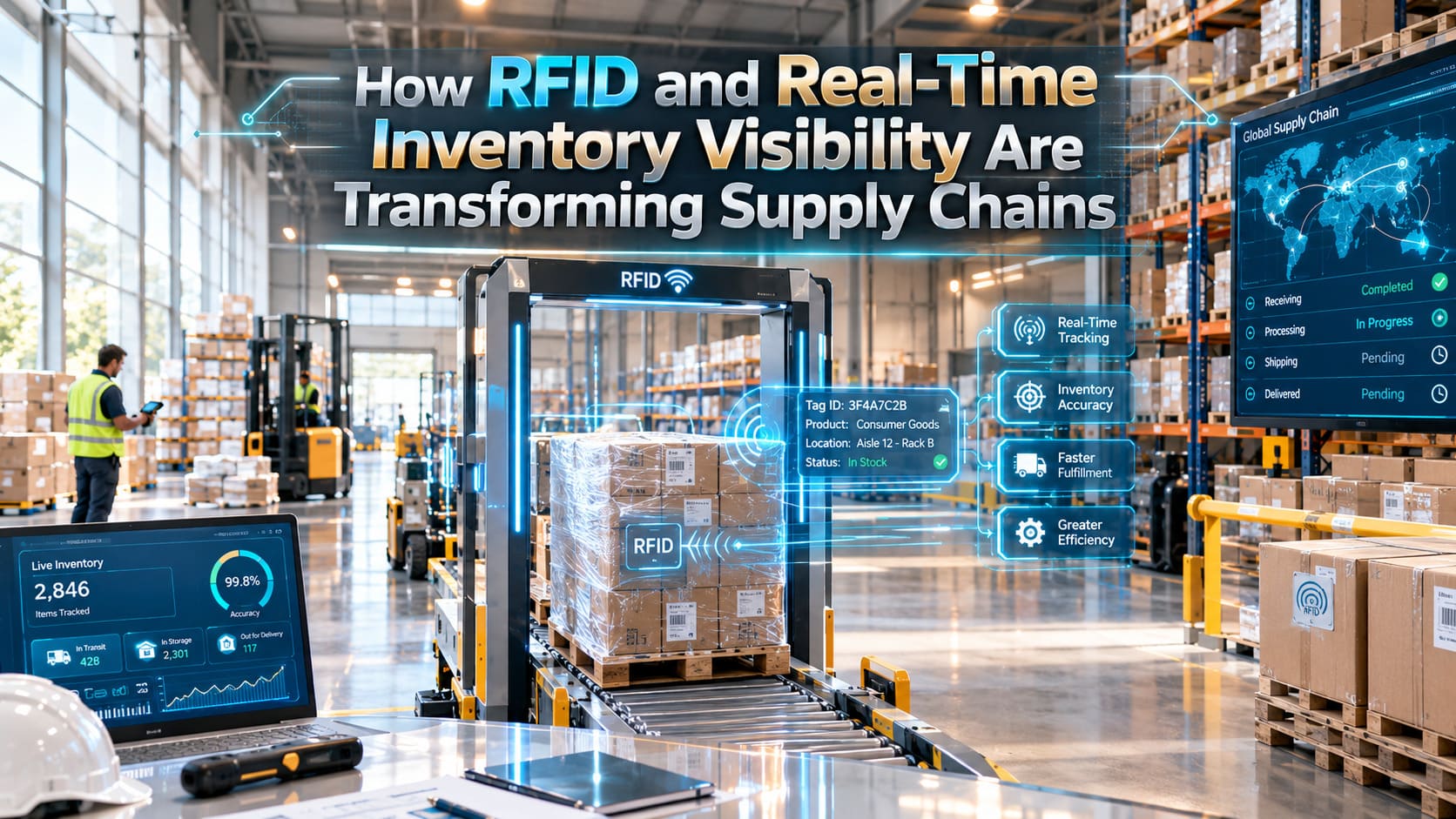
Fixed readers are mounted in place and connected to one or more antennas, usually by cable. They read automatically, with no one pressing a trigger: ceiling antennas track a sales floor or stockroom, dock-door portals record cartons as they are received or shipped, and exit readers catch unsold items leaving a store.
RFID Tunnels and Portals
A tunnel encloses a conveyor or a table with antennas and shielding, so every tag in a closed carton is read and checked against the order before it ships. Portals do the same job at the size of a door or a pallet.
POS and Desktop Readers
Counter readers ring up tagged items at checkout or self-checkout, and pistol-grip scanners combine short-range RFID with a barcode imager for one-item-at-a-time work.
RFID Printers
An RFID printer prints the label face and encodes the chip in one pass, then verifies the tag. It is the reader you use to create tags in the first place.
Which RFID Reader Fits Which Job?
| Reader type | How it reads | Best for |
|---|---|---|
| Handheld | Carried by a person, on demand | Cycle counts, full counts, finding items, receiving |
| Fixed reader with ceiling or wall antennas | Automatically, around the clock | Hands-free inventory of floors, rooms and racks |
| Dock-door portal | Automatically as goods pass | Receiving and shipping verification |
| Tunnel | Every tag in a closed carton | Carton audits and order accuracy |
| Exit reader | Automatically at the door | Loss prevention alerts |
| POS counter reader | Items laid on the counter | Fast checkout and self-checkout |
| RFID printer | Encodes and checks each label | Printing and encoding tags on site |
What Affects RFID Read Range
- Tag size and design: larger tag antennas read farther. Small labels may read at a few feet, long-range labels at 35 ft or more.
- Reader power and sensitivity: long-range handhelds read much farther than compact ones.
- Antenna gain and polarization: high-gain antennas reach farther in a narrower beam; circular polarization reads tags in any orientation.
- Materials: metal and liquids near the tag reduce range unless you use tags designed for them.
- Environment: dense stock, shelving and other readers all affect performance, which is why a site survey and tuning pay off.
How to Choose an RFID Reader: Checklist
- Frequency and region: UHF for inventory, set to the right band (FCC 902–928 MHz in the US).
- Read range and read rate: matched to your shelves, racks and the number of items per count.
- Form factor: handheld, fixed, portal, counter or printer, depending on whether people or doorways do the reading.
- Barcode support: useful while some items are still barcoded.
- Battery and ruggedness: hot-swappable batteries and drop and IP ratings for warehouses and yards.
- Connectivity: Wi-Fi, Bluetooth or Ethernet, and power over Ethernet for fixed readers.
- Software: make sure the reader works with your inventory software and that it syncs to your POS, ERP or WMS.
- Support: configuration, replacement and help when something stops reading.
RFID Readers From Senitron
Senitron supplies, configures and supports handheld RFID scanners, fixed readers, RFID printers, POS readers and dock-door portals that work with the Senitron software out of the box, backed by seven-days-a-week support. Handhelds run $1,550 to $3,500, from Zebra models to the Senitron long-range handheld that reads high-performance tags up to about 95–100 ft, and Zebra RFID printers start at $1,999, with a price-match guarantee and a 30-day money-back guarantee. Fixed readers power RFID exit alerts for loss prevention, RFID tunnels for carton audits and RFID checkout at the POS, all managed from one cloud dashboard.
Frequently Asked Questions
What does an RFID reader do?
An RFID reader sends radio energy through an antenna, powers the RFID tags in range, receives each tag’s unique ID and passes those reads to software that turns them into counts, locations and alerts.
What is the difference between a handheld and a fixed RFID reader?
A handheld reader is carried by a person to count or search an area on demand. A fixed reader is mounted in place with one or more antennas and reads tags automatically as they pass a door, sit on a shelf or move through a tunnel.
How far can an RFID reader read?
With passive UHF tags, handheld readers typically read from about 20 ft up to roughly 60 ft, and long-range handhelds reach about 95 to 100 ft with high-performance tags. Range depends on the tag size, the reader power, the antenna and the surroundings.
Can an RFID reader read multiple tags at once?
Yes. UHF RFID readers use the anti-collision rules in the EPC Gen2 standard to read hundreds of tags per second, which is how a full store or warehouse count takes minutes.
Can a phone be used as an RFID reader?
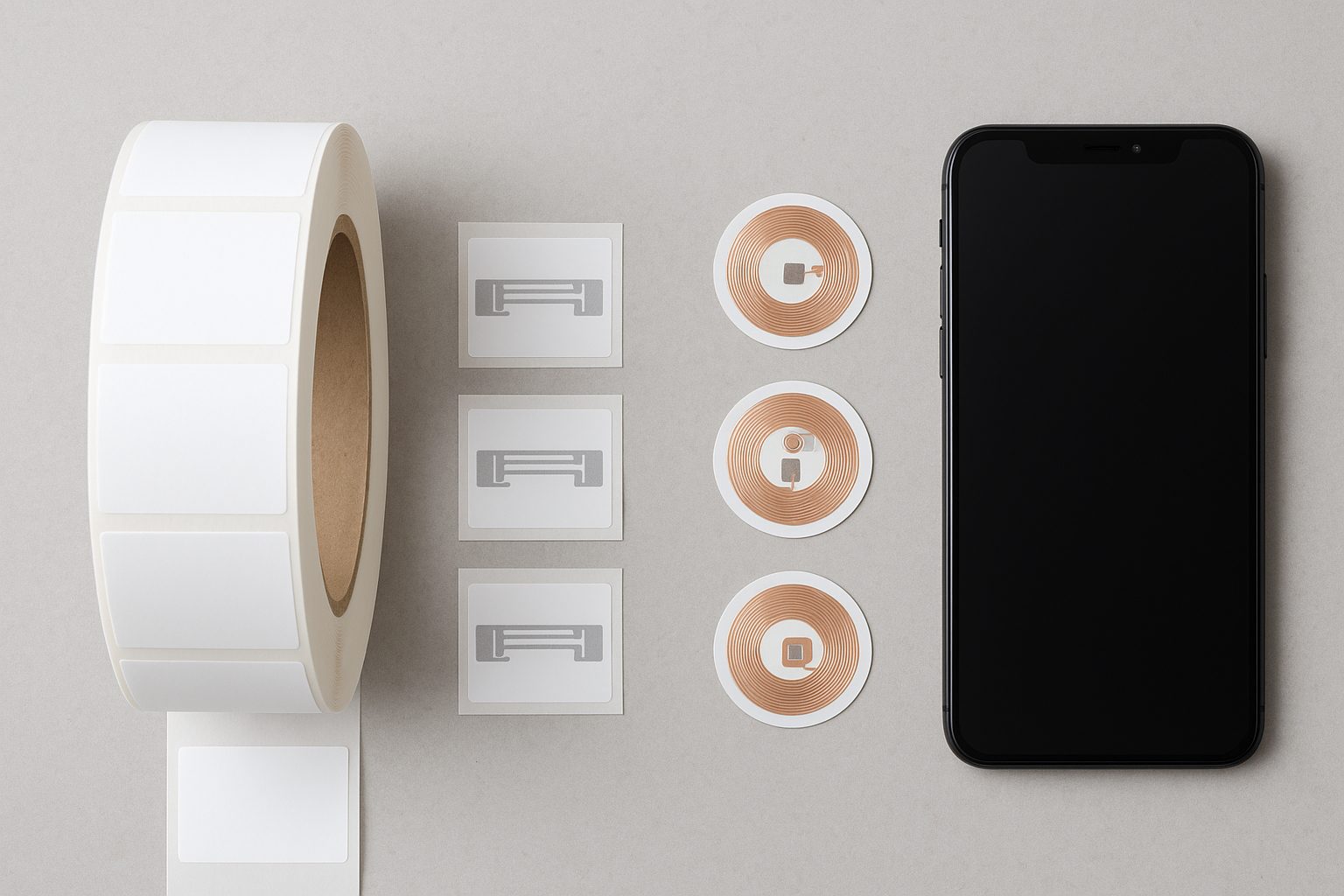
A phone can read NFC tags at touch distance. To read the UHF tags used for inventory, the phone or mobile computer needs a UHF RFID sled attached, or you use a handheld with a built-in UHF reader.
How much does an RFID reader cost?
Through Senitron, handheld RFID scanners run $1,550 to $3,500 and Zebra RFID printers start at $1,999, with a price-match guarantee and a 30-day money-back guarantee.
Do RFID readers need software?
Yes. The reader only reports tag IDs. Inventory or asset software links each ID to an item, compares what was read with what should be there, and syncs the results to your POS, ERP or WMS.
Want help choosing readers for your site? Contact Senitron and we will match handhelds, fixed readers and tags to how you count and move inventory.