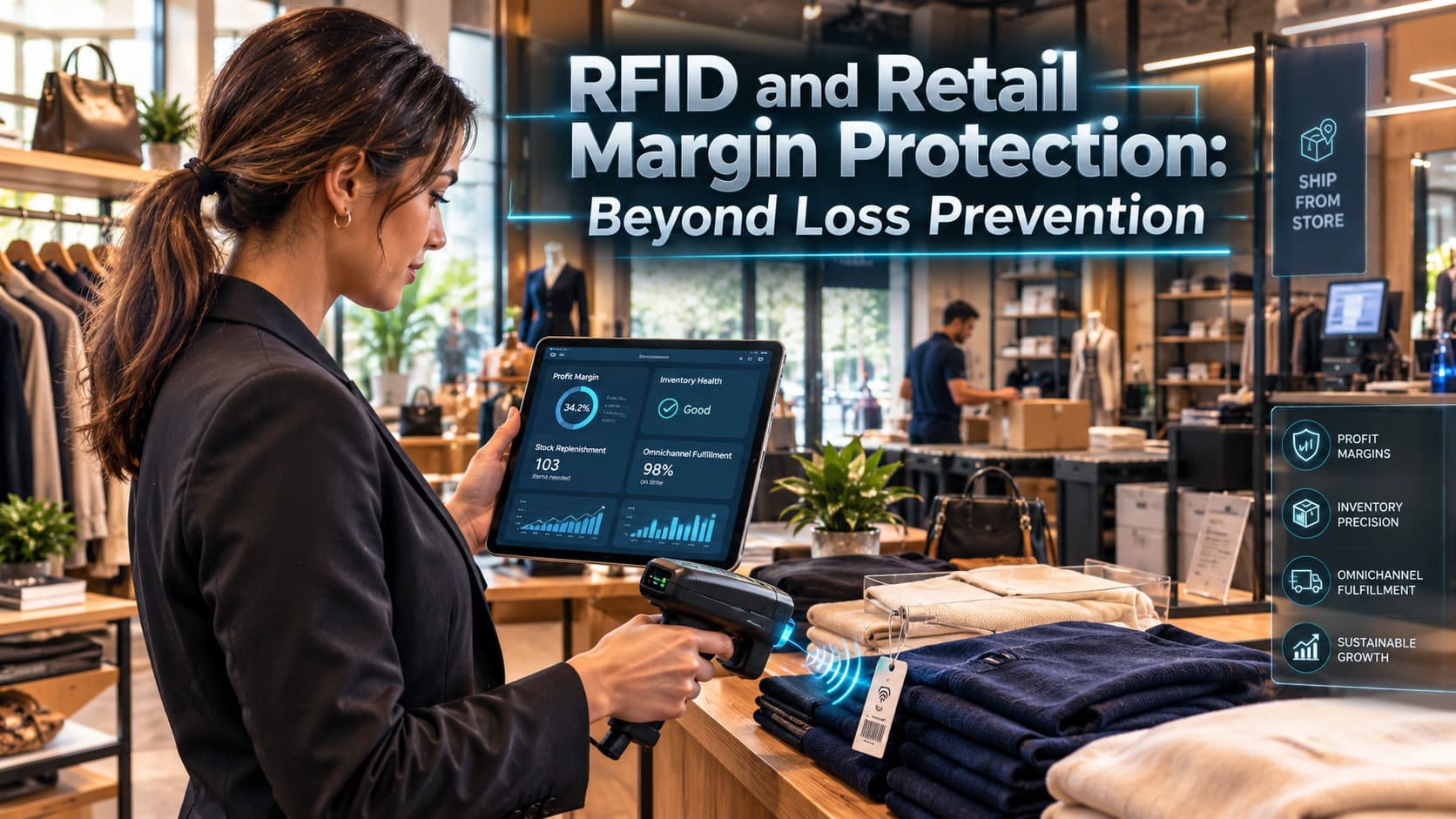
Traditionally, RFID has been seen as a loss prevention, inventory visibility, and theft reduction solution for retailers. However, its benefits go beyond that. RFID can safeguard profitability at several stages of the product lifecycle in a retail business where margins are being reduced due to markdowns, stockouts, overstocks, fulfillment mistakes, and business inefficiencies.
The ability to accurately determine the location of margin leaks at the item level is why RFID is important to retailers.
What is Retail Margin Protection?
Retail margin protection refers to the general strategy of keeping the margin between what the product sells for and all costs. Loss prevention is just one component.
Margin can be lost in various ways:
- Theft and shrinkage
- Incorrect inventory records
- Lack of sales and stock-outs
- Having too many units and too many markdowns is not desirable.
- Misplaced merchandise
- Errors in receiving and delivering
- Fulfillment mistakes
- Returns problems and reverse logistics problems.
- All the products are priced and promoted correctly.
- Labor-intensive inventory processes
All of these can be solved with RFID because it can provide much more accurate and timely inventory information.
Avoiding Shrink Beyond Traditional Security
RFID tags can be used to detect discrepancies between what the system indicates should be in the store versus what is in the store.
RFID can be used to help inventory investigations, revealing:
- What was received
- Postal record of the goods’ last location
- Whether the items are transported from one place to another
- What products are missing
- Whether any differences are accentuated in specific regions
Retailers can use this data to differentiate between theft, administrative errors, lost merchandise, and receiving issues.
The outcome is a more specific response to shrink as opposed to assuming it’s theft.
Preventing Stockouts and Lost Sales
If someone doesn’t find a product in the backroom, then it’s not making revenue for the company.
The accuracy of the inventory can be enhanced by the ability of RFID to perform faster cycle counts and to find specific products. Retailers can better replenish sales floors when inventory data is more accurate.
For instance, employees might find that a specific size is offered in a system but can’t locate it, and RFID can help determine if it is, in fact, located somewhere else in the store.
Improved availability can be a game-changer when it comes to sales and inventory productivity.
Reducing Unnecessary Markdowns
Markdowns can drastically impact gross profit margins, especially when products are not sold due to poor distribution or awareness.
With the capability to offer a view of the inventory at the product level, RFID allows retailers to know where products are and how fast they are moving.
This can assist when making decisions on:
- Store-to-store transfers
- Replenishment
- Promotional timing
- Allocation
- Seasonal inventory management
Retailers can look at the retailer who may have too much in inventory and consider trying to shift it to a store with higher demand.
Improving Inventory Accuracy
To ensure margin protection, inventory accuracy is a crucial element.
When the inventory management system reports 20 items, but the actual inventory is 12, the information is not reliable, and decisions may be incorrect. The availability for purchase, replenishment, promotion, e-commerce, and transfers can all be impacted.
The main advantage of RFID is that it can drastically increase the speed of inventory counting over manual, line-of-sight scanning of barcodes, as multiple items can be accessed simultaneously.
This allows for more frequent cycle counting to be practical.
Protecting Omnichannel Margins
Buy-online-pickup-in-store (BOPIS), ship-from-store, and other omnichannel strategies offer more chances for margin leakage.
An inaccurate inventory record can cause:
- A customer orders something.
- The system guarantees an item.
- It’s not available to the employees.
- The order has to be called off, replaced, or obtained from another source.
This is unnecessary labor, shipping expense, customer frustration, and even loss of revenue.
RFID can enhance the degree of trust placed in the stock available, thereby supporting their stock fulfillment choices.
Minimize Receiving and Fulfillment Errors
Margin protection starts in the pre-sales process.
RFID can assist retailers in confirming shipments during the receiving process and determining whether the volume or product is what was expected.
The same visibility can be used for outbound operations. Retailers can be assured that the appropriate items are being picked and shipped, minimizing errors and returns, reshipping, and customer service costs.
In cases of high volume, even a minor drop in fulfillment mistakes can translate to significant savings.
Increasing the visibility of returns
Returns can add to margin leakage.
A returned product can require inspection and restock, transfer, repair, discount, or removal from stock. Scrutineers may not be able to understand its history if it is not clear, and it is more likely to contain errors.
RFID can offer item-level identification, which can help employees identify what the product is and where it belongs.
This, coupled with a wider inventory and returns process, can enable retailers to move items away from inventory and get sellable items back into stock more quickly.
Tips for using RFID for margin protection
The plan is to avoid seeing RFID as just a technology buy, and to make sure retailers don’t get carried away with the excitement. The best ones are when you tie RFID data back to specific business problems.
- Begin with measurable leaks in the margins. Determine if shrink, stockouts, markdowns, fulfillment errors, or inventory inaccuracy are the largest issue.
- Take pre- and post-measurements. Set baseline data for inventory accuracy, shrink, markdown percentages, order cancellations, and labor hours.
- Pay attention to higher value categories. A high-dollar, quick-moving, or easily lost item could offer a better business argument.
- Integrate RFID data. The data is now more actionable when coupled with inventory management, warehouse, e-commerce, and analytics systems, thanks to the ability to connect RFID with them.
- Train employees. While RFID enhances visibility, there must be clear procedures in place for dealing with discrepancies.
- Consider other outlets for your product. Think of docks, warehouses, distribution centers, returns, and transport, rather than just items on the sales floor.
In the retail sector, RFID is no longer just a loss-prevention tool; it’s a margin-management tool.
The greatest opportunity is not just in the capture of more stolen goods. It is keeping out of the myriad operational issues that gradually chip away at profitability: wrongful inventory, out-of-stock products, needless markdowns, delivery errors, and inefficient staffing.
With item-level RFID visibility, combined with accurate processes and analytics, retailers can make faster, better decisions.
Finally, margin protection is the concept of retaining more of each sale. Retailers can do that by making merchandise more visible, inventory more accurate, and problems more noticeable before they cost them money, thanks to RFID.
FAQ
- How does RFID help protect retail margins?
RFID can help protect margins by improving inventory accuracy, decreasing shrink, avoiding stockouts, reducing unnecessary markdowns, and decreasing fulfillment and receiving errors. The increased item-level visibility allows retailers to spot margin leakage and act upon it.
- Can RFID reduce unnecessary retail markdowns?
Yes. RFID offers accurate visibility into not only where merchandise is, but how fast it is moving. This allows retailers to redeploy inventory from one channel to another, thus improving markdowns by reducing the need to discount as much.
- Is RFID useful for omnichannel retail?
Yes. RFID can help improve inventory accuracy for BOPIS, ship-from-store, and other fulfillment models, so that retailers can be more confident that products are available, decreasing canceled orders, unnecessary shipping, picking errors, etc., which have a negative impact on margins.