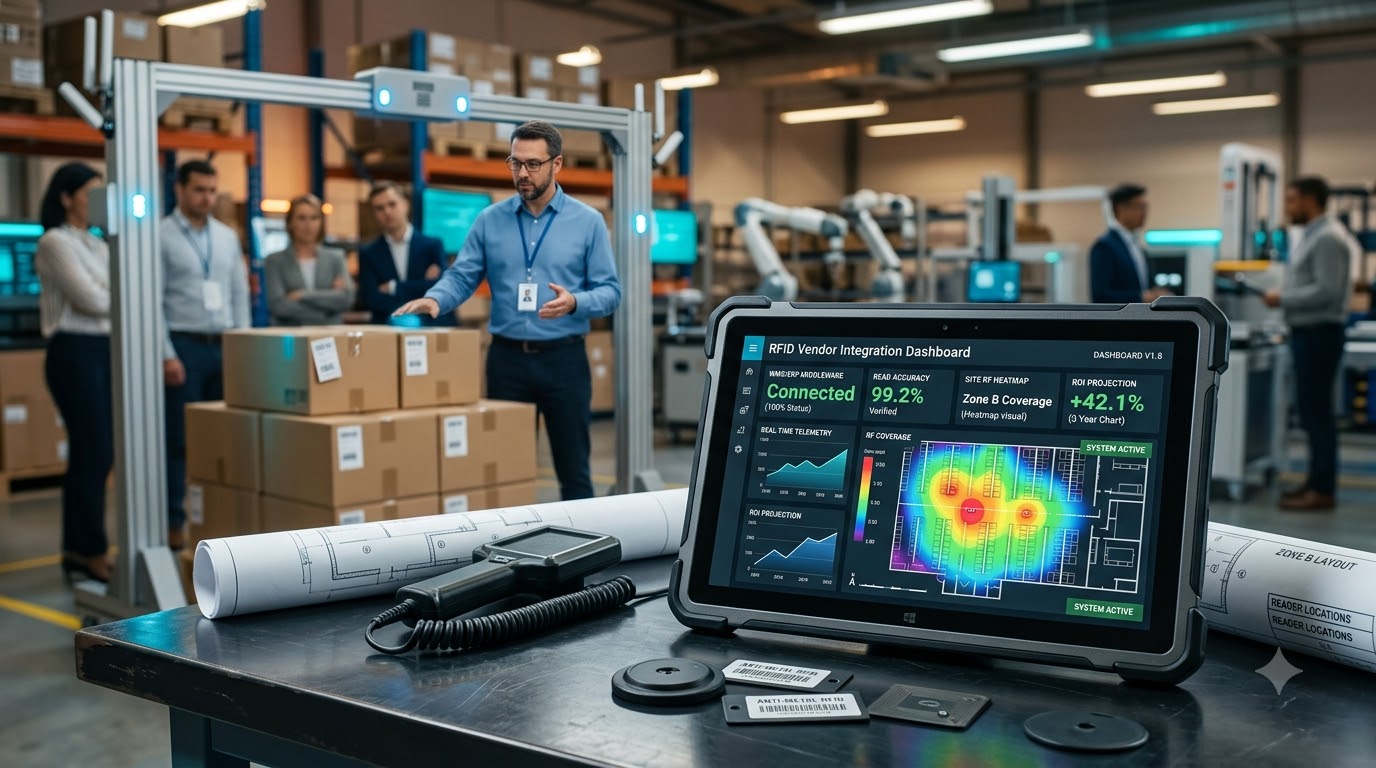
One of the best solutions to solving operational transparency, reducing lost stock, and increasing inventory accuracy is investment in Radio-Frequency Identification (RFID) technology. But buying the hardware is not enough to ensure a successful deployment; it requires a strategy that involves an experienced solutions provider. Too many companies find themselves buying one-off hardware and software, only for the implementation to fail and money to be lost.
The key to maximizing your investment’s Return on Investment (ROI) and integrating it into your business is to analyze your prospective partners carefully. If you are thinking about hiring a vendor for your RFID system, you should ask them the following 10 questions.
Q1: Do you have proven experience and tailored solutions for our specific industry?
The use of RFID is not uniformed. A high-temperature manufacturing facility necessitates vastly different tags, readers, and software setup as opposed to a retail store in the apparel industry.
Request case studies, client references, and firsthand experience in your industry from the vendor. The experienced partner will already be familiar with industry compliance and environmental requirements, workflow pain points, and much more, making the deployment process much smoother.
Q2: How seamlessly will your RFID system integrate with our existing WMS or ERP?
If you can’t get your current software to communicate with an RFID system, then it’s worthless. Discuss with the vendor how their solution will integrate with your existing Enterprise Resource Planning (ERP) or Warehouse Management System (WMS).
Are the APIs and middlewares they provide strong enough to filter the data before it hits the back end? The aim is to improve the existing system with minimal or no duplication of data entry and no need for a ‘breakthrough’ software re-wiring.
Q3: What is your process for hardware and tag selection?
In difficult conditions, generic tags don’t work. Don’t accept a price from any vendor without having them evaluate your facility. Question whether they do an audit of the site and environmental evaluation.
They have to try out the impact of metals, liquids, and high-density storage on radio frequencies in your warehouse. From this, they ought to be able to suggest specialised hardware, such as anti-metal tags or specific dense reader modes, depending on your specific physical surroundings.
Q4: Can you provide a pilot program or a live proof-of-concept?
Do not make a blanket decision to implement a full rollout to a facility. Inquire if the vendor has a pilot program to evaluate the technology in a small-scale, on-farm environment in your operation.
A pilot program can test the accuracy of reading, software integration, and feasibility on a small scale. It’s the ideal approach to identifying potential workflow breakers and addressing them before making the decision to deploy it across the enterprise.
Q5: Is your RFID solution fully scalable for future growth?
The more your business grows, the more tracking you’ll require. Inquire with the vendor if their architecture can be easily extended to include new warehouses, new dock doors, and vastly more data volume.
Do they have software that integrates with the cloud? Is it suitable for future automation, such as robotics or Artificial Intelligence (AI) systems? Scalability will help you not lose your initial investment with growth.
Q6: Do you provide a true end-to-end solution, or will we have to manage multiple vendors?
Having to deal with a different provider for each tag, reader, middleware, and installation is a logistical nightmare. Ask them if they are an end-to-end systems integrator or not. They should be responsible for everything involved from site survey to purchase of the hardware, software development, physical installation, and training the employees. With one point of accountability, vendors will not be able to blame each other if there is a technical problem.
Q7: What level of post-implementation support and maintenance do you offer?
RFID is not a technology that is “set and forget”! Forklifts can bump antennas, tags can be damaged, and software must be updated on a regular basis. Ask about the vendor’s Service Level Agreements (SLAs). What is the mean of their responses?
Are there on-site technical support, remote help desk, and preventive maintenance plans? The key is to have reliable post-installation support, which can help reduce downtime.
Q8: How does the system perform if our local network or internet goes down?
Network disruptions are a part of life in industrial settings. Inquire with the vendor about how they handle connectivity loss. Your RFID solution must have “offline” data caching capabilities and multiple levels of redundancy.
Your dock doors and production lines must not come to a standstill if the Wi-Fi goes out. It should be able to collect data locally and automatically upload the data to the cloud or server when the connection is restored.
Q9: What are your data security protocols and compliance standards?
RFID systems are sensitive devices for capturing and sending operational and supply chain information. Make sure that the vendor is making security a priority by having encrypted chips to avoid tag cloning and unauthorized scanning.
Also, check whether its software framework conforms to industry data privacy requirements like GDPR or ISO certifications. As critical as the tracking is, making sure that an external party doesn’t capture your supply chain visibility is just as important.
Q10: How do you help us measure and prove the Return on Investment (ROI)?
The deployment of RFID is a huge strategic investment and must be financed. Discuss the vendor’s definition and measurement of success. Are they able to show measurable progress towards saving on labor expenses, inventory accuracy, quicker audit processing, and minimizing the risk of asset loss? A good partner with advisory capabilities will be able to help you set up a clear baseline and timeline for ROI.
Conclusion
Choosing an RFID vendor is the key to your technology’s success or failure. These specific questions can help you cut through the “no-brainer” hardware vendors and work with a true “solutions integrator” that can help you add value for long-term efficiency, accuracy, and profitability.
FAQs
Why is a site survey necessary before buying RFID equipment?
A comprehensive site survey identifies environmental factors—such as metal racking, liquid containers, or dense storage—that cause RF interference. Skipping this step often leads to signal blind spots, failed deployments, and costly hardware replacements down the line.
What is RFID middleware, and why is it important to ask about it?
Middleware is the critical software layer that sits between your physical RFID readers and your ERP/WMS. It filters out duplicate reads, processes raw radio signals into meaningful events, and prevents your backend systems from crashing due to data overload.
Can an RFID vendor guarantee 100% inventory accuracy?
While 100% accuracy is theoretically possible in highly controlled environments, most top-tier vendors will promise and deliver an operational accuracy of 99%+. Be cautious of vendors guaranteeing absolute perfection without conducting a thorough evaluation of your specific operational workflows.
Learn more: RFID warehouse management system · ERP-integrated RFID for NetSuite, Acumatica and Dynamics