RFID (Radio Frequency Identification) and RTLS (Real-Time Location Systems) are used by businesses to track assets, provide more accurate inventory counts, and optimize operations. Both technologies are based on wireless signals and can track physical objects, which makes them sometimes considered interchangeable.
They are not.
The basic distinction is easy: RFID basically indicates that an object has been located at a particular location, while RTLS can tell you the location of an object over time within a covered area.
It is important to grasp this distinction first before investing in tracking infrastructure.
RFID: Identifying at the Right Place
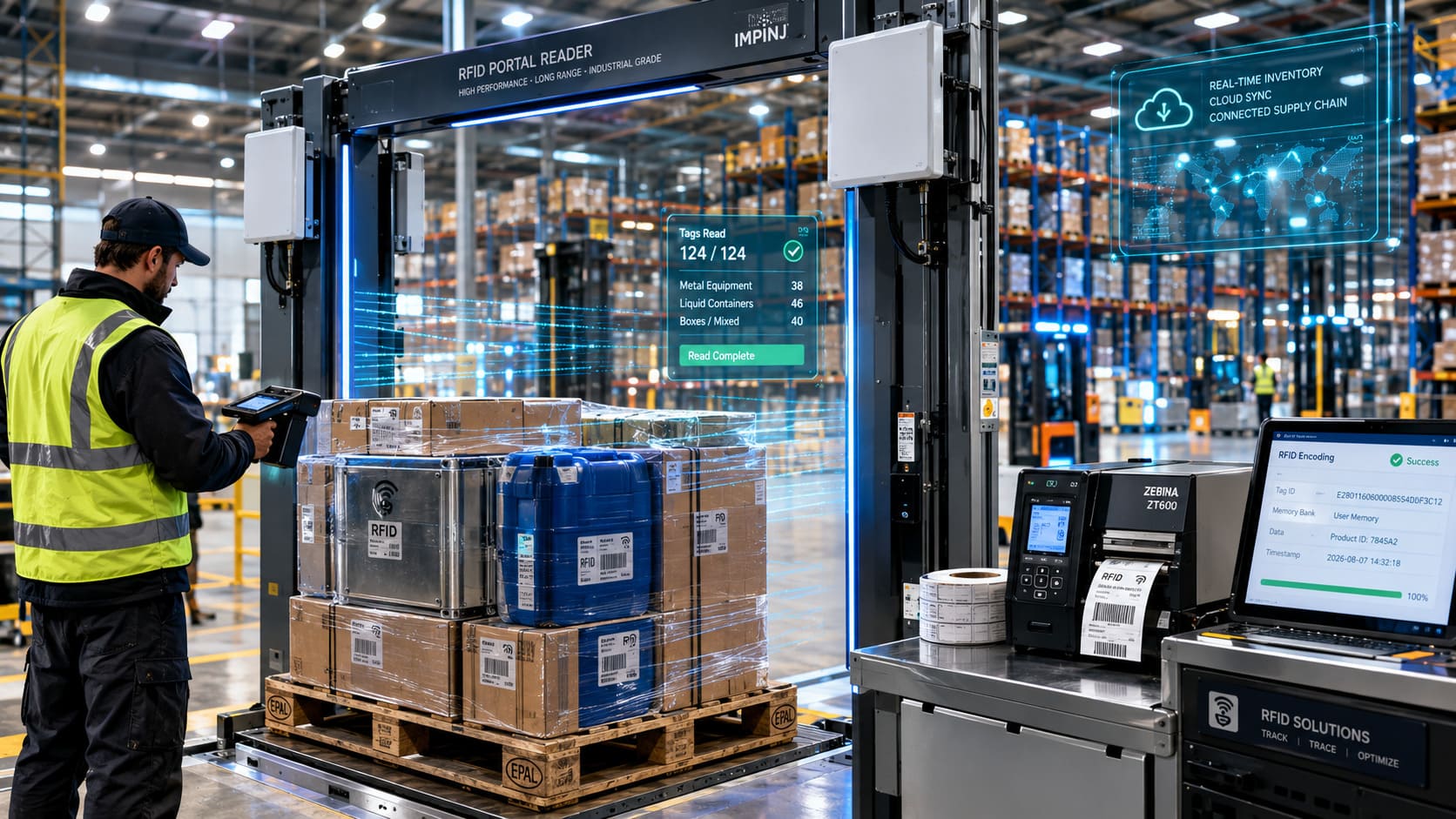
RFID is a technology that involves tagging products, equipment, containers, tools, or other assets. The information can be read by readers without having to line up the tag to be seen.
Passive RFID tags are especially popular as they are battery-less. The tag has to be energized by the reader. This means that passive RFID is cost-effective for tracking large numbers of items.
In one case, a warehouse may equip its readers with RFID readers at the following locations:
- Loading docks
- Receiving areas
- Shipping gates
- Conveyor points
- Inventory checkpoints
- Tool-room entrances
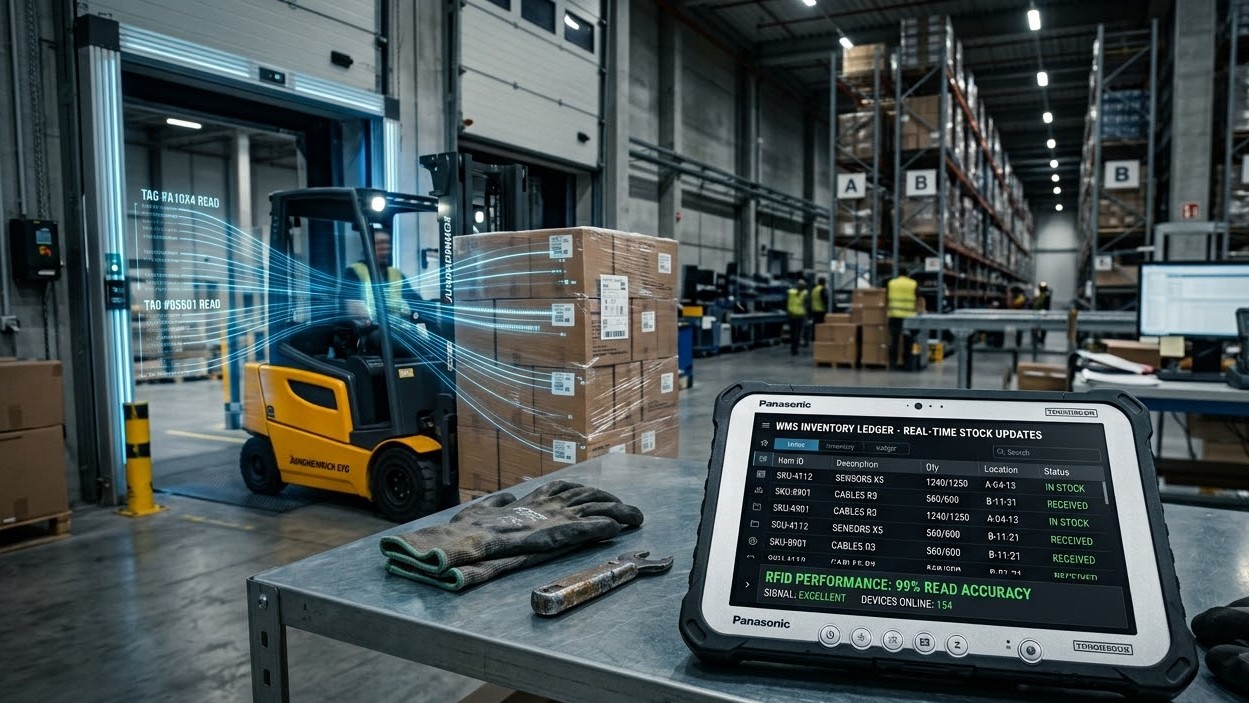
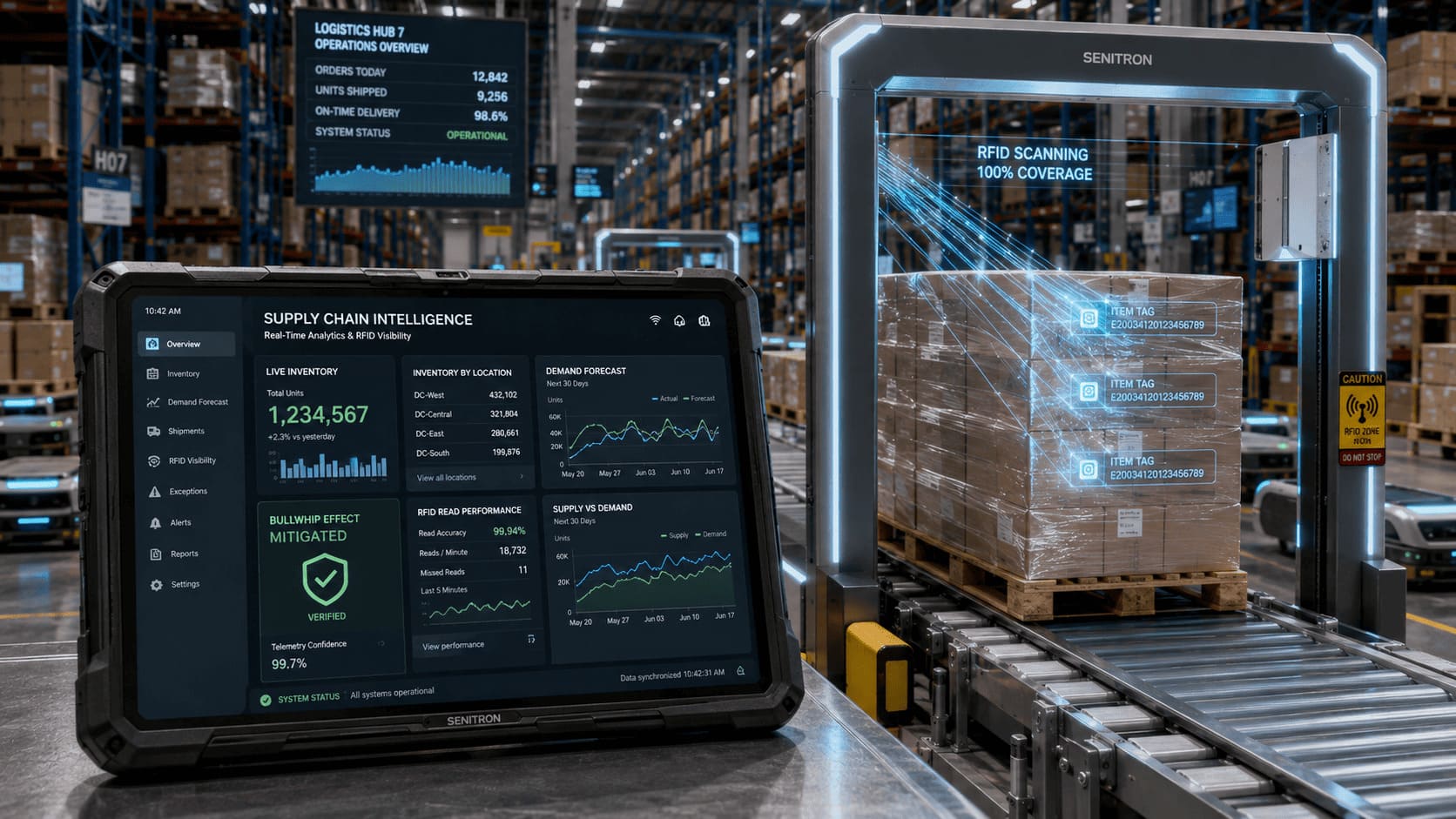
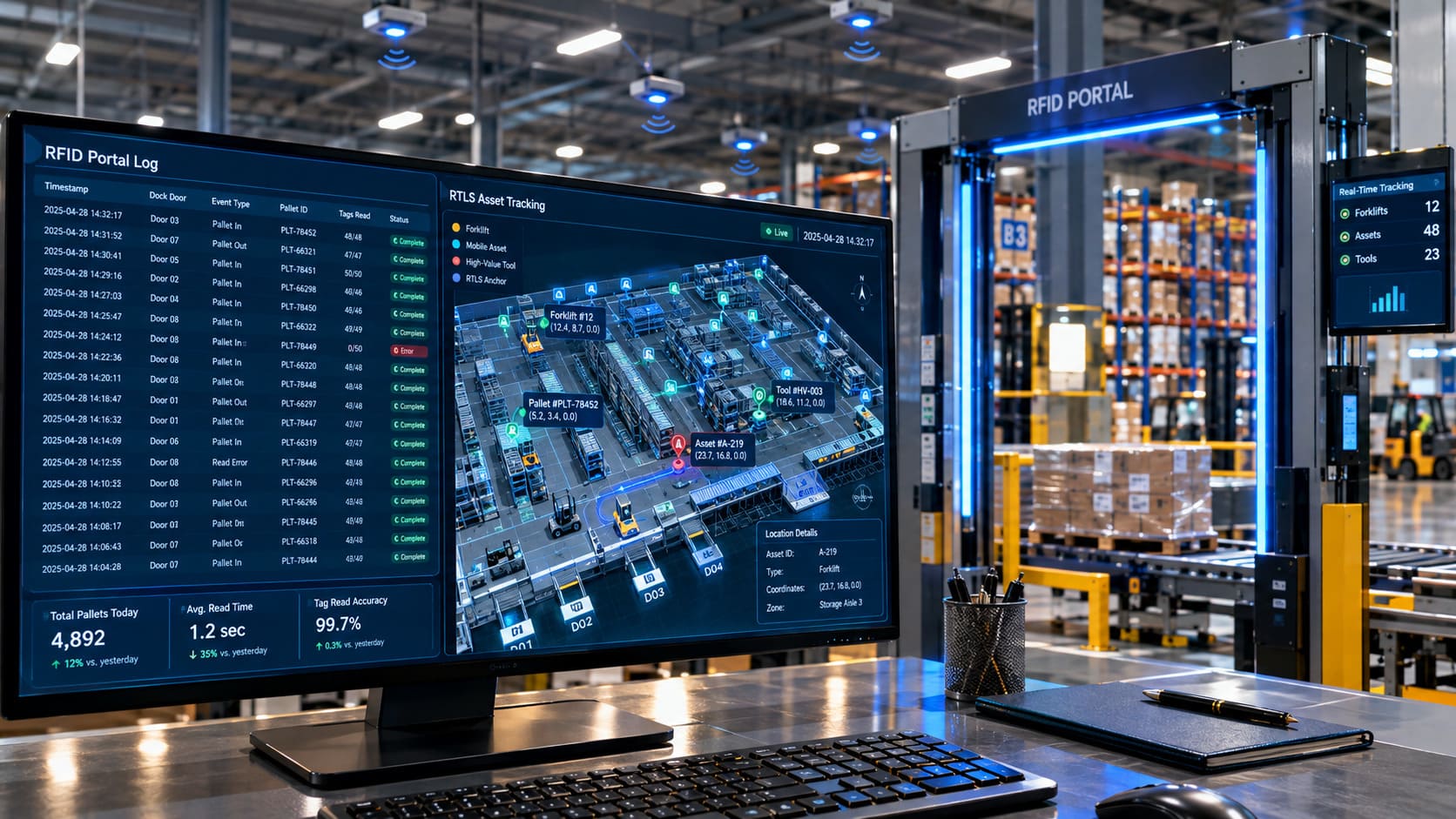
Once the pallet is in a reader zone, the system can see what passed, where it passed, and when it passed.
Once the pallet moves beyond that reader, however, conventional passive RFID is not generally able to report the pallet’s location on an ongoing basis.
RTLS: Location Across the Facility
RTLS does not. An RTLS deployment is not dependent on specific reading points, but uses tags, receivers/anchors, positioning technology, and software to continuously estimate the location of an asset.
RTLS can utilize technologies like:
- Ultra-Wideband (UWB)
- Bluetooth Low Energy (BLE)
- Wi-Fi
- Active RFID
- Other positioning technologies
This can be a live display of the location of tagged assets or personnel. There are various levels of accuracy between different RTLS technologies; businesses need to choose the technology they require for the operation, not the most accurate technology.
The Cost of Tags Is More Than Just the Price of The Tag
An error that is often made is to compare only the price of the tags.
Passive RFID tags can be very cost-effective and suitable for thousands or even millions of products. Generally, RTLS tags are more complex and may need batteries based on the technology.
But infrastructure expenses are not to be overlooked.
Specific doors, gates, shelves, or checkpoints can be where an RFID system is needed. Receivers or anchors may need to be placed across a whole facility for an RTLS deployment.
So, the low-cost tag doesn’t necessarily imply a low-cost total system.
Businesses should calculate:
- Tag cost
- Costs of reader/anchor time
- Installation
- Network requirements
- Battery replacement
- Software licensing
- Whether the item has been integrated with ERP/WMS systems
- Maintenance
- Expected lifespan
- Labor savings
Accuracy is NOT the same as visibility!
Another crucial strategic question is: what does “accuracy” mean?
RFID can offer very accurate identification when a tag is brought into the range of coverage for a tag reader. The information that an asset has been detected at Dock 3 does not give you information about where an asset is once it is out of Dock 3.
RTLS is the provision of location data within a user-defined coverage area. The accuracy depends on the technology deployed, ranging from zone-level positioning to highly precise positioning.
This makes a critical difference:
At a checkpoint, the accuracy of RFID can be quite high. Continuous location over an area is possible with RTLS.
Why Should We Choose RFID?
RFID is typically the more preferable solution when the number of goods to be tracked is large, and the cost of the items is relatively low.
Typical applications include:
- Warehouse inventory
- Retail merchandise
- Shipping and receiving
- Library management
- Laundry tracking
- Manufacturing components
- Pharmaceutical inventory
- Returnable transport items
When it comes to the main question, “Did this item arrive, leave, or pass through this point?” then RFID could be all the business needs.
What are the Benefits of RTLS?
The value of RTLS comes when the knowledge of its location directly contributes to improved productivity, safety, or decision-making.
Examples include:
- Hospital equipment
- Manufacturing tools
- Forklifts and vehicles
- High-value machinery
- Construction equipment
- Personnel safety
- Aerospace components
- Warehouse automation
As an illustration, a hospital could verify with RFID that a piece of equipment has been placed in a department, but locate the location of the equipment in the hospital with RTLS.
The Best Course of Action Might be both!
There is no competition between RFID and RTLS.
For high-volume checkpoint events, a business can use RFID, but for critical assets that must be tracked continuously, they could use RTLS.
For example, a manufacturing facility could use:
- Passive RFID chips to track parts coming into production.
- RFID portals for entry/exit checking between core areas.
- RTLS tags on high-dollar equipment and tools for mobile use.
- Analytics software that will be used to merge both data streams.
This is a blended approach that can offer a balance of cost and visibility.
Tips and Tricks for Choosing the Right Technology
When you are considering investing, certain questions need to be answered:
- Is there a need for ID or continual location? If identity and checkpoint events are enough, start with RFID.
- How often does the piece of equipment change locations? RTLS might be more beneficial for frequently moving assets.
- How much is the asset worth? High tracking costs can be warranted by the use of expensive gear.
- What is the number of items that must be tagged? Economical passive RFID is appropriate for large inventories.
- What is the precision needed for the location? Specify where to place the doorway, zone, room, or exact position.
- Is there any possibility of using the existing infrastructure? An existing network can have an impact on the economics of an RTLS deployment.
- What happens if an asset is lost? RTLS might be more suitable if employees require a live location instead of a last seen checkpoint.
The question of whether RFID is better or RTLS is better should not be the starting point of the RFID vs. RTLS decision.
Rather, consider the question: “What visibility does our operation really require?”
RFID is a great way to track assets, to automate inventory, and to record movement across defined points. RTLS is designed to provide continuous visibility of the location of critical assets and its ability to track assets within a facility.
In many cases, the best strategy is not to pick just one or the other. RFID can be used for high-volume ID, and RTLS can be used for real-time ID for assets that really need to be located.
The strategic objective is not just to keep count of more assets. It’s about gathering the correct location and identity information at the correct price, and then making that information operate faster, safer, and more efficiently.
FAQ
What is the main difference between RFID and RTLS?
RFID technology generally reads and tracks items that pass through a specific area designated by the reader. On the other hand, RTLS locates the position of an item inside an area.
Is RFID cheaper than RTLS?
In general, RFID is cheaper than RTLS for tracking many items. The latter requires several powered tags and more expensive hardware and software to read the tags and locate them continuously.
Can we use both of them together?
As a result, I think that you can combine the two technologies. For instance, you can use RFID to track inventory and assets at certain checkpoints. Instead, you could use RTLS to locate high-value equipment that requires constant monitoring.