One of the most significant challenges for warehouses, distribution centers, and retailers is inventory accuracy. Conventional physical inventory can involve employees scanning barcodes one by one or having to manually check inventory. RFID cycle counting provides businesses with an alternative option: to tag an item and simply detect and count it without having to scan each barcode individually.
But what exactly is RFID cycle counting, and how does it work?
What is RFID Cycle Counting?
RFID cycle counting is an inventory management method that utilizes RFID (Radio Frequency Identification) technology to periodically count components of the inventory rather than a complete physical inventory count once a year.
An RFID system involves tags that are attached to products, cartons, pallets, tools, or any other asset. Each tag has an electronic identifier that can be sensed by an RFID reader.
Rather than discontinue operations for a full warehouse count, a business may schedule counts for selected items, locations, or categories.
A warehouse could, for instance, count one storage zone each Monday, another each Wednesday, and high-value items each day.
How do RFID Cycle Counting Systems Work?
Typically, the process consists of several steps that are interrelated.
- RFID Tags are Attached
An RFID tag with a unique identification is attached to each item in the inventory. The tag is linked to data in the company’s inventory or WMS.
The tags can be attached to:
- Individual products
- Cases and cartons
- Pallets
- Shelving locations
- Equipment and tools
- Reusable containers
- The RFID Readers detect the Tags
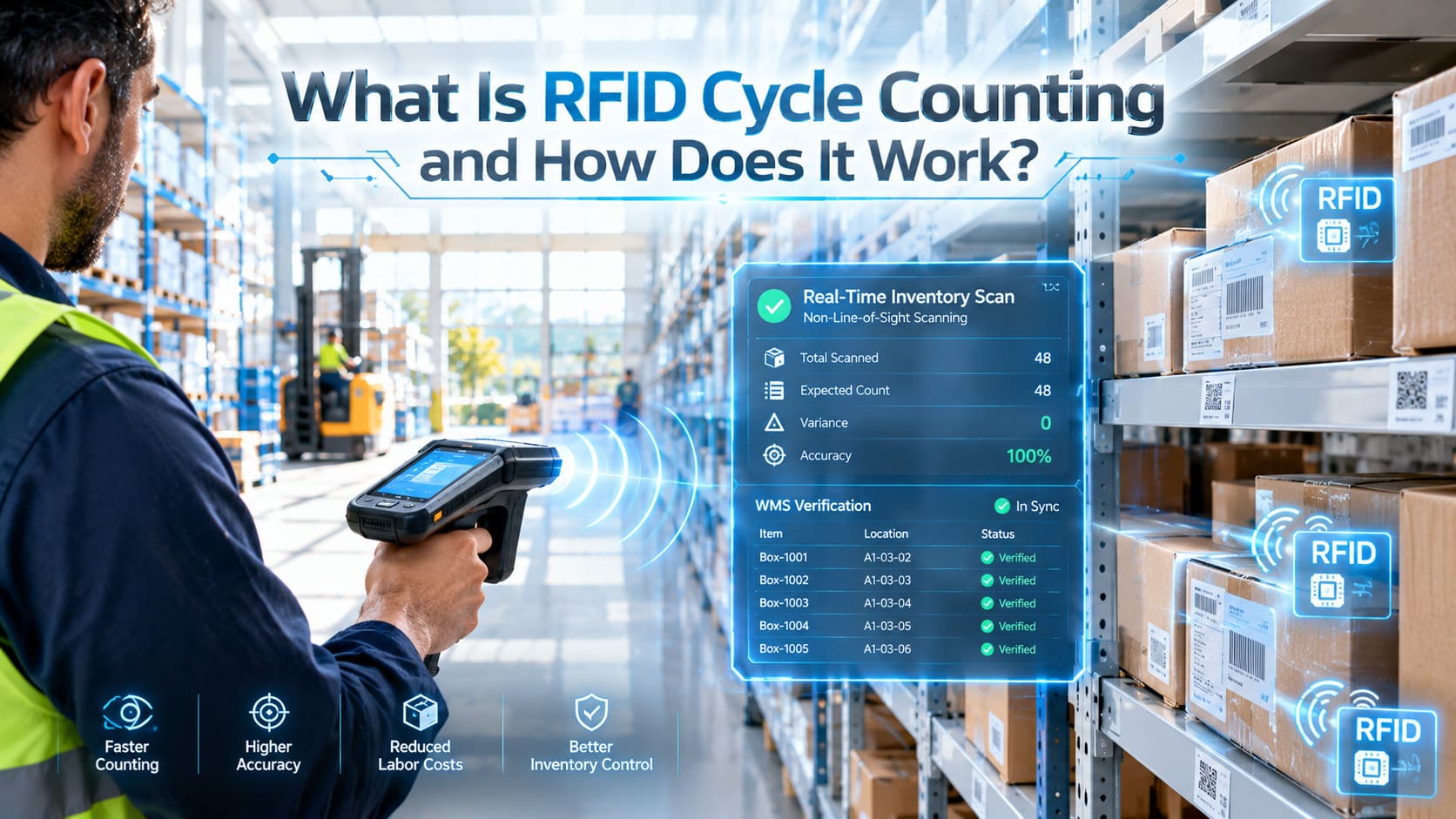
The RFID reader emits radio-frequency signals through an antenna. The compatible tags reply with the information they contain about themselves.
The RFID system doesn’t need direct line of sight as long as multiple objects are tagged within reader range.
- Inventory Data is captured
Handheld readers can be swept throughout the warehouse, and fixed readers can track specific areas.
The system reads the tag ID and passes it to an inventory system or warehouse management system.
- Expected vs. actual inventory
The software matches RFID data with the inventory records.
It can identify:
- Items that are present
- Missing inventory
- Unexpected items
- Inconsistent or duplicate records
- Items that are not in the right place
Then staff members can investigate the discrepancies rather than recounting each and every item.
RFID Cycle Counting vs. Barcode Counting
While both technologies can be used in inventory management, they are not the same.
With barcode counting, a worker will take a scanner and point it at each barcode. RFID can recognize multiple tags at once, which is very useful when there are numerous items to be counted in a timely manner.
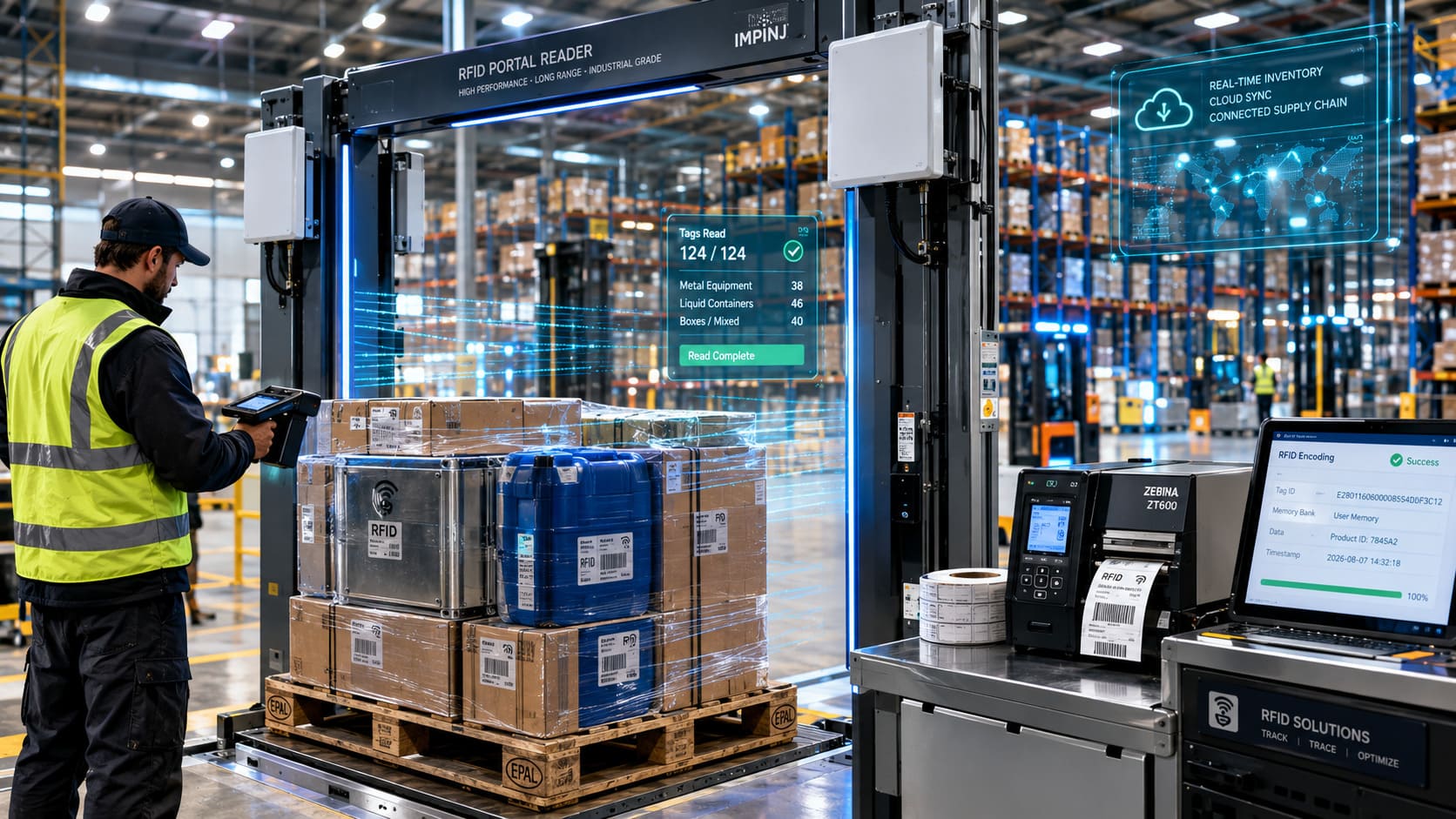
Additionally, RFID is not necessarily a line-of-sight technology. But the performance of RFID may be influenced by metal, liquid, tag orientation, reader configuration, and environment.
That does not imply RFID is just about eliminating every barcode and putting a tag in its place.
What’s in it for you?
- Faster Inventory Counts
The most significant benefit of RFID is how quickly it works. Instead of having to scan each product, employees may be able to scan a large number of tag IDs in a single pass through an area.
- Better Inventory Accuracy
Regular count cycles will uncover differences more quickly. There is no need for businesses to discover that system records are not accurate until an annual physical inventory.
- Reduced Labor
Automating identification will minimize repetitive scanning and manual counting, which will free up employee time to delve further into exceptions and inventory management.
- Less Operational Disruption
The process of cycle counting can be carried out without a complete shutdown of the warehouse for a large inventory, as it can be done within the normal routine of the warehouse.
- Better Visibility
The use of RFID can enable businesses to locate tagged inventory and find out where it was found, to help improve inventory location accuracy and reduce lost stock.
What Are the Best Applications for RFID Cycle Counting?
RFID cycle counting can be useful in a variety of industries such as:
- Retail stores and distribution centers
- Manufacturing facilities
- Healthcare inventory
- Automotive parts operations
- The aerospace and defense supply chains
- Libraries and archives
- Manage tools and equipment.
- Apparel and footwear
Items with high dollar value or frequently misplaced items may be well suited for RFID counting.
Common Challenges
RFID isn’t perfect. There are a variety of factors that may impact performance.
- Metal interference: Radio signals are reflected or detuned by metal, and on-metal tags and placement of the reader must be used.
- Liquid-rich products: Water and other liquids have the ability to absorb RF energy and can degrade read performance.
- Tag placement: Orientation and positioning can influence the ability to detect a tag reliably.
- Reader configuration: Too much read range can cause “false reads” of the near inventory, and the lack of read range can result in “false misses”.
- Data integration: The best results can be seen when the data collected by the readers is integrated with inventory and warehouse management software.
For successful RFID cycle counting, you should follow these tips:
Businesses that are considering deploying an RFID system should:
- Begin with a specified inventory space. Implement RFID at the pilot level – in one zone or product category.
- Test tags on products. Materials will need varied types of tags.
- Create exception workflows. Establish guidelines for working with employees to investigate missing or unexpected items.
- Integrate with inventory software. Tag IDs are only valuable if the information is used to update operational systems.
- Determine the appropriate frequencies for counting. High-value items might require greater frequency than low-risk inventory.
- Measure results. Monitor the time, accuracy, labour, and discrepancies for tracking.
- Train employees. Staff need to be aware of reader operation and what to do if an exception is detected by the system.
The RFID cycle counting enables inventory counting to be performed in a more automated and continuous way as compared to the traditional manual method of counting. Businesses can find out if there is any difference between the readings and the inventory records early on, as multiple items are tagged within a short span of time, and can get more accurate stock information.
The most effective combination of RFID tags, readers, software support, and inventory system design will yield the best results. That’s a combination that can make cycle counting faster, more frequent, and much less disruptive for organizations with large inventories.
FAQ
What is RFID cycle counting?
RFID cycle counting makes use of radio-frequency identification technology. It allows the regular counting of a sample of goods in inventory to ensure accuracy. RFID readers can pick up several tagged items at a time and do not require line-of-sight to do so.
How is RFID cycle counting different from barcode counting?
Compared to RFID technology, barcode readers usually require line of sight to read information from a barcode. RFID readers can read multiple tags at a time and do not generally need line of sight to read the information from tags. This makes RFID technology useful for counting inventory quickly and accurately.
Can RFID cycle counting improve inventory accuracy?
Yes, regular RFID cycle counts would allow a business to discover lost, misplaced, or stolen inventory sooner than without RFID technology. Cross-referencing RFID counts with what the business’s inventory management software indicates allows a business to know that its physical inventory matches its digital records.