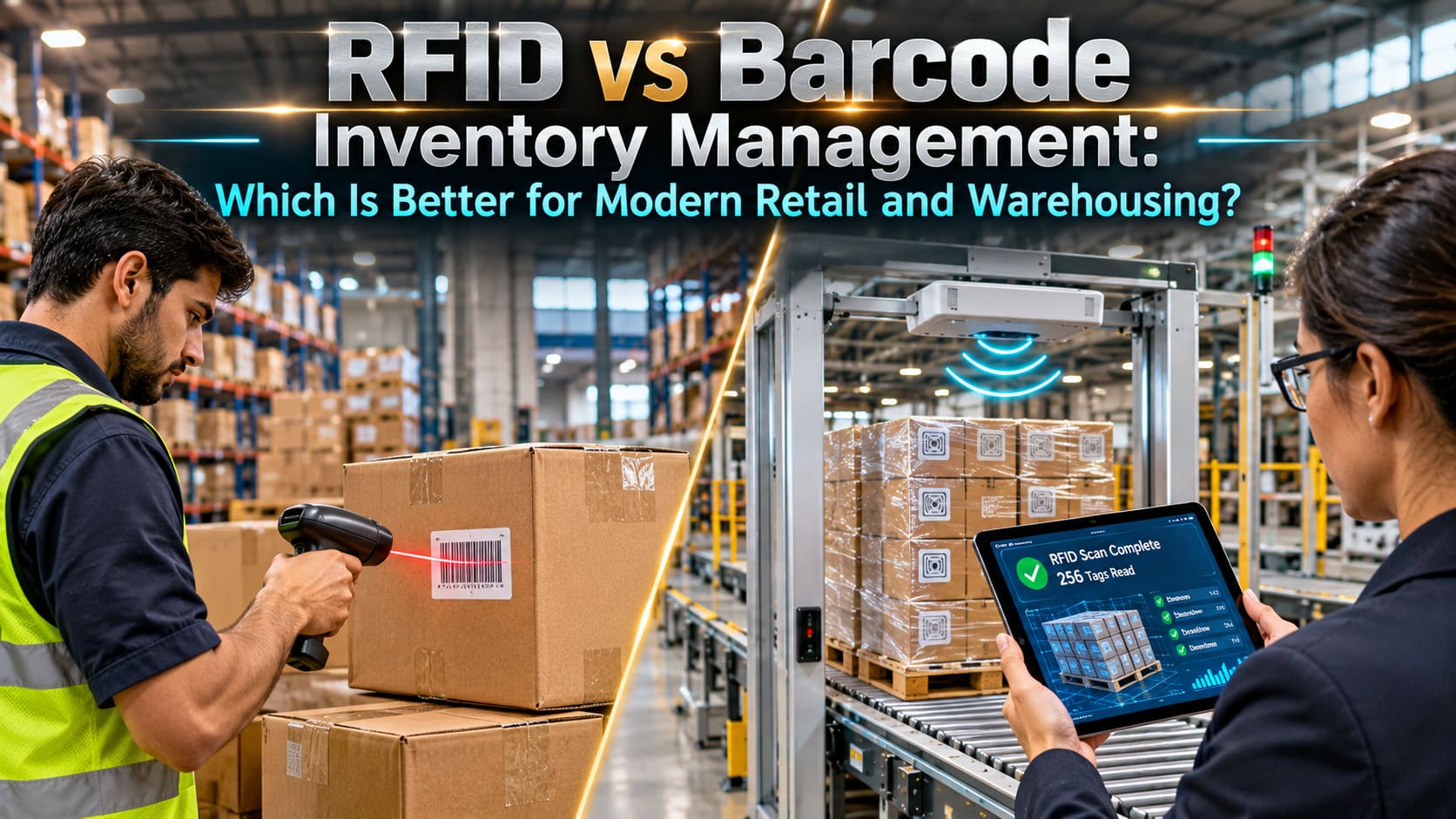
Third-party logistics (3PL) providers are integral to businesses needing to handle warehousing, stock, order processing, and distribution. But as the supply chain grows more complex, clients are becoming more demanding of accurate, real-time information about their inventory. Expectations are that traditional tracking systems, such as manual counting and barcode scanning, may fall short.
Learn How the 3PL Industry Can Leverage RFID Technology
RFID is a combination of tags, readers, and software that can identify and track inventory without the need for human scanning by direct sight.
An RFID system consists of:
RFID tags: Mounted on products, cartons, pallets, or reusable containers. Each tag has information that identifies it.
Readers: Read the tag information via radio waves. Handheld, fixed, or warehouse-integrated readers can be used.
Antennas: Send and receive information from tags via radio waves.
Tags: Contain information that is transmitted and received by radio waves.
RFID middleware: Processes RFID tag reads, filters out redundant information, and transforms RFID readings into meaningful inventory events.
Warehouse Management System (WMS): An application that manages the stock, receiving, picking, and shipping of goods and reconciliation of stock using the data from RFID.
This feature enables 3PLs to automate inventory handling in a massive warehouse.
Enabling Multi-Client Inventory Visibility
One of the most difficult aspects of the 3PL is how to handle stock for various companies in a single facility.
Clients should be aware of what stock they have, its location, and whether it can be fulfilled.
Traditional systems could rely on periodic barcode scans or manual updates, leaving room for discrepancies between actual and recorded inventory.
With RFID, 3PL companies can provide clients with:
- Current stock quantities
- Inventory location information
- Receiving and shipping confirmation
- Movement history
- Exception notifications for unusual stock transactions
- Enhanced insight into stock available and reserved
This translates into reduced uncertainties and more control of their supply chain operations for clients.
Stock Management Software for Warehouses
One of the most crucial stages of warehouse inventory management is receiving.
Once goods are received into the warehouse, staff are responsible for checking quantities, identification, and putting away. Manual verification may take longer, especially if there are hundreds of cartons or individual pieces of equipment in the shipment.
RFID can help to make this easier.
Discrepancies can be detected before the product is put into inventory storage.
For example, if the shipments are supposed to have 100 cartons, and RFID checks only reveal 97, it can alert the system for investigation.
Another use of RFID is to provide automated putaway by linking tagged inventory with warehouse locations.
The Following Hints Will Be Helpful When Receiving Operations:
- Use fixed RFID readers at suitable dock-door locations.
- Ensure tags can be read before rolling out RFID in large-scale shipments.
- Set up alerts for missing inventory, unexpected inventory, or duplicate inventory.
- Make RFID events part of the WMS system to minimize manual data entry.
- Develop policies for unreadable or damaged tags.
Automated receiving minimizes processing time and enhances inventory accuracy from the moment the goods are received.
Faster and More Accurate Cycle Counting
It is important to keep accurate inventory records, and cycle counting is a key way to do that.
But in standard cycle counting, the worker must find the product(s), read the single barcode, and verify the count with the system.
This can be a significant amount of man hours for 3PLs with thousands of SKUs across many client accounts.
RFID can help employees to do the inventory check faster.
Warehouse staff can scan multiple tagged products with a hand-held RFID reader without having to find and scan each product’s barcode. A suitable fixed reader can be used to continuously capture inventory movements at suitable locations.
This enables 3PL companies to conduct more regular inventory counts and save time on physical inventories.
Benefits include:
- Reduced labor requirements for counting.
- Quick resolution of discrepancies in stock.
- Improved stock accuracy.
- Reduced disruption of warehouse operations.
- Improved support for client stock checks.
RFID is not the solution to replace physical verification. It can, however, help to make inventory checks more frequent, efficient, and accurate.
Increasing the accuracy of Order Picking and Fulfillment Operations
Another field where RFID is proving to add measurable value is order fulfillment.
Error picking can lead to incorrect shipments, extra transportation expenses, product returns, and, of course, unhappy customers.
RFID can be used to confirm the proper item(s) are being chosen for each order.
As the tagged products pass through a picking zone, this process can be used to identify the products and match them against the picking requirements.
The system can alert you if the wrong product is selected before you get to packing or shipping time.
RFID can also be used for packing verification, that is, ensuring that the right products are put in the right packing cartons.
This can help 3PLs with high-volume e-commerce fulfillment to increase productivity and mitigate expensive mistakes.
A Secure Fulfillment Process with RFID Could Feature:
- Accepting picking orders from the WMS
- Using RFID to identify the products needed
- Ensuring that the appropriate items are chosen
- Pre-shipment carton inspections
- Keeping track of the completed order and updating the inventory
This makes it easier to provide a more reliable fulfillment process and better service to clients.
Real-Time Client Inventory Dashboards
These days, 3PL customers are not only expecting inventory reports, but they are also looking for them on a regular basis. They desire to have the information available when they need it.
This expectation can be met with the help of RFID, which can deliver real-time inventory data feeds to client-facing dashboards.
A single central visibility platform can provide inventory levels, storage locations, receiving activity, order status, and shipment information.
These dashboards enable clients to keep track of their stock without having to call warehouse staff for an update.
For instance, an online business could discover what goods are about to run out of stock, after which they can make sure to order them in time.
Manufacturers can track component and finished goods flow through their supply chain.
Retailers can optimize their inventory and plan for seasonal trends.
Some handy dashboard tools are:
- Update/Report SKU and Location Inventory.
- Available stock, reserved, and damaged stock.
- Inbound and outbound operations.
- Inventory ageing and movement.
- Low-stock notifications.
- Discrepancy/Exception Reports.
The best dashboards provide meaningful, actionable data instead of raw RFID data.
RFID and Other Systems Integrate with WMS and ERP Systems and Client Systems
The value of RFID is great when integrated into the existing logistics technology platforms.
A stand-alone RFID reader is able to detect tagged products but cannot autonomously handle inventory allocation, order processing, or client reporting.
The need for integration is, therefore, critical.
RFID middleware will include functions to filter repeated reads, interpret reader events, and interface with warehouse management systems.
This can then feed inventory data back into the WMS and send relevant details to client ERP systems, order management systems, or visibility portals.
For 3PL companies, integration also allows them to handle multiple customers.
The right client, SKU, shipment, and warehouse location should be linked to each RFID event.
This helps to avoid wrong inventory information being attributed to the other client account.
The Key Issues When Integrating Include:
- Setting standards for product identification
- Assigning client SKUs to the RFID identifiers
- Clear Ownership records of stock
- Data synchronization between systems
- Ensuring client data security with proper access control measures
- Staffing to track system performance and integration issues
The integrated, well-designed RFID system converts identification data into actionable operational intelligence.
Integrating RFID into a smart grid system for supply chain and warehouse security and accountability
When inventory is lost, misplaced, or moved without authorization, it can cause serious financial issues for 3PLs.
One way to improve accountability is to document inventory movement at important checkpoints in the warehouse using RFID.
For instance, readers placed near a restricted storage area or outbound dock can detect tagged products that pass through these areas.
The system can record the inventory change when it’s a non-authorized transaction for investigation.
Another area where RFID might be useful is in determining what products have gone missing in the warehouse.
But RFID isn’t a panacea for security problems. There are a number of factors that affect effectiveness: reader coverage, tag performance, access controls, and system configuration.
Using RFID together with warehouse techniques, monitoring, and exception management can yield increased inventory control.
New and Emerging RFID Applications
The cost of implementing an RFID solution includes tags, readers, software, integration, and training employees.
Therefore, 3PL companies are required to quantify their impact on operations and finances.
Adopting RFID can be challenging, but there are some helpful tips to keep in mind in order to make the process a success.
The following are key points that 3PL companies should take into account before implementing RFID throughout a logistics process:
- Go with a scoped pilot: Begin with a pilot that is focused on a process with clear visibility or accuracy issues.
- Choose suitable tags: Take into account the material of the product, packaging, where the tag will be attached, and environmental conditions.
- Some surfaces, liquids, dense packing, and overlapping signals may impact test reader coverage.
- Common inventory tag naming: Maintain consistent naming of inventory tags.
But its main benefit goes beyond warehouse productivity. With RFID, 3PLs can provide greater information, accountability, and transparency to their clients.
With supply chains becoming more and more data-driven, companies that are willing to invest in a strong RFID infrastructure and effective system integration can enhance their relationships with clients and, at the same time, create more competitive logistics operations.